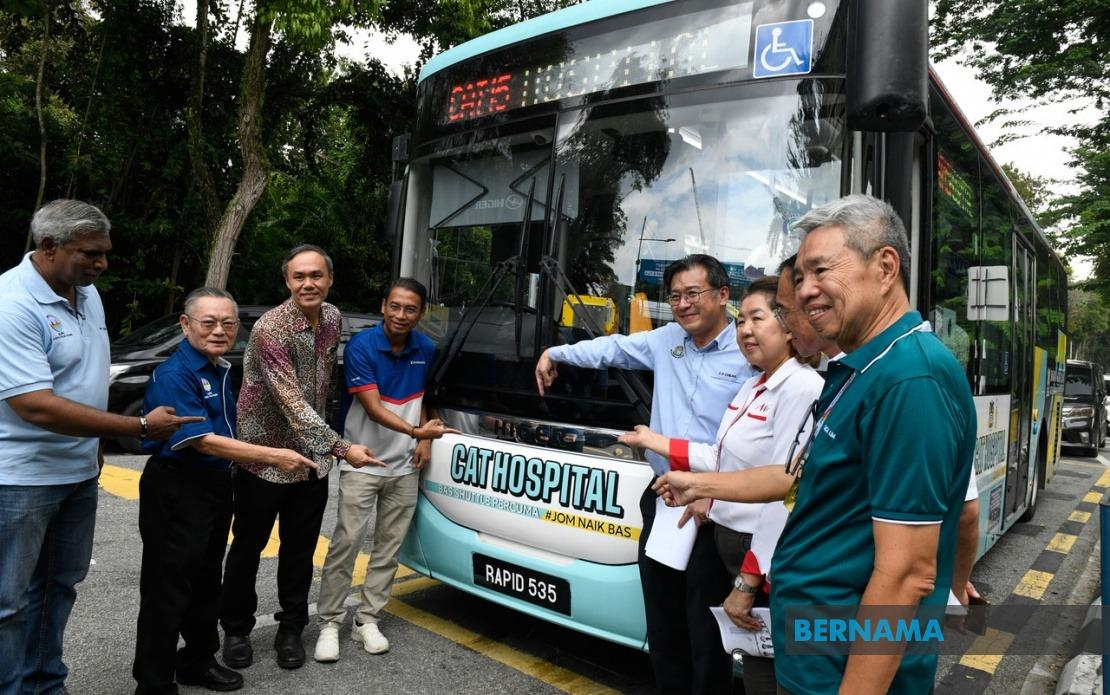
The Penang Island City Council (MBPP) is investing RM900,000 each year to operate a free shuttle bus service that transports passengers between the city centre and Penang Hospital, alongside three private healthcare facilities and several other medical institutions. Launched on January 1 this year, the Central Area Transit (CAT) service represents a significant commitment to improving public mobility and reducing vehicular congestion in one of Penang's busiest areas, according to MBPP Engineering Director Cheah Chin Kooi.
The initiative addresses a longstanding challenge created by Penang Hospital's recent expansion project. As the facility added capacity to treat more patients, parking shortages intensified around the hospital grounds and surrounding streets. Rather than simply accepting increased congestion as inevitable, MBPP conducted detailed surveys to understand transport patterns and identified a free shuttle service as the most effective solution. The approach reflects a shift toward demand-management strategies that complement infrastructure development with public transport options.
Operationally, the service spans an eight-kilometre route traversing the city centre with three buses deployed by Rapid Penang throughout the day. Between 6 am and 8 pm, the buses operate at regular 20-minute intervals, completing 36 daily trips. This frequency is designed to accommodate hospital shift changes, patient appointment windows, and general commuter patterns throughout the working day. The regular scheduling removes uncertainty for users and encourages adoption over reliance on private vehicles or taxis.
Early patronage figures suggest the service has struck a chord with Penang's healthcare users. When operations began, the shuttle attracted approximately 300 daily passengers. Within months, this figure nearly doubled to around 600 daily riders, indicating that demand for convenient, cost-free transport to medical facilities substantially exceeds initial expectations. This growth trajectory may influence how the council evaluates future public health transport initiatives across the state.
The service particularly benefits vulnerable populations including patients undergoing treatment, elderly individuals with mobility limitations, and family members providing care support. By eliminating the RM3 to RM4 per trip cost that would otherwise apply to regular bus fares, the free shuttle reduces financial burdens on families managing medical expenses. For elderly patients or those recovering from procedures, avoiding the hassle of parking or navigating complex payment systems improves accessibility and encourages appropriate use of hospital facilities.
Beyond individual benefits, the shuttle generates broader urban advantages. Every vehicle diverted from private car use reduces traffic congestion on central city streets, lowering emissions and air pollution near the hospital where vulnerable patients may be particularly sensitive to poor air quality. Decreased demand for parking spaces around the hospital frees scarce ground-level area for alternative uses, potentially supporting commercial activity or green space development in this densely built zone.
Penang Hospital director Dr Goh Hin Kwang signalled the institution's partnership commitment by noting ongoing improvements to pedestrian infrastructure. Walkways along Jalan Residensi have been upgraded, while renovation work continues on the main entrance along Jalan Utama to ensure seamless connectivity between the bus stops and hospital access points. These complementary investments demonstrate recognition that transport infrastructure proves effective only when integrated with physical accessibility enhancements.
The RM900,000 annual outlay reflects careful budgeting within MBPP's public health transport mandate. This figure covers vehicle operation costs, driver compensation, fuel, and maintenance for the three-bus fleet, though the council's partnership with Rapid Penang likely involves shared operational efficiencies. For a city-level council, this represents a manageable investment with measurable public health returns.
The shuttle's success may establish a template for similar interventions at other large medical institutions across Malaysia and the region. As hospitals expand and patient volumes grow, transport connectivity becomes a healthcare quality issue rather than merely an urban convenience. Penang's model demonstrates that relatively modest annual investments in dedicated public transport can meaningfully improve hospital accessibility while reducing congestion. Other state governments and municipal authorities managing sprawling medical complexes may view this experience as evidence that transport integration deserves consideration during facility planning.
The initiative also touches on broader sustainability considerations gaining prominence in Southeast Asian city planning. By offering free public transport to hospital destinations, MBPP creates positive incentives for modal shift away from private vehicles, supporting long-term goals to reduce carbon emissions and improve urban air quality. Health outcomes and environmental outcomes thus become mutually reinforcing, creating a compelling case for continued funding.
Looking forward, the doubling of ridership within months suggests the service may eventually require capacity expansion. Whether MBPP allocates additional resources for a fourth or fifth bus will depend on usage trends over the coming year and competing budget pressures. Nevertheless, the strong early response validates the council's decision to prioritize this investment, demonstrating that removing cost barriers meaningfully increases public transport adoption for healthcare-related journeys.

