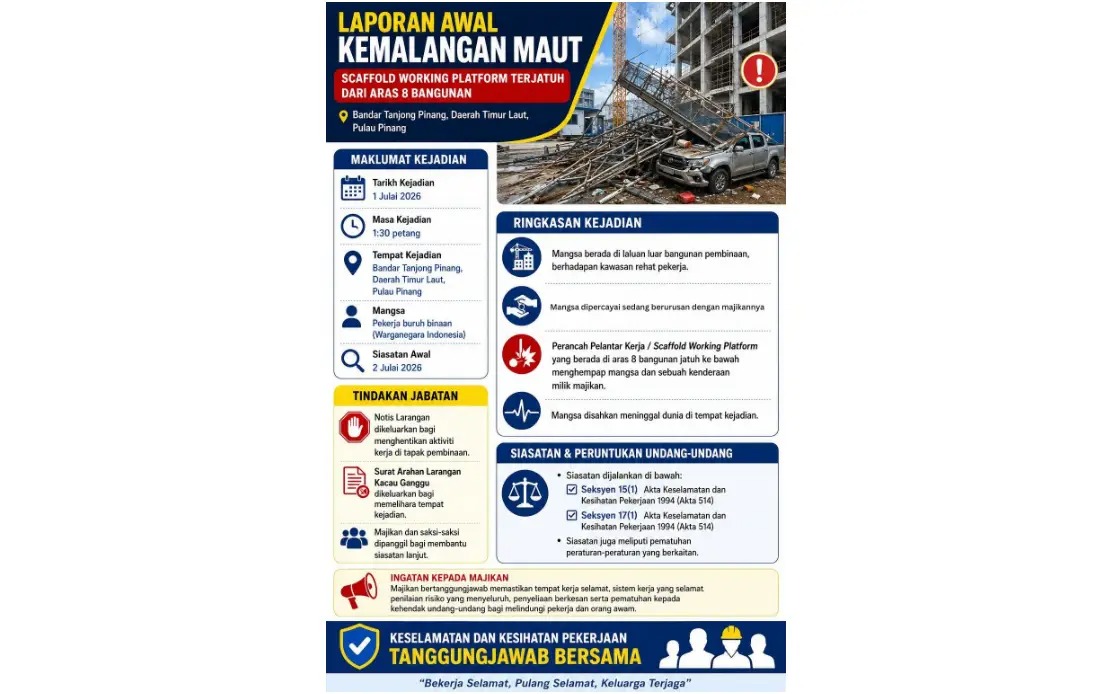
The Department of Occupational Safety and Health in Penang has moved swiftly to impose a full work stoppage at a construction project in Bandar Tanjong Pinang following a tragedy that claimed the life of a migrant worker on July 1. The regulatory action reflects the seriousness with which Malaysian authorities are treating workplace fatalities, particularly in the construction sector where safety lapses have long been a persistent challenge across the region.
According to DOSH Penang's official statement, the victim, an Indonesian construction worker, was struck by a collapsing scaffolding working platform that detached from the eighth floor of the building being developed at the site. The incident occurred at approximately 1.30 pm, catching the worker on an external walkway positioned in front of a workers' rest area. At the moment of impact, he was engaged in discussion with his employer, and the falling structure also damaged a vehicle belonging to the employer, underscoring the violent nature of the collapse.
The authority's decision to issue a prohibition notice immediately halting all related work activities demonstrates the regulatory framework's capacity to respond decisively when worker safety is compromised. Beyond merely stopping operations, DOSH Penang also imposed a non-disturbance order to preserve the accident scene in its original state, a critical step that enables investigators to examine structural conditions, equipment placement, and maintenance records without interference. This procedural approach is essential for establishing whether negligence, inadequate equipment inspection, or systemic failures contributed to the tragedy.
Investigators are now examining whether the site operators complied with their statutory obligations under Sections 15(1) and 17(1) of the Occupational Safety and Health Act 1994, which establish broad duties for employers to maintain safe working environments and ensure proper planning and execution of hazardous activities. These provisions carry significant weight in Malaysian occupational law, and enforcement officers will be scrutinising documentation relating to scaffolding installation, certification, load calculations, and routine safety audits. The inquiry will also determine whether contractors conducted adequate risk assessments before deploying workers at elevated positions.
The involvement of an Indonesian migrant worker highlights the vulnerability of foreign nationals in Malaysia's construction workforce. Migrant labourers frequently occupy lower-wage positions on sites and may face communication barriers or reluctance to report unsafe conditions due to concerns about employment status or repatriation. This incident raises questions about whether language barriers or power imbalances prevented the deceased from raising safety concerns before the fatal collapse occurred. Advocacy groups monitoring migrant worker welfare have long flagged construction sites as particularly hazardous environments where enforcement of safety standards can be inconsistent.
Penang DOSH has signalled that enforcement action will follow if investigators uncover violations of legal provisions. This stance reflects a broader regulatory shift in Malaysia toward holding construction companies accountable when preventable tragedies occur. The authority has also issued a general reminder to developers, main contractors, and subcontractors that all work must be meticulously planned and executed to the highest safety standards. Such statements serve both as formal notices and as warnings that regulatory tolerance for lax practices is diminishing.
The construction sector in Malaysia and across Southeast Asia operates under persistent pressure to deliver projects quickly and cost-effectively, sometimes at the expense of safety protocols. Scaffolding-related incidents are particularly troubling because they often stem from deferred maintenance, inadequate inspection regimes, or corner-cutting during installation. The fact that this platform detached from the eighth floor suggests potential issues with mounting hardware, load-bearing calculations, or failure to identify material degradation during routine checks. Such failures are frequently attributable to inadequate supervision rather than isolated worker negligence.
This incident follows years of safety concerns in Malaysia's construction industry, where annual fatality rates have prompted recurring calls for stricter enforcement and higher penalties for non-compliance. Penang, as a major economic and development hub with ongoing infrastructure projects, has particular responsibility to maintain exemplary safety standards that protect both local and migrant workers. The state's swift regulatory response may serve as a model for how authorities elsewhere should react to fatal workplace incidents, though the real test will be whether subsequent prosecutions and penalties are substantial enough to deter similar negligence.
The broader context for this incident extends to the entire Southeast Asian construction boom, where rapid urbanisation and infrastructure development have created high demand for labour but sometimes outpaced the development of robust safety cultures. Malaysia's legal framework for occupational health and safety is relatively mature compared to neighbouring countries, yet implementation gaps persist. This tragedy underscores the importance of translating legal requirements into tangible workplace practices through adequate training, supervision, and enforcement.
For families of workers and their dependents relying on earnings from Malaysian construction sites, incidents like this underscore the real human costs of inadequate safety measures. The prohibition notice and ongoing investigation should extend beyond determining technical causes to examining systemic issues: whether the contractor maintained adequate insurance, whether workers received proper induction training, and whether site management prioritised speed over safety. These questions will likely shape the eventual regulatory response and any penalties imposed.

