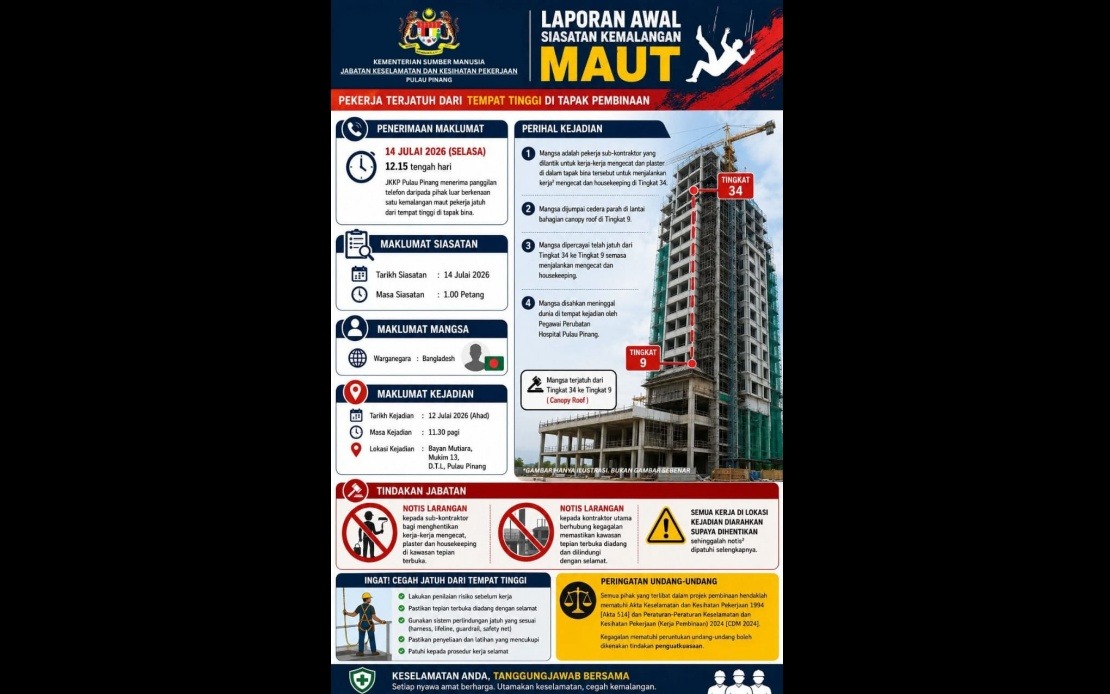
Authorities in Penang are conducting a formal investigation into the fatal fall of a Bangladeshi worker at a residential construction project in the Bayan Mutiara area. The incident, which occurred on July 15, resulted in the worker's death and has triggered immediate safety enforcement actions by the Department of Occupational Safety and Health (DOSH). The discovery of the deceased worker on a lower floor canopy, after falling from a much higher level of the structure, underscores the severe hazards that persist at active construction sites across Malaysia despite existing regulatory frameworks.
DOSH director Hairozie Asri revealed that the department learned of the tragic incident through a report from an external party at approximately 12.15 pm on the day in question. Within a short timeframe, DOSH dispatched a team of investigating officers to conduct on-site assessments and gather evidence. The swift mobilisation of resources highlights the department's protocol for responding to serious workplace incidents, though such tragedies raise broader questions about whether current prevention measures and site monitoring are sufficiently robust across the construction industry.
According to preliminary findings disclosed by Hairozie, the deceased worker was engaged by a subcontractor that specialised in painting, plastering, and housekeeping services at the construction site. The worker was believed to be performing duties on the 34th floor when he sustained injuries that proved fatal. His body was subsequently located on the canopy roof structure at Level 9, indicating a catastrophic fall spanning approximately 25 floors. Medical personnel from Penang Hospital pronounced him dead at the scene, eliminating any possibility of emergency intervention.
The circumstances surrounding the fall remain under active investigation, though the substantial height differential between the worker's work location and where he was discovered suggests a potential breach of safety protocols. In high-rise construction environments, workers are typically required to wear approved harnesses and use safety lines when operating in open-edge areas. The fall from the 34th floor to the Level 9 canopy raises critical questions about whether such protective equipment was in use, properly maintained, and adequately secured to appropriate anchor points.
In response to the incident, DOSH has taken decisive enforcement measures against both the subcontractor and the main contractor involved in the project. A prohibition notice has been issued to the subcontractor, specifically forbidding continuation of painting, plastering, and housekeeping operations in any open-edge areas of the construction site. Simultaneously, a separate prohibition notice targeting the main contractor has been implemented. These orders represent a legal instrument that carries significant weight under Malaysia's occupational safety legislation and reflects the severity with which authorities are treating the incident.
All work activities connected to the accident site have been suspended indefinitely, with resumption explicitly prohibited until both contractors demonstrate complete compliance with the requirements stipulated in their respective prohibition notices. This blanket cessation of operations is a standard measure employed when a workplace fatality occurs, as it allows investigators to preserve the scene, gather evidence without interference, and conduct a thorough examination of contributing factors. For the contractors involved, the shutdown creates substantial financial pressure and schedule delays that serve as both a consequence and a deterrent against future safety violations.
The incident underscores persistent vulnerabilities within Malaysia's construction sector, where migrant workers frequently occupy the most hazardous positions and often lack robust advocacy mechanisms to report unsafe conditions. Bangladeshi workers represent a significant proportion of the construction workforce in Malaysia, particularly in roles involving manual labour on high-rise projects. Language barriers, limited familiarity with Malaysian workplace safety standards, and economic dependence on employment can create situations where workers feel pressured to proceed despite recognising hazardous circumstances.
This fatality joins a troubling pattern of workplace accidents at construction sites across the country. While Malaysia has invested in expanding DOSH capabilities and enforcement mechanisms, the frequency of serious incidents suggests that compliance remains inconsistent across the industry. Small and mid-sized contractors, in particular, sometimes operate with minimal safety infrastructure, viewing protective measures as cost burdens rather than essential investments in worker welfare. Main contractors bear responsibility for ensuring their subcontractors maintain adequate safety standards, though enforcement of this accountability remains challenging.
For Penang's construction industry and the broader Malaysian development sector, incidents of this magnitude prompt reflection on whether current penalties and enforcement strategies sufficiently deter unsafe practices. The investigation by DOSH will likely examine multiple dimensions including site management protocols, worker training and supervision, equipment maintenance, and the adequacy of fall-prevention systems. Findings from this inquiry may inform recommendations that reshape safety requirements or enforcement approaches across comparable projects.
The human cost of construction-related fatalities extends beyond the deceased worker to his family in Bangladesh, who will likely face severe financial hardship resulting from the loss of remittance income. Malaysian employers and contractors bear both moral and legal obligations to ensure that workers are provided with working conditions that do not jeopardise their safety. As investigations proceed, regulatory authorities will focus on determining whether systemic failures or individual negligence contributed most substantially to this preventable tragedy, with findings potentially influencing future safety standards and practices across the industry.

