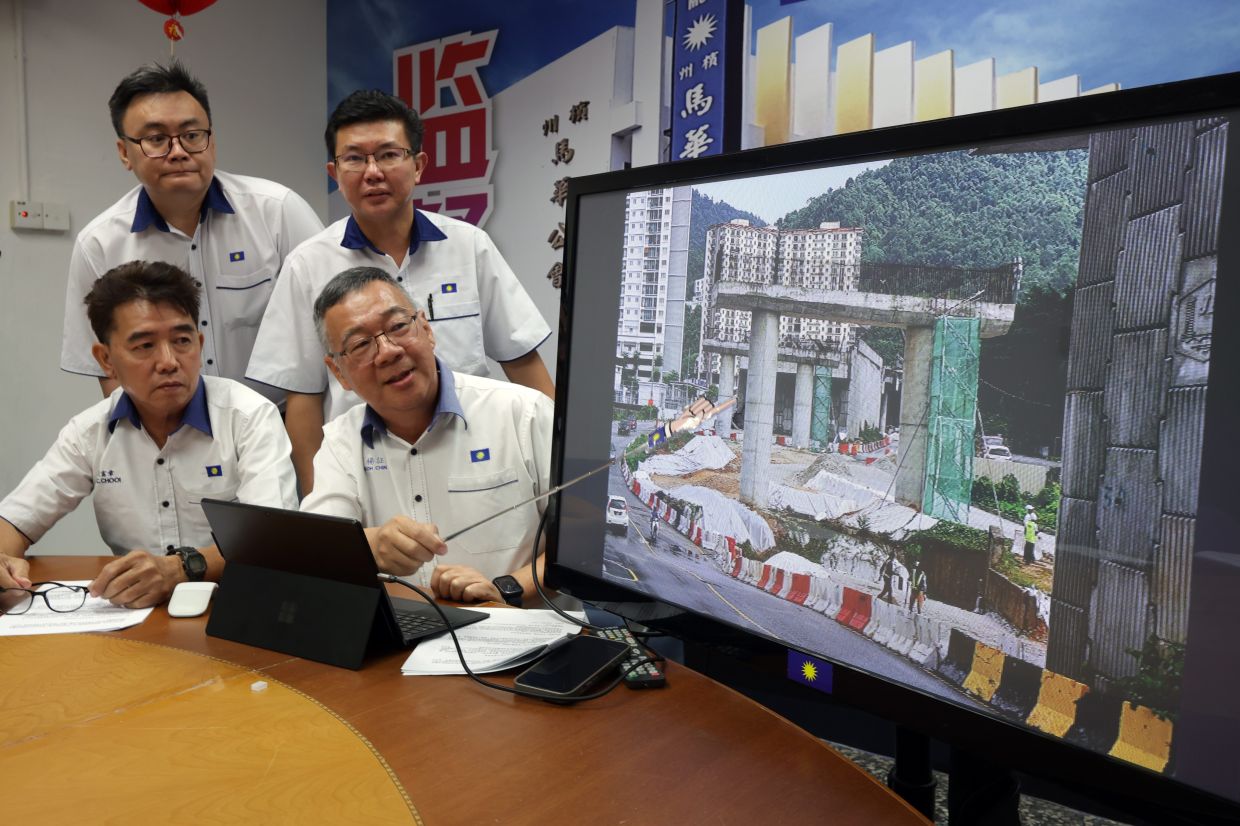
The Penang branch of the Malaysian Chinese Association has intensified scrutiny of the Air Itam-Tun Dr Lim Chong Eu Expressway bypass development, demanding that state authorities provide comprehensive documentation to substantiate completion claims. The party's secretary Yeoh Chin Kah has called for immediate disclosure of payment documentation, independent consultant certifications, and full project assessment records, framing the dispute as fundamentally about restoring public confidence rather than merely addressing construction delays.
The six-kilometre toll-free bypass, which forms Package Two of Penang's undersea tunnel and paired roads initiative, has become a focal point of political tension as its delivery timeline continues to shift. Originally scheduled for completion in 2024, the project has already absorbed two deadline extensions, with the current target set for April 12, 2027. This pattern of delays has fuelled scepticism among opposition politicians and residents alike, particularly given the infrastructure's strategic importance to traffic management across the northern corridor.
Yeoh's challenge to the state government's earlier characterisation of works being in a "final sprint" carries particular weight given the discrepancy between reported progress metrics and ground-level conditions. The MCA delegation's site inspection on July 1 documented substantial incomplete elements across multiple sections, including Valley Road, Changkat Tembaga, and Jalan Thean Teik. Their observations contradicted official figures suggesting the project had advanced from 80 per cent completion in May to 89 per cent by December, noting the absence of bridge beams and decking despite installed piers, incomplete road surfacing, and missing guardrails, noise barriers, and mechanical-electrical systems across numerous segments.
This transparency standoff reflects broader anxieties about megaproject governance in Malaysia's urban corridor states. The RM3 billion undersea tunnel and paired roads scheme represents one of Penang's most ambitious infrastructure undertakings, directly affecting transportation patterns for approximately 300,000 residents in Air Itam, Bandar Baru Air Itam, and Paya Terubong. When projects of this scale experience repeated delays, the ripple effects extend beyond construction timelines to encompass public resource allocation, contractual accountability, and government credibility during election cycles.
Yeoh has stipulated a seven-day deadline for the state administration to furnish the requested documents, warning that non-compliance would trigger formal complaints to the National Audit Department and the Malaysian Anti-Corruption Commission. The MCA secretary has additionally announced plans to establish a dedicated monitoring committee tasked with tracking construction progress and verifying payment compliance going forward. This escalation strategy positions the party to sustain political pressure regardless of whether immediate documentation is released.
State officials have responded with competing assertions about project momentum. Paya Terubong assemblyman Wong Hon Wai countered the MCA's scepticism by claiming the bypass has reached 91 per cent completion and maintains trajectory toward the April 2027 delivery target. Wong, who attended a construction coordination meeting on June 30, referenced contractor assurances regarding schedule adherence and outlined specific milestones for beam launching operations. He disclosed that twelve structural beams on the Gelugor sector are scheduled for installation between July and August, with six additional beams earmarked for the fourth quarter.
The assemblyman's explanation partially addresses MCA concerns by confirming that work on Bandar Baru Air Itam bridge sections has progressed further than apparent during the opposition inspection, with all structural beams already positioned at that location. However, Wong acknowledged that completion of construction does not automatically translate to immediate public opening, emphasising that the Public Works Department must first conduct a Road Safety Audit following deck slab and parapet finishing. This sequential requirement introduces an additional variable that could further extend the timeline between construction completion and actual commissioning.
The political dimensions of this disagreement extend beyond the immediate infrastructure dispute. Penang's state government, governed by the Democratic Action Party-led Pakatan Harapan coalition, faces mounting criticism from federal-level MCA officials who have championed greater scrutiny of state megaprojects. The bypass development has become a proxy battleground for broader questions about financial governance and political accountability in states where opposition parties hold power. Each delay and disputed progress figure amplifies scepticism about state capacity to deliver promised infrastructure benefits.
For Malaysian readers and Southeast Asian observers, the Air Itam bypass episode illustrates persistent challenges in megaproject delivery across the region. Even in relatively developed states with established engineering expertise, large-scale infrastructure frequently encounters timeline pressures, financing complications, and verification difficulties. The transparency issues Penang MCA has raised reflect concerns evident in comparable projects across Thailand, Vietnam, and Indonesia, where rapid urbanisation has created demand for major transportation infrastructure that construction sectors struggle to complete within budgeted timeframes.
The dispute also underscores the importance of independent verification mechanisms in public procurement. Rather than relying solely on contractor and state government reports, Malaysia would benefit from more robust third-party certification systems that provide regular, credible progress assessments accessible to both political representatives and the public. The current situation—where competing claims cannot easily be adjudicated against objective standards—creates space for legitimate political criticism while simultaneously undermining public confidence in stated completion dates.
Moving forward, the seven-day document disclosure deadline will prove critical in determining whether this dispute escalates to federal investigations or is contained within Penang's political sphere. The National Audit Department and Malaysian Anti-Corruption Commission possess authority to conduct independent assessments that could definitively address completion rate discrepancies. However, such escalation would carry diplomatic consequences for state-federal relations and potentially delay project finalisation further, creating incentives for negotiated resolution before formal complaints are lodged.
The Air Itam bypass ultimately represents a test case for infrastructure governance standards that will influence public expectations for future megaprojects across Malaysia. Whether transparency demands are met, progress figures vindicated or corrected, and accountability mechanisms invoked will establish precedents for how political parties, state authorities, and federal agencies manage information asymmetries in publicly funded construction ventures. For residents awaiting congestion relief and policymakers planning subsequent transport infrastructure, the coming weeks will clarify whether institutional frameworks exist to provide credible answers to legitimate questions about public money deployment.

