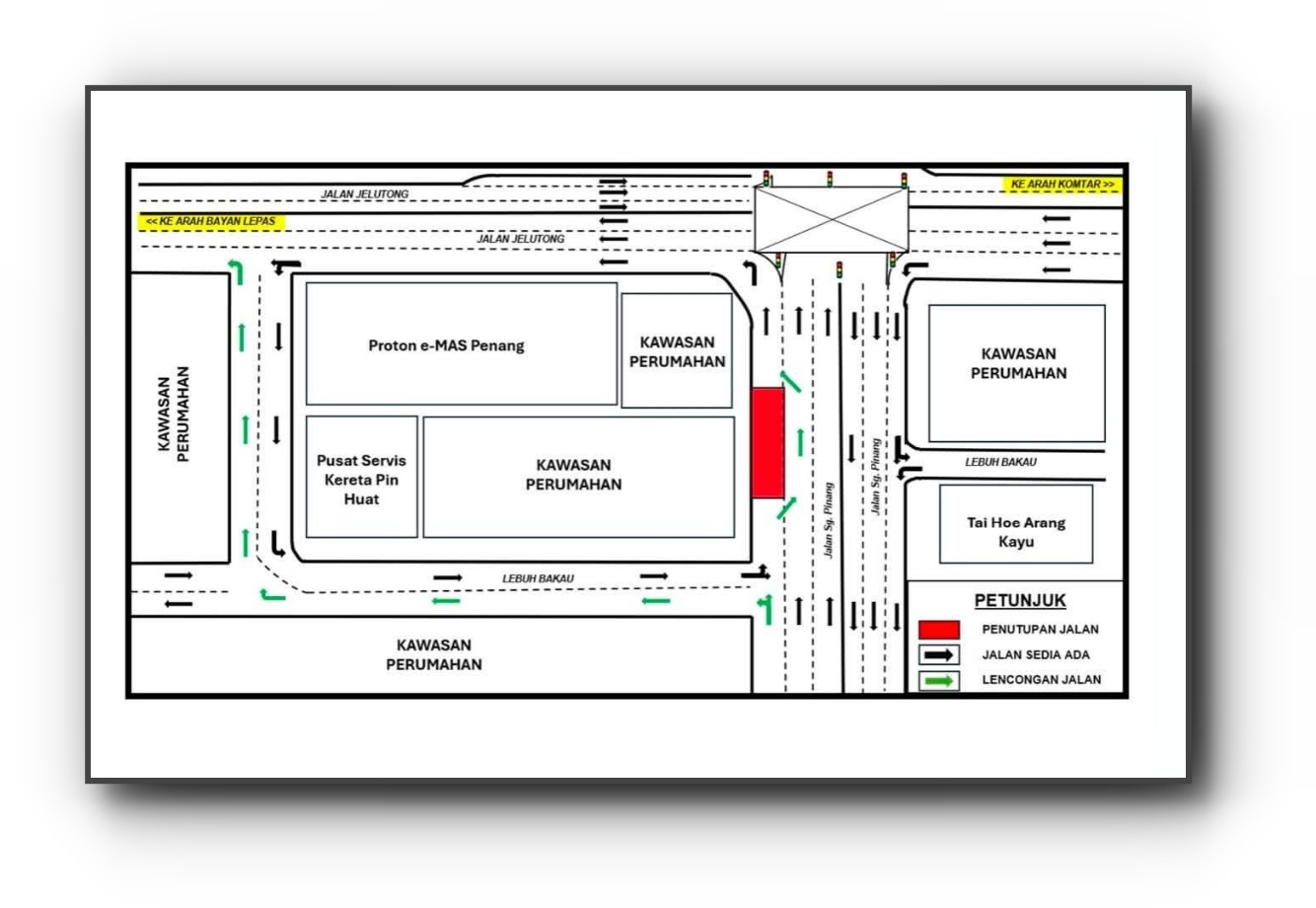
The leftmost lane of Jalan Sungai Pinang heading towards Jalan Jelutong in George Town will be sealed off for ten consecutive days beginning tomorrow morning as part of essential utility infrastructure work, Sungai Pinang state assemblywoman Lim Siew Khim announced on Tuesday evening. The closure, which commences at 9 am on August 28 and persists until 11.59 pm on September 6, has been necessitated by Tenaga Nasional Bhd's need to relocate power distribution lines and related electrical infrastructure in this congested part of Penang Island.
The affected section extends from the Lebuh Bakau junction through to the traffic light intersection at Jalan Sungai Pinang-Jalan Jelutong, meaning motorists traversing this corridor during peak hours will encounter significant congestion unless they adopt alternative routing strategies. The 24-hour round-the-clock nature of the closure means commuters travelling to and from work, school runs, and commercial activities will need to budget additional transit time throughout the fortnight. Lim, who serves concurrently as the state Social Development, Welfare and Non-Islamic Religious Affairs Committee chairman, emphasised that while one lane disappears entirely, the remaining vehicular corridors will continue operating normally to absorb diverted traffic flows.
The state representative outlined the primary detour option available to affected road users: Lebuh Bakau provides a viable bypass route for those heading towards Jalan Jelutong, thereby circumventing the sealed section entirely. Commuters familiar with George Town's street network will recognise this alternative as a well-established thoroughfare, though its capacity during peak periods remains uncertain given the anticipated influx of diverted traffic. The authorities have not yet quantified the expected volume of traffic rerouting or provided estimates of potential delay increases on adjacent streets, raising questions about whether peripheral routes possess adequate capacity to absorb this displacement.
To manage pedestrian and vehicular safety across the work zone, authorities will deploy an array of traffic management measures throughout the ten-day period. Safety signboards will be positioned at strategic intervals alerting approaching drivers to the lane closure and hazards associated with ongoing construction activity. Cylindrical traffic cones will delineate the closed section and guide vehicles into remaining passable lanes, while uniformed flagmen will be stationed at key points to manually direct traffic flow and prevent confusion at critical junctions. These layered safety protocols attempt to minimise accident risks inherent whenever high-speed arterial roads undergo partial closure amidst active construction operations.
Jalan Sungai Pinang carries substantial daily traffic volumes given its function as a primary conduit connecting central George Town with outer residential and commercial zones. The timing of this utility work during the late August through early September period coincides with the end of the school holiday season and the commencement of the new academic calendar, potentially compounding congestion challenges as families return to regular routines. Additionally, the closure occurs during what is typically moderate weather—neither monsoon nor drought season—suggesting authorities deliberately scheduled works for conditions regarded as operationally feasible for both TNB crews and traffic management personnel.
Tenaga Nasional Bhd's utility relocation necessity reflects broader urban infrastructure challenges facing Penang as the island continues densification and economic expansion. Electrical distribution networks installed during earlier phases of urban development often become inadequate as demand intensifies, requiring proactive interventions to reinforce capacity and reliability. By systematically upgrading these backbone systems now, TNB aims to prevent future service disruptions that could affect far larger population segments. However, such works inevitably impose temporary inconvenience on the communities they ultimately serve, creating short-term friction to achieve medium and long-term benefits.
The George Town municipal authorities and Lim's constituency office have positioned this announcement as advance notification enabling residents and businesses to prepare appropriately. Establishing a ten-day runway before implementation allows commercial establishments dependent on direct access to explore supply chain alternatives, enables educational institutions to communicate adjusted commute expectations to students and parents, and permits logistical companies to reroute delivery patterns. This advance notice period is considerably longer than many infrastructure disruptions receive, theoretically allowing stakeholders time for meaningful adjustment.
For Malaysia's growing urban centres, such utility works represent a recurring necessity as ageing infrastructure networks require systematic rehabilitation and expansion. Penang, hosting both a major port and thriving industrial sectors alongside residential concentrations, experiences perpetual pressures to upgrade utility capacity. The visibility and inconvenience associated with ten-day traffic disruptions, while genuinely disruptive, must be contextualised against the scale of disruption that utility failures would inflict. A major power distribution line failure could affect hundreds of thousands of residents and derail commercial activity across much wider areas for unpredictable durations, rendering planned-ahead, time-limited disruptions preferable to chaotic emergency responses.
Motorrists navigating the George Town area during this period should factor additional travel time into journey planning, particularly during conventional rush hours when traffic concentrates most heavily. Navigation applications providing real-time congestion updates may offer utility during the closure window, though their effectiveness depends on sufficient user adoption to generate meaningful traffic pattern data. Businesses located along the affected corridor should consider whether temporary operational adjustments might prove worthwhile, whilst residents should mentally prepare for reduced mobility in this particular direction, understanding that the inconvenience represents investment in longer-term infrastructure resilience.

