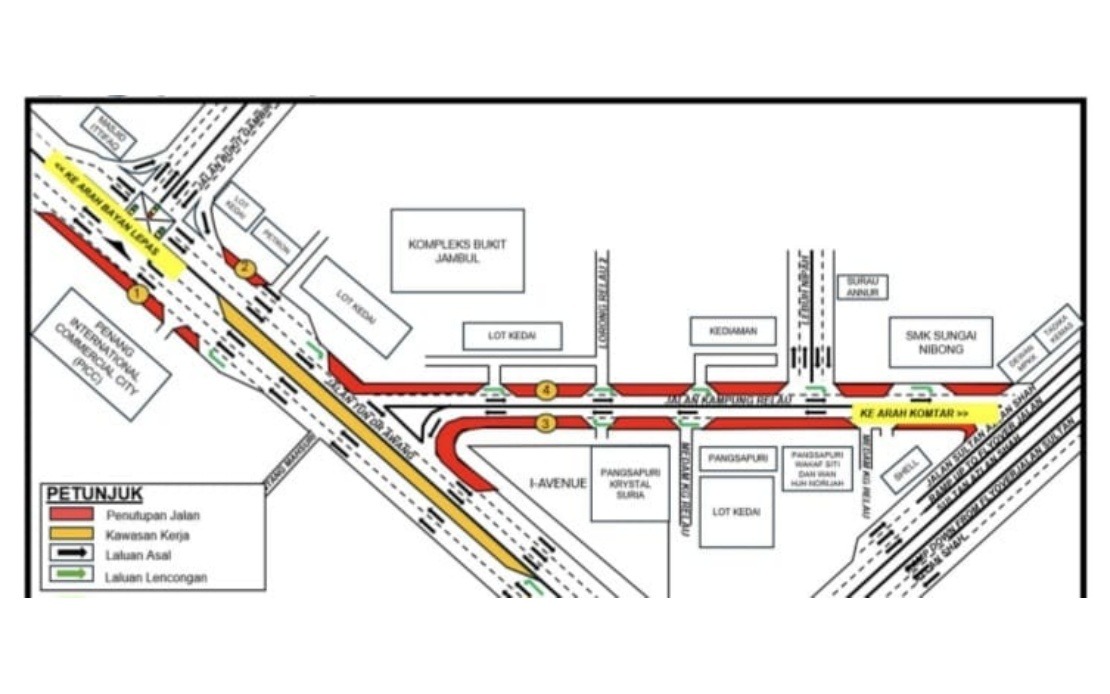
A significant traffic management operation begins tomorrow in Penang as Malaysia Rapid Transit Corporation Sdn Bhd (MRT Corp) implements partial lane closures on two major thoroughfares to advance the Mutiara Line Light Rail Transit Project. The work will affect Jalan Kampung Relau and Jalan Tun Dr Awang over a 75-day period, with daily restrictions running from 8 am to 4 pm through October 15. The initiative marks an important phase in Penang's long-term public transport infrastructure expansion, though it will inevitably create traffic challenges during peak commuting hours across the northern state.
Three specific sections face intermittent closures as part of the preliminary works for the project's CMC1 Package. The leftmost lane along Jalan Kampung Relau in front of Penang International Commercial City toward Bayan Lepas will be affected, alongside the corresponding lane near the Petron Bukit Jambul petrol station heading toward Komtar. Additionally, the leftmost lane from the Jalan Tun Dr Awang entry slip road leading to Jalan Kampung Relau and SMK Sungai Nibong toward Komtar will experience restrictions. These targeted closures reflect a careful approach to minimising disruption while enabling essential infrastructure work to proceed without compromise.
The underlying purpose of these closures centres on drainage system improvements and road widening initiatives required to support the Mutiara Line LRT development. Infrastructure expansion projects of this magnitude invariably demand significant preparatory groundwork, particularly when they involve modifying existing traffic corridors. By concentrating the work during daylight business hours, MRT Corp aims to manage the impact on general traffic flow, though the morning and late-afternoon windows will still experience congestion as drivers adjust to the revised lane arrangements. The phased approach demonstrates an attempt to balance development urgency with operational continuity across Penang's commercial zones.
For motorists navigating these areas during the 75-day window, MRT Corp has emphasised the importance of following directional signage carefully. The corporation's commitment to keeping alternate lanes operational provides some mitigation against complete gridlock, allowing traffic to continue flowing through the affected sections, albeit at reduced capacity. However, commuters can expect delays during peak periods, particularly on weekday mornings and evenings when these corridors typically experience their heaviest usage. The restricted timeframe—eight hours daily—offers some relief for those who can adjust their travel schedules to avoid the closure windows.
The Mutiara Line LRT Project represents a substantial investment in Penang's public transport infrastructure, addressing long-standing connectivity needs across the island and mainland districts. The project's advancement is significant for the broader Southeast Asian context, where Malaysian urban centres increasingly pursue integrated transit systems to manage growing congestion and environmental pressures. Penang, as a major economic and tourism hub, has particular urgency in modernising its transport networks to remain competitive regionally. The infrastructure improvements enabled by these roadworks ultimately serve to strengthen the state's position within the region's economic landscape, though the immediate inconvenience to daily commuters cannot be overlooked.
For businesses operating within the affected zones, particularly those fronting Jalan Kampung Relau near PICC and the Petron station, the construction period may present challenges in terms of customer accessibility and parking convenience. Commercial establishments will need to communicate proactively with clientele about alternative access routes and adjusted arrival expectations. Similarly, SMK Sungai Nibong and surrounding institutions should prepare for modified traffic patterns affecting staff and student commute times. Stakeholder communication from MRT Corp will be crucial in managing expectations and minimising complaints throughout the implementation period.
The decision to concentrate work during business hours rather than overnight or weekend periods reflects a pragmatic but challenging trade-off. While nighttime work would reduce daytime congestion, the increased noise and operational complexity of conducting major infrastructure work during off-peak hours typically elevates costs and extends project timelines. By compressing the intensive work into specific daytime windows, MRT Corp appears to have prioritised project completion efficiency, accepting that the burden falls primarily on regular traffic users. This approach demands effective traffic management coordination, with the corporation's reliance on directional signage proving either reassuring or inadequate depending on implementation quality.
The contact mechanisms provided by MRT Corp—the Careline at 1-800-88-6782 and email [email protected]—represent important channels for public communication and complaint resolution. During extended construction projects, responsive customer service becomes critical in managing stakeholder frustration and ensuring that emerging logistical problems receive prompt attention. Residents and business operators experiencing unforeseen difficulties should not hesitate to engage these channels, as feedback during the early phases helps MRT Corp refine traffic management strategies and adjust protocols where necessary.
From a broader development perspective, these 75 days of disruption serve as an investment in Penang's long-term transportation resilience and environmental sustainability. The Mutiara Line LRT, once complete, will provide an essential alternative to private vehicle use, reducing traffic congestion, lowering emissions, and improving air quality across the state. While the immediate friction and inconvenience are real, they represent the tangible cost of modernisation—a temporary sacrifice for durable infrastructure benefits that will extend across decades. The project's successful completion hinges on cooperative implementation during phases like this current construction period, making public tolerance and understanding essential components of the overall initiative.

