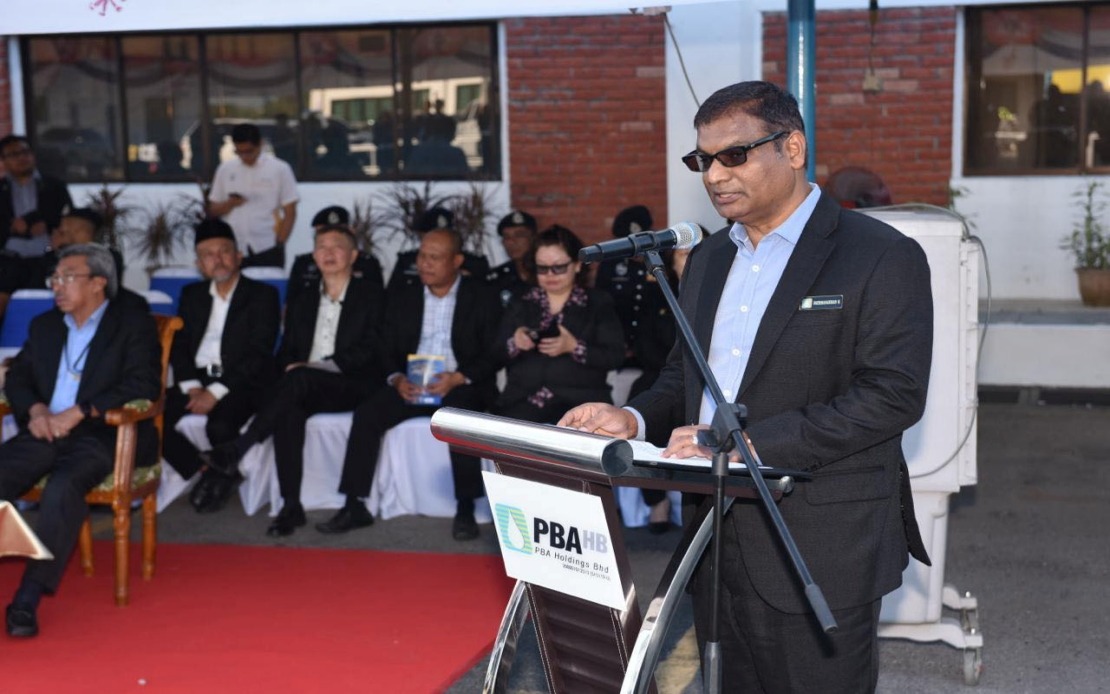
Penang's water authority is moving to significantly expand treatment capacity in the southern Seberang Perai region through a series of interconnected infrastructure projects designed to sustain the state's ambitious industrial and residential development agenda. The Penang Water Supply Corporation (PBAPP) announced plans for a new 80 million litres-per-day treatment facility in Seberang Perai Selatan (SPS), scheduled to commence operations in 2027. Developed through a Build-Operate-Transfer arrangement, the plant will draw raw water from Sungai Kerian, according to Datuk K. Pathmanathan, the corporation's chief executive officer, marking a critical component of the state's medium-term water security strategy.
The timing of this expansion reflects intensifying pressures on Penang's water infrastructure driven by rapid economic transformation and demographic shifts. Seberang Perai Selatan currently serves 87,611 registered water users and recorded average consumption of 116.8 million litres daily in 2025, representing approximately 13.5 per cent of the entire state's total usage. With major industrial projects and residential developments in the pipeline, this consumption is forecast to climb substantially over the coming years, putting existing treatment capacity under considerable strain.
The new 80 MLD facility functions as the first phase of a three-pronged approach to water security in the district. PBAPP has already begun operating a smaller facility since March of last year, a RM8.1 million compact treatment plant capable of producing 6.4 MLD of treated water sourced from Sungai Kerian. This interim installation currently serves approximately 4,000 users and was conceived as a temporary measure to bridge supply gaps over a three-year horizon while larger infrastructure projects moved through the planning and construction stages.
Beyond the 2027 commissioning date, the corporation expects to bring the larger Sungai Kerian treatment facility online by 2030, operating at 114 MLD capacity under the Water Contingency Plan 2030. This staggered approach reflects both the lead times required for major construction projects and a pragmatic recognition that demand will continue escalating as industrial zones develop further. The phased expansion strategy provides flexibility while ensuring that supply shortfalls do not become a bottleneck constraining economic growth in the region.
The most transformative initiative comes through the Perak-Penang Water Project, anticipated to commence operations by 2031 and delivering between 300 and 500 MLD of treated water sourced from neighbouring Perak state into Seberang Perai Selatan and Seberang Perai Tengah. This interstate initiative represents a significant departure from relying exclusively on local water sources and exemplifies how Malaysian states are increasingly developing cross-border water sharing arrangements to manage regional supply challenges. The scale of this intervention—potentially supplying up to 500 MLD—indicates planners' projections for demand growth are substantial and extend well beyond current consumption patterns.
The demand surge stems from several major industrial investments confirmed or proposed for the district. The RM2.2 billion Batu Kawan Industrial Park 3, spanning approximately 165 hectares, is projected to consume around 220 MLD by the 2030s, representing a single facility that rivals the current total district consumption. This massive industrial complex underscores how manufacturing and heavy industry generate demands far exceeding residential consumption and why water planners must design infrastructure assuming deployment of megaton-scale developments.
Additional commercial and manufacturing projects will compound these pressures. The SkyWorld Cassia development and a proposed Siliconware Precision semiconductor manufacturing facility are expected to increase water demand significantly throughout the same period. The semiconductor sector's particular relevance reflects Penang's long-established positioning as a global electronics manufacturing hub, with the proposed facility indicating the state continues attracting advanced technology manufacturing. Such facilities typically require substantial water volumes for cooling systems and manufacturing processes, placing them among the most water-intensive industrial operations.
PBAAPP's expansion programme operates under the leadership framework of Chief Minister Chow Kon Yeow, who has prioritised sustainable and resilient water infrastructure as essential to Penang's continued socio-economic progress. The underlying policy philosophy rejects the premise that water shortages should constrain development ambitions. Instead, planners are treating water infrastructure expansion as a prerequisite for unlocking economic potential. This approach aligns with broader Malaysian development paradigms that treat water security as foundational infrastructure comparable to electricity and transportation networks.
For Malaysia's larger infrastructure and economic narrative, Penang's water expansion initiatives carry implications beyond the state's borders. As a pioneering industrial centre and home to a substantial concentration of electronics manufacturing, semiconductor production, and emerging technology sectors, Penang serves as a prototype for how Malaysian states manage the tensions between rapid industrialisation and resource constraints. The willingness to develop interstate water-sharing arrangements through the Perak-Penang Water Project signals a pragmatic approach to regional resource management that could provide a model for other states facing similar pressures.
The financial commitments underlying these projects, including the RM8.1 million interim facility already operational and larger expenditures on the 2027 and subsequent plants, demonstrate substantial governmental investment in water infrastructure. These capital outlays represent confidence in the continued viability of manufacturing-led development in Penang while acknowledging that such development requires corresponding investments in foundational infrastructure. The staged approach—with facilities coming online in 2027, 2030, and 2031—provides a mechanism for testing and refining delivery models while spreading capital expenditures across multiple budget cycles.
The implications for residential and commercial consumers in Penang extend beyond simple questions of water availability. Infrastructure expansion of this magnitude typically leads to cost considerations, investment in distribution networks, and potential rate adjustments as utilities seek to recover capital expenditures. Whether PBAPP can deliver water security while maintaining affordability and service quality standards will prove crucial to sustaining both public support for industrial expansion and the state's ability to attract continued manufacturing investment. The corporation's success in executing this complex programme will likely influence how other Malaysian regions approach similar infrastructure challenges as industrialisation and urbanisation continue accelerating.

