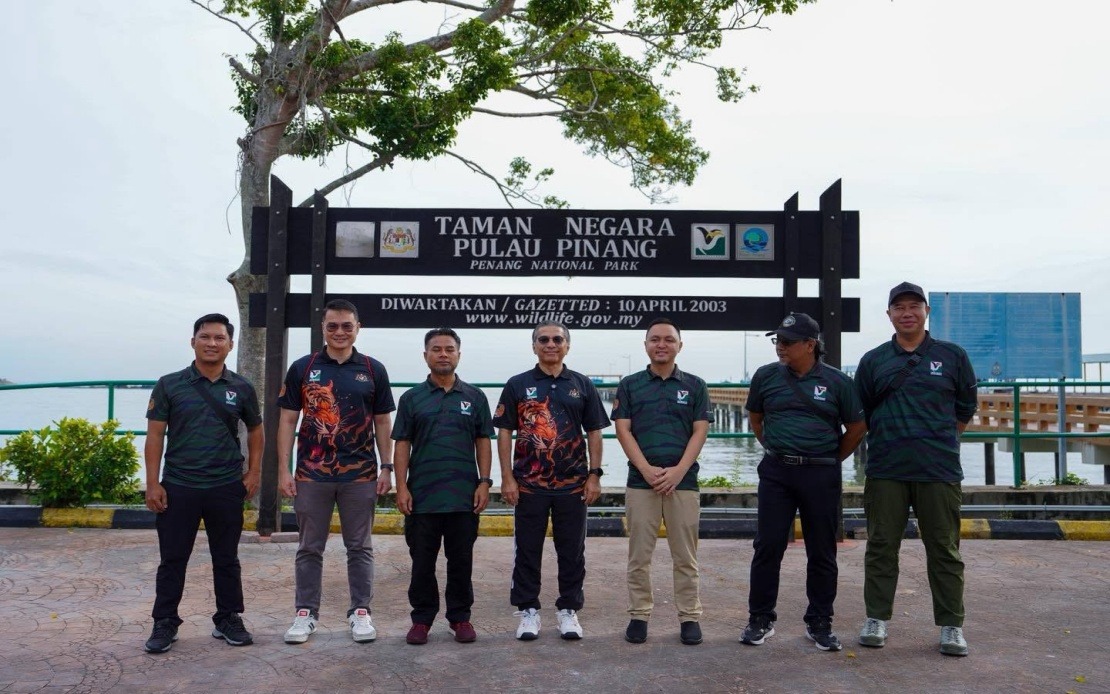
The intricate biological systems found within Penang National Park demand a fundamentally different approach to environmental stewardship—one that extends beyond the fences and boundaries of protected areas to encompass the broader community. Deputy Minister of Natural Resources and Environmental Sustainability Syed Ibrahim Syed Noh outlined this philosophy during a comprehensive field inspection of Teluk Bahang's sprawling park, underscoring that preservation efforts must evolve to reflect modern conservation science's emphasis on participatory management. The ecosystems within the park—encompassing dense forests, marine habitats, wildlife sanctuaries, and the scientifically significant meromictic lake—collectively represent irreplaceable natural capital that requires both institutional protection and grassroots stewardship to survive the pressures of development and climate change.
During his visit, Syed Ibrahim engaged with the Penang Department of Wildlife and National Parks to understand the technical and operational dimensions of site management. The guided tour revealed the park's remarkable biodiversity credentials, particularly through observation of the meromictic lake—an unusual water body with distinct layers that do not mix, creating multiple distinct ecological niches within a single body of water. This feature exemplifies how Penang's parks contain concentrations of globally significant natural phenomena, warranting intensified conservation attention. The interconnectedness between forest systems, coastal zones, and aquatic environments demonstrates how ecosystem services depend upon the health of multiple habitat types operating in concert, a concept increasingly central to contemporary conservation planning across Southeast Asia.
A focal point of the ministerial inspection involved the Turtle Conservation Centre at Kerachut Beach, operated by the Department of Fisheries Malaysia. This facility represents a tangible commitment to protecting endangered marine reptiles, particularly Green Turtles and Olive Ridley Turtles, both of which undertake remarkable oceanic migrations that make them vulnerable to threats across multiple jurisdictions. The centre's work addresses the complex reality that protecting such species requires not merely defending nesting beaches but managing interconnected marine environments across international waters. For Malaysian policymakers, the centre demonstrates how single-species conservation programmes generate broader ecological benefits while simultaneously creating touchpoints for public engagement with scientific research.
The inclusion of Entopia Penang in the ministerial itinerary reflects recognition that conservation education functions as a multiplier for preservation efforts. Interactive facilities that enable visitors to learn about biodiversity through immersive experiences transform passive observation into active learning, particularly among younger demographics whose environmental values remain malleable. Syed Ibrahim emphasised that such educational programming proves crucial for cultivating long-term public support for conservation policies and restrictions that may occasionally inconvenience commercial interests or individual preferences. Educational approaches grounded in direct experience tend to generate stronger conservation ethics than abstract appeals to environmental responsibility.
The deputy minister articulated a strategic vision positioning ecotourism as a reconciling force between commercial development and ecological protection. When managed responsibly, tourism activities can generate economic incentives for communities to maintain natural areas in productive condition, creating a financial mechanism that rewards conservation rather than exploitation. This approach proves particularly relevant for Malaysian regions dependent on natural resource extraction, where conservation policies often face resistance from stakeholders viewing environmental protection as economically counterproductive. By demonstrating that biodiversity generates sustained revenue through tourism, policymakers can potentially shift local sentiment toward preservation.
However, the ecotourism model carries inherent risks requiring careful management. Uncontrolled visitor access degrades habitats, disturbs wildlife, and ultimately undermines the ecosystem integrity that tourists come to experience. The deputy minister's emphasis on "responsibly managed" ecotourism acknowledges this tension, though the statement provides limited specificity regarding mechanisms ensuring sustainability. In practice, this requires investment in infrastructure, staff training, carrying capacity assessments, and enforcement of visitor regulations—elements often underfunded in Malaysian protected areas facing budget constraints and competing administrative priorities.
The framing of conservation as a shared responsibility between government agencies and local communities represents a shift from earlier models that treated protected areas as fortress conservation zones insulated from human activity. This collaborative approach aligns with emerging international best practices documented through the Convention on Biological Diversity and the Intergovernmental Science-Policy Platform on Biodiversity and Ecosystem Services. For Penang specifically, meaningful community engagement requires identifying and mobilising stakeholder groups including indigenous communities with historical territorial claims, fishing communities whose livelihoods intersect with marine conservation, and business operators in the tourism and hospitality sectors.
The meromictic lake exemplifies the scientific value concentrated within Penang's protected areas. These stratified water bodies create stable conditions for specialist organisms unable to survive in conventional lake environments, making them natural laboratories for studying evolutionary adaptation and ecosystem function under extreme conditions. The preservation of such features ensures that Malaysia maintains baselines against which climate-driven ecological changes can be measured and assessed. Furthermore, these systems provide ecosystem services including water storage and carbon sequestration that conventional economic analyses often fail to quantify.
The deputy minister's characterisation of biodiversity as "heritage that must be passed on to future generations" invokes intergenerational equity arguments central to sustainability discourse. This framing acknowledges that environmental degradation imposes costs on populations not party to the decisions generating that degradation, creating moral obligations to future citizens. For Malaysia, a nation pursuing ambitious middle-income status with associated pressures on natural resources, this philosophical stance represents a deliberate prioritisation of long-term ecological security over short-term extraction profits. Whether this rhetorical commitment translates into sufficient budget allocations and enforcement capacity remains an open question.
The inspection also implicitly acknowledged that Penang's conservation challenges extend beyond the park's boundaries. Upstream land use changes affecting water quality, coastal development impacting marine habitats, and atmospheric pollution reducing air quality all influence ecosystem health within formally protected areas. Comprehensive conservation therefore requires landscape-level coordination across multiple municipalities, states, and national agencies—an institutional coordination challenge that Malaysia's fragmented environmental governance structures have historically struggled to achieve. The success of Penang's conservation agenda depends partly on whether government agencies can transcend jurisdictional silos to implement truly integrated environmental management.
For Malaysian readers and regional policymakers, Syed Ibrahim's emphasis on community-centered conservation offers a template for addressing the conservation-development dilemma confronting rapidly urbanising Southeast Asian economies. The Penang National Park visit demonstrates how biodiversity protection can incorporate education, sustainable livelihoods, and scientific research rather than simply imposing restrictions on human activity. Yet implementation requires sustained political will, adequate funding, and institutional mechanisms capable of managing competing interests. As climate change intensifies pressure on remaining natural areas throughout Southeast Asia, the effectiveness of Malaysia's conservation philosophy will increasingly determine whether the region maintains the ecological capital upon which long-term development depends.

