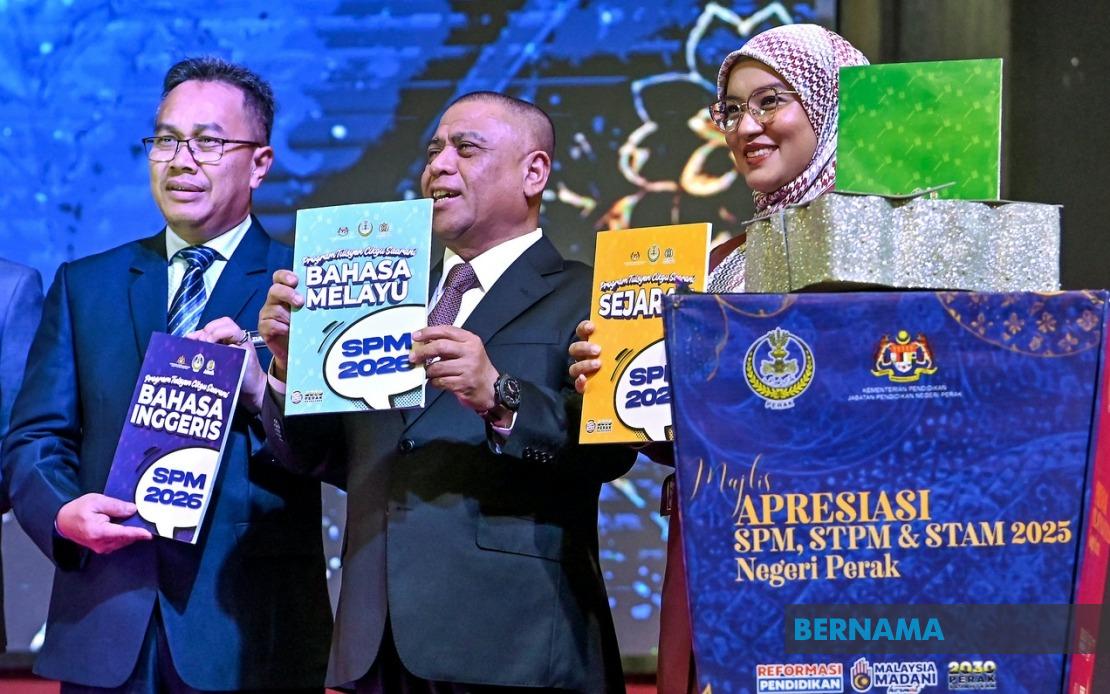
Perak has achieved its strongest Sijil Pelajaran Malaysia examination performance in more than a decade, with a State Average Grade of 4.49 recorded for the 2025 cohort. The result caps a sustained period of improvement spanning three consecutive years and underscores intensifying efforts across the state's education sector to elevate academic standards and student outcomes.
Menteri Besar Datuk Seri Saarani Mohamad disclosed the milestone at an awards ceremony in Ipoh recognising outstanding performers at SPM and higher secondary levels. He characterised the achievement as validation that ongoing initiatives and coordinated investment in education quality are yielding tangible returns. The upward trajectory signals both institutional commitment and systemic effectiveness in addressing long-standing performance gaps.
Particularly noteworthy is the narrowing disparity between urban and rural students, which now stands at just 0.04 grade points. This razor-thin differential represents a fundamental shift in educational equity within Perak, suggesting that geographic location no longer determines academic trajectories to the degree it historically did. The compression of this gap reflects deliberate policy choices and resource allocation decisions that have extended genuine opportunities for academic excellence beyond major towns and cities.
The contextual backdrop makes this achievement particularly significant for Southeast Asia's broader education landscape. As regional economies compete increasingly on human capital and knowledge-based productivity, states that can democratise academic performance across different communities gain competitive advantage. Perak's trajectory demonstrates that centralised coordination, consistent resource commitment, and systemic attention to underperforming areas can materially alter outcomes within measurable timeframes. The model offers instructive lessons for similarly stratified education systems across Malaysia and the region.
Beyond SPM results, Perak demonstrated comparable strength at pre-university level examinations. In the Sijil Tinggi Persekolahan Malaysia assessments, the state attained a Cumulative Grade Point Average of 2.91, surpassing the national benchmark of 2.88. This consistency across different examination frameworks suggests improvement is not concentrated in single cohorts or subject areas but reflects broader institutional capability development. Additionally, 116 Perak STPM candidates achieved perfect 4.00 grades out of 1,336 nationally, a representation exceeding the state's proportional share and indicating particular strength in rigorous academic pathways.
Islamically-oriented examinations also registered strong results. The Sijil Tinggi Agama Malaysia assessment yielded a State Average Grade of 3.03, with 36 students attaining the highest Mumtaz distinction. This performance dimension extends Perak's educational achievement profile beyond conventional academic metrics into religious and ethical knowledge domains, reflecting the state's commitment to holistic student development aligned with Malaysia's constitutional framework and Islamic institutional priorities.
However, Saarani's remarks injected crucial perspective beyond numerical outcomes. He contended that examination grades represent only one dimension of meaningful educational attainment and human development. Student accomplishment emerges through accumulated effort, institutional support, and complex intergenerational contributions that standardised metrics inadequately capture. This framing prevents reductionist interpretation of examination data and acknowledges the distributed effort underlying any individual achievement. It also signals recognition that education's societal purpose extends beyond certification and credential accumulation toward formation of capable, conscientious citizens.
The Menteri Besar's emphasis on shared success—distributing credit across teachers, parents, and broader school communities—reflects contemporary understanding of educational systems as ecosystems rather than collections of individual learners. In Malaysian context, where parental and community engagement significantly correlates with student outcomes, this acknowledgement carries particular weight. It reinforces norms of collective responsibility and interdependence that strengthen social cohesion even as education increasingly emphasises individual meritocratic advancement.
The ceremony recognised 266 recipients spanning students, educators, schools, and district-level education offices, attempting to institutionalise excellence through public validation and incentive structures. Such recognition programmes theoretically cascade motivational effects throughout education systems, signalling to participating stakeholders that their efforts receive acknowledgement and validation. For students, public recognition creates psychological reinforcement and peer influence mechanisms that may sustain academic orientation. For educators and schools, such validation legitimises pedagogical approaches and resource allocation decisions, potentially encouraging replication of successful practices.
The significance of Perak's results extends beyond the state's immediate context. Within Malaysia's federation, education remains jointly administered between federal and state governments, creating complex governance environments where state-level performance variations reflect both federal policy effectiveness and subnational implementation capacity. Perak's trajectory consequently suggests that federal education frameworks, when paired with committed state-level execution and resource mobilisation, can generate outcomes approaching developed-economy standards. This proves consequential for crafting education policy across economically heterogeneous federations, particularly regarding rural-urban equity imperatives.
Regionally, Malaysia positions itself as a middle-income nation transitioning toward high-income status through service-sector and technology-intensive development. Such transition necessarily depends on workforce capabilities that SPM and STPM credentials signal to employers. Perak's achievement therefore contributes to Malaysia's economic transformation narrative, suggesting subnational capacity to develop human resources competitive with regional peers. The state's success in narrowing urban-rural achievement gaps particularly matters given Southeast Asia's broader rural-urban development disparities that constrain inclusive growth.
Looking forward, sustaining momentum demands attention to the structural factors underlying recent improvements. Whether gains reflect temporary policy emphasis, durable institutional changes, or demographic composition shifts remains analytically important. If improvements prove durable, replication across other Malaysian states could materially elevate national education outcomes. If concentrated in particular demographics or reflecting temporary resource allocation patterns, results may prove transitory. Continued monitoring of Perak's trajectory and comparative analysis with other states will clarify whether the state has genuinely restructured its education system or achieved cyclical performance variations.

