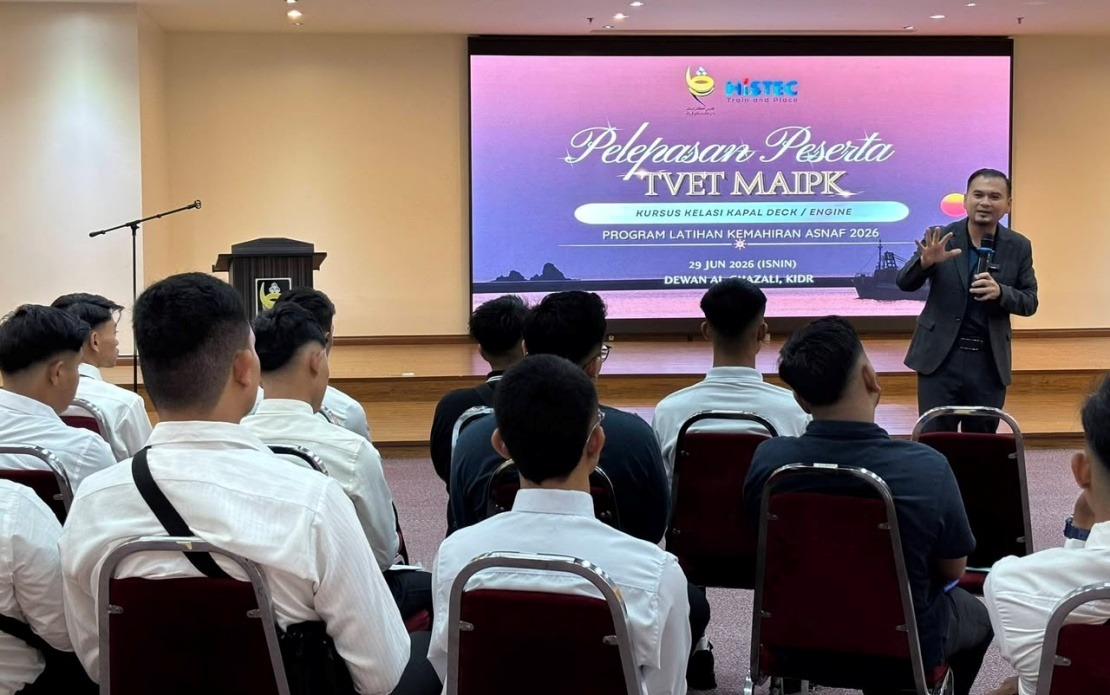
The Perak Islamic Religious and Malay Customs Council (MAIPk) has taken a decisive step toward bridging the skills gap in Malaysia's maritime sector by channelling RM470,000 into a targeted sponsorship programme for 25 underprivileged youth. The initiative, announced during a send-off ceremony at Kompleks Islam Darul Ridzuan in Ipoh, underscores a strategic pivot toward Technical and Vocational Education and Training (TVET) as a mechanism for inclusive economic growth in a state long dependent on traditional industries.
At RM18,800 per participant, the investment represents a meaningful commitment to breaking cycles of poverty through market-oriented skills training. The selected youth will undertake specialised courses in deck and engine operations—critical operational roles aboard commercial vessels—through a partnership with Ranaco Education and Training Institute in Chukai, Terengganu. This choice of institution and specialisation reflects careful alignment with genuine labour market demand rather than aspirational training disconnected from employment reality.
The three-month training curriculum combines classroom instruction with hands-on practical experience, culminating in professional certification and a seaman's licence—documentation essential for maritime employment. By bundling skill acquisition with formal credentials, the programme removes a significant barrier that often prevents vocational graduates from transitioning into formal sector employment. The emphasis on securing this regulatory qualification before programme completion ensures participants enter the job market with unambiguous proof of competency recognised across the shipping industry.
For Perak specifically, this initiative addresses a longstanding gap in workforce development strategies. While the state has emphasised manufacturing and agriculture, maritime opportunities remain underdeveloped despite geographic proximity to ports and shipping routes. By cultivating a pool of trained crew members, MAIPk is essentially positioning local talent to capture employment opportunities that might otherwise draw workers from other states or countries. This has multiplier effects: improved household incomes flow back into local economies, and successful practitioners often become mentors and recruiters for subsequent cohorts.
The asnaf designation—referring to eligible beneficiaries under Islamic welfare frameworks—ensures the programme targets those facing genuine structural barriers to employment. Beyond skill gaps, asnaf youth often lack social networks within industries, struggle with transport to training venues, or face discrimination. By fully underwriting costs and providing institutional support, MAIPk removes friction points that would otherwise limit participation to those with existing family connections or financial cushions. This democratisation of access to maritime careers is particularly significant in regions where intergenerational poverty constrains opportunity exposure.
The promised employment placement upon graduation represents an equally crucial dimension. Many vocational programmes invest in training but leave graduates navigating job searches independently, often unsuccessfully. By securing commitments from maritime employers to absorb completers, MAIPk creates a closed-loop system where training directly translates into stable income. Initial employment serves as a credential for subsequent advancement; crew members with documented experience can pursue certifications for supervisory and technical roles, establishing clear career trajectories that extend beyond first placement.
This initiative also reflects evolving policy frameworks across Southeast Asia that prioritise TVET as an antidote to skills mismatches and youth underemployment. Malaysia's national development agenda emphasises high-skilled industries, yet regional competition for maritime talent is intensifying as shipping hubs expand throughout the region. By cultivating domestic capacity, programmes like MAIPk's reduce dependence on imported labour and strengthen Malaysia's competitive position in maritime services, a sector worth billions in regional economic activity.
The involvement of MAIPk's Asnaf Empowerment Division, with Amirudin Osman presiding over the send-off ceremony, signals institutional embedding of this approach within religious administrative structures. Zakat and waqaf systems across Muslim-majority Malaysia possess substantial resources—often underutilised for productive economic interventions—that could be deployed similarly. This precedent may encourage other state Islamic councils and faith-based organisations to channel welfare funds into vocational pathways rather than purely consumptive relief, generating lasting human capital improvements.
Economic sustainability depends critically on follow-through. Post-placement monitoring of employment retention, wage progression, and workplace safety is essential for validating the model's effectiveness and identifying refinements. Tracking participant advancement into supervisory certifications or entrepreneurial ventures—establishing shipping agencies or marine services—would demonstrate whether the programme catalyses genuine career building or merely temporary employment. These metrics will determine whether similar allocations by other councils represent replicable best practice or one-off initiatives.
The broader context matters too. Malaysia's maritime workforce must compete internationally; trained crews increasingly require not just technical skills but English-language proficiency and cross-cultural competency to operate on multinational vessels. If the Ranaco curriculum adequately addresses communication and collaboration standards, graduates will command premium employment opportunities. Conversely, programmes generating certificates without substantive capability development merely flood markets with credentials, depressing wages and frustrating participants. MAIPk's institutional credibility will depend substantially on the quality of training delivery and the calibre of employers receiving graduates.
For underprivileged communities in Perak, this programme signals that pathways to dignified, income-generating work exist beyond informal sectors. The maritime industry offers stability, structured employment conditions, and advancement opportunities—precisely the attributes that interrupt poverty cycles. By demonstrating tangible success stories of asnaf youth advancing into secure maritime careers, MAIPk creates visibility effects that encourage subsequent cohorts and motivate parents to support young people's engagement with TVET. This cultural shift—repositioning technical training as prestigious rather than remedial—may ultimately prove as valuable as the RM470,000 direct investment.

