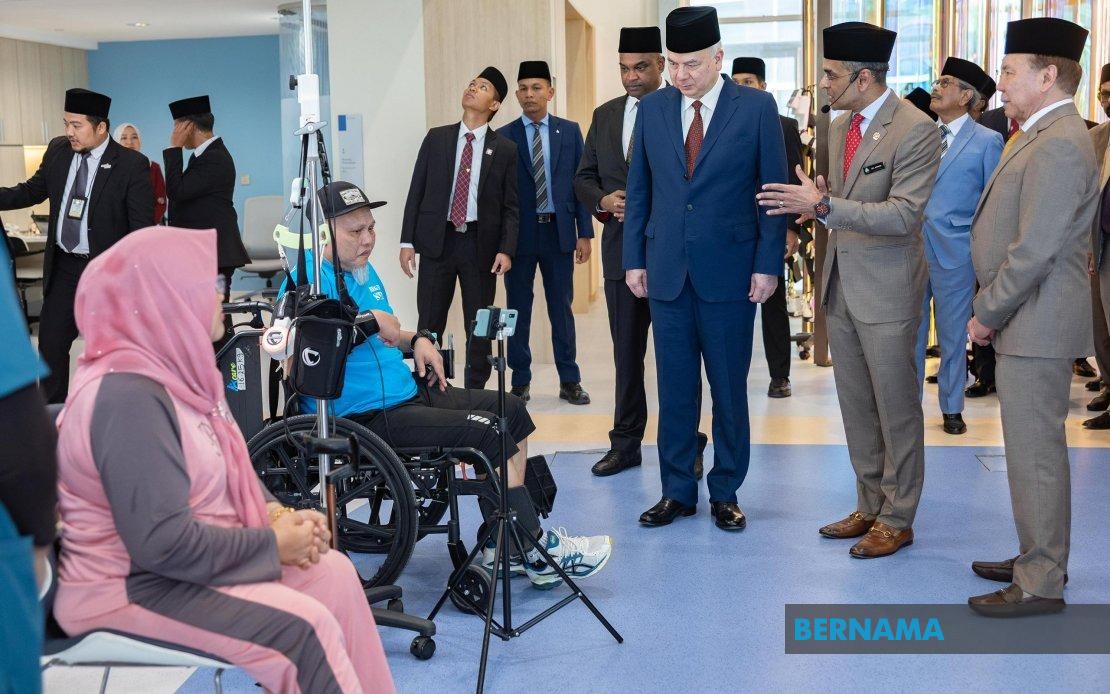
Sultan Nazrin Shah of Perak formally opened the Social Security Organisation's (PERKESO) Neuro-Robotics and Cybernetics Rehabilitation Centre in Meru Raya on June 16, representing a significant advancement in how Malaysia delivers rehabilitation and social healthcare to its workforce. The facility, which will now bear the Sultan's name as "Pusat Rehabilitasi Perkeso Sultan Nazrin Shah", underscores the nation's commitment to modernising disability services and reintegrating injured workers into society.
The architectural design of the new centre draws inspiration from the traditional Malaysian art of gold-thread embossing, a cultural touch that grounds the facility's technological advancement in local heritage. This aesthetic choice reflects a broader vision of rehabilitation that balances cutting-edge medical innovation with deeply rooted values of compassion and cultural sensitivity. The opening ceremony drew senior royal figures from Perak, including Raja Muda Raja Jaafar Raja Muda Musa and Raja Di Hilir Perak Raja Iskandar Dzulkarnain Sultan Idris Shah, alongside Menteri Besar Datuk Saarani Mohamad and Minister of Human Resources Datuk Seri R. Ramanan, highlighting the initiative's cross-sectoral importance.
In addressing the assembled guests, Sultan Nazrin emphasised that the centre's true value extends far beyond its sophisticated medical equipment and technological infrastructure. The facility brings together a multidisciplinary team including medical specialists, physiotherapists, occupational and vocational therapists, social workers, and psychologists—a comprehensive ecosystem designed to address the complex needs of individuals recovering from workplace injuries and neurological conditions. This integrated approach recognises that rehabilitation is not merely a clinical process but a holistic journey towards restoring independence and self-worth.
The Sultan articulated a vision of rehabilitation that represents a fundamental reorientation in national thinking. Rather than viewing disability as an endpoint, the centre embodies the aspiration that proper medical treatment, assistive technology, and unwavering personal determination can enable individuals to rebuild their lives with both dignity and economic independence. This philosophical stance carries particular weight in Malaysia, where traditional attitudes toward disability have sometimes limited employment opportunities for those who complete rehabilitation programmes.
The facility carries historical significance as the conceptual initiative of M. Kulasegaran, who championed the project during his tenure as Minister of Human Resources from 2018 to 2020. The centre's creation reflects years of advocacy for modernised rehabilitation infrastructure, addressing a gap in Malaysia's healthcare system where advanced neuro-rehabilitation services have been limited. For stroke survivors, the centre offers possibilities of regaining mobility and function. For workers recovering from traumatic brain injuries, it provides pathways toward restoring cognitive function, speech, and psychological confidence.
Sultan Nazrin's remarks highlighted the profound human dimensions of the facility's mission. Beyond individual recovery, the centre serves as a beacon of hope for families navigating the uncertainty and disruption that serious workplace injuries or illness create. The centre's existence communicates to patients and their loved ones that recovery remains possible, that society values their reintegration, and that technology and human expertise can combine to restore capability and independence.
The Sultan explicitly called on Malaysian society to confront and eliminate prejudice against persons with disabilities, framing this cultural shift as essential to the centre's ultimate success. A state-of-the-art rehabilitation facility can only achieve its potential if labour markets open to receive graduates of rehabilitation programmes. To this end, the Sultan particularly commended PERKESO's partnership with 7-Eleven, which provides workplace training and subsequent employment opportunities for individuals completing rehabilitation, demonstrating that private-sector engagement with disability inclusion is both feasible and strategically valuable.
Crucially, the Sultan extended an invitation to Malaysia's broader corporate sector to participate in this inclusive employment model through corporate social responsibility initiatives, vocational training programmes, and hiring commitments. This call represents a subtle but significant shift in framing disability inclusion not as charitable benevolence but as a collective social responsibility and moral obligation. The Sultan positioned support for rehabilitation graduates as intrinsic to a society's ethical character and commitment to justice, elevating the conversation beyond tokenistic corporate philanthropy.
The Sultan's remarks reframed the definition of national progress itself. While acknowledging the importance of physical infrastructure and economic metrics, he contended that genuine progress must be measured by a nation's willingness and capacity to implement social programmes that preserve human dignity, protect vulnerable populations, and offer second chances to individuals tested by illness, injury, or disability. This statement challenges Malaysia's development narrative, suggesting that true advancement requires not just highways and buildings but systems that safeguard the welfare and potential of citizens facing adversity.
For Malaysian readers and policymakers, the opening of this centre raises important questions about the accessibility and availability of similar facilities throughout the country. Perak's new centre serves the northern region, but rehabilitation gaps likely persist in other states, particularly in rural and less developed areas. The facility's success in demonstrating the outcomes of integrated, technology-enabled rehabilitation may create momentum for similar investments elsewhere, yet government resources remain constrained and competition for healthcare funding intense.
The centre also emblematises evolving international standards in disability rehabilitation, aligning Malaysia with best practices in developed economies where specialised neuro-rehabilitation centres have become standard components of modern healthcare systems. However, the sustainability of such facilities depends on adequate government funding, skilled workforce development, and the willingness of employers to hire rehabilitation graduates—all factors that remain variable across Malaysia's diverse economic landscape.
The Sultan's emphasis on dignity and second chances carries particular resonance in Malaysia's context, where large informal economies and industrial sectors create significant workplace injury risks, yet rehabilitation and reemployment support systems remain underdeveloped compared to advanced economies. The PERKESO centre represents an important institutional commitment to changing this reality, though its impact will ultimately depend on how successfully its philosophy diffuses throughout Malaysian workplaces and society more broadly.