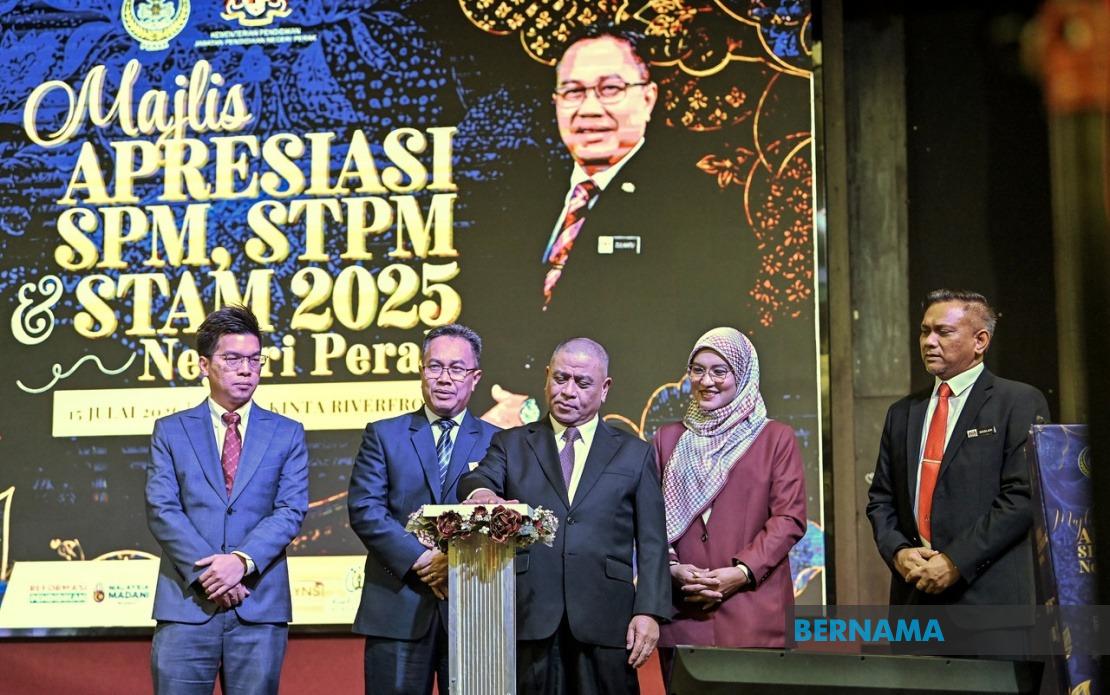
The Perak state government's Menteri Besar Scholarship continues to demonstrate tangible benefits for students navigating the challenging transition from secondary to tertiary education. During an appreciation ceremony in Ipoh honouring the 2025 cohort of SPM, STPM and STAM achievers, scholarship recipients highlighted how the monthly stipend—ranging from RM1,000 to RM1,200 per semester—has fundamentally altered their educational trajectories and eased pressure on their households.
Yoong Lam, a 20-year-old alumna of SMK Sultan Yussuff who attained a perfect 4.00 OGPA in STPM, articulated the practical reality facing many Malaysian families of modest means. Her scholarship allocation covers essential expenses that would otherwise strain her father's self-employed income: examination fees, academic reference materials, and supplementary tuition classes. As the eldest of two children, she acknowledges that this support extends beyond personal benefit, materially reducing the financial anxiety her primary breadwinner would otherwise experience. Her perspective reflects a broader Malaysian demographic reality—families where parental income, though stable, leaves limited margin for investing in the educational extras that increasingly determine university admission prospects and programme selection.
Muhammad Haziq Hafit and Muhammad Taufiq Ikwan Mohammad Asri, both recipients from Al-Ulum Al-Syar'Iyyah Religious Secondary School in Bagan Datuk, underscored how the assistance functions as crucial seed capital for the immediate pre-university phase. Haziq plans to pursue education studies at the University of Malaya, while Taufiq is preparing to complete his tertiary education in Egypt—both scenarios requiring upfront expenditure on materials, travel, accommodation arrangements, and registration fees. Though neither characterised the sum as generous relative to comprehensive scholarship programmes, they recognised its significance specifically for middle-income households where neither poverty-based assistance nor wealth-based self-sufficiency applies, yet where genuine financial constraints remain.
The timing and magnitude of Perak's scholarship intervention reveals strategic thinking about educational support structures. By targeting students at the examination-completion threshold—when they have demonstrably achieved—the programme incentivises academic rigour while addressing the precise moment when families face peak financial demand. Unlike universal assistance, merit-based allocation signals that excellence carries material reward, potentially motivating younger cohorts to intensify their preparation. The RM1,200 semester amount, while modest in absolute terms, represents meaningful purchasing power for reference materials, tutorial fees, and technology access that intermediate-income families often deprioritise.
Perak's educational commissioner Zulkafli Mohamed Mokhtar framed the scholarship within a broader ecosystem of state-level interventions designed to elevate examination outcomes. The Tuisyen Cikgu Saarani (TCS) Programme, distributing supplementary reference materials developed by experienced educators, has reached nearly 25,000 SPM candidates across daily schools, tahfiz institutions, and religious secondary schools. The 63,567 copies of customised study guides disseminated statewide represent a different form of support—not financial but intellectual, providing pedagogically refined learning materials specifically calibrated to Perak's student cohort.
Menteri Besar Datuk Seri Saarani Mohamad leveraged the ceremony to announce exceptional 2025 SPM outcomes, with the state achieving a 4.49 Grade Point Average—the strongest result in thirteen years and continuing an upward trajectory across three consecutive examination cycles. More significantly, the achievement gap between urban and rural candidates narrowed to merely 0.04 points, suggesting that educational opportunity increasingly transcends geographical location within Perak. This equity dimension carries particular relevance for a Southeast Asian context where rural-urban educational disparities remain a persistent challenge across the region.
The integration of religious and secular educational pathways into scholarship and support mechanisms reflects Malaysia's distinctive dual-system reality. Extending the reference book initiative to Sekolah Menengah Tahfiz Darul Ridzuan and Sekolah Menengah Agama Rakyat signals recognition that Islamic education students require equivalent academic scaffolding and examination preparation support. This inclusive approach acknowledges that educational excellence across different institutional streams strengthens Perak's overall human capital development rather than fragmenting support along sectarian lines.
From a Malaysian policy perspective, Perak's model offers instructive elements as other states contemplate educational financing strategies. The combination of merit-based financial assistance targeting examination-successful students, coupled with universalised access to quality learning materials, creates a two-tier support mechanism addressing both family-level financial constraints and individual-level academic preparation gaps. The scholarship particularly benefits first-generation university attendees from middle-income households—demographics increasingly prominent in Malaysia's socioeconomic landscape but frequently overlooked in conventional assistance frameworks that prioritise either the poorest households or elite performers accessing international scholarships.
The programme's design also reflects fiscal pragmatism. By concentrating direct financial support on demonstrated achievers, the state concentrates resources where motivational and material returns appear highest, while broader distribution of reference materials maximises reach relative to expenditure. For students proceeding to overseas universities—as Taufiq plans for Egypt—even modest scholarship funds assume importance as seed capital for initial relocation expenses and materials that Malaysian tertiary institutions or government loans do not typically cover.
Looking across Southeast Asia, educational financing remains a critical policy frontier. Thailand, Vietnam, Indonesia and the Philippines all grapple with middle-income trap dynamics where families exceeding poverty thresholds struggle to afford quality education, yet lack access to comprehensive scholarship ecosystems. Perak's integrated approach—merging targeted financial assistance, supplementary academic materials, and structured recognition ceremonies—offers a template that respects fiscal constraints while leveraging multiple intervention channels. The explicit acknowledgment that scholarship support relieves parental anxiety, not merely individual student circumstances, recognises the household-level financial psychology underlying educational decisions in Southeast Asia.
For Malaysian students from moderate-income backgrounds nationwide, Perak's scholarship demonstrates how targeted state-level intervention can shift feasibility calculus regarding university attendance, programme selection, and the ability to access supplementary resources that enhance academic competitiveness. As other states calibrate their educational support strategies, the Perak model's emphasis on post-examination merit recognition, equity across geographical settings, and inclusion of diverse educational pathways warrants careful examination. The scholarship recipients themselves—Yoong Lam, Haziq, and Taufiq—represent exactly the demographic that Malaysia's higher education system requires: motivated, academically accomplished individuals for whom financial barriers rather than capability constraints previously created uncertainty.

