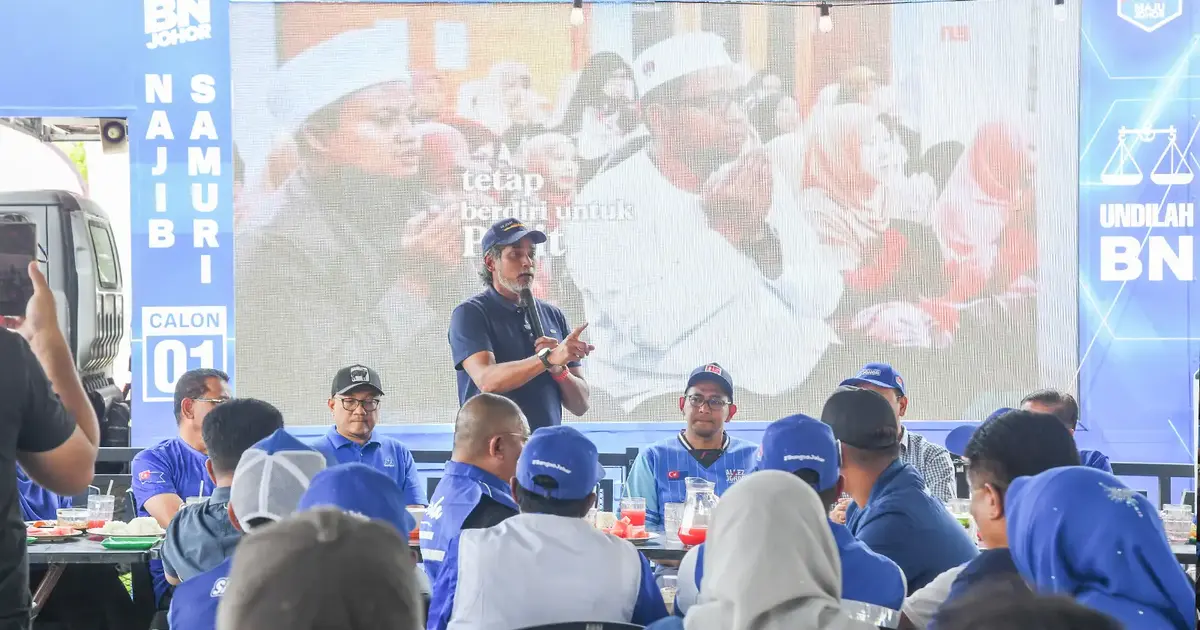
Khairy Jamaluddin, the prominent former Umno Youth chief, has raised the bar for any potential debate involving Johor BN chairman Onn Hafiz Ghazi, insisting that Pakatan Harapan must deploy a candidate of matching political weight if it wishes to engage in such an exchange. The condition reflects broader dynamics within Malaysian opposition politics, where questions of legitimacy and representational authority remain central to campaign strategy.
KJ's stipulation centres on a fundamental principle of political debate protocol: opposing sides should enter discussions with representatives holding comparable mandates and authority. Since Onn Hafiz holds the position of Johor BN chairman and is widely regarded as the coalition's choice for menteri besar in the state, KJ argues that PH should counter with its own designated prospective menteri besar candidate rather than sending lower-ranking officials or state assemblymen. This demand essentially ensures that any public forum becomes a head-to-head contest between the two frontrunners vying to lead Malaysia's southernmost peninsula state.
The intervention from the former youth movement leader carries considerable weight within Umno circles, and his public statements on such matters typically reflect broader party calculations. By articulating this position, KJ effectively establishes a threshold that could either facilitate or obstruct campaign discourse depending on whether PH has formally announced a unified menteri besar candidate. The condition also serves as a tacit acknowledgment that Onn Hafiz himself represents the BN establishment's most serious attempt to recapture state leadership after previous electoral setbacks.
For Malaysian political observers, such conditionality around debate participation underscores how electoral contests now hinge not merely on policy platforms but on symbolic assertions of legitimacy and institutional weight. The insistence on equivalent-ranking candidates reflects a sophisticated understanding that public debates function as more than mere information exchanges; they constitute legitimacy-affirming events where the very decision to participate and the terms of participation carry meaning beyond the substantive arguments advanced.
Packatan Harapan faces a strategic choice in responding to KJ's framing. The coalition could interpret the condition as a straightforward organizational requirement and move to formalize its menteri besar selection if it has not already done so, thereby clearing the path for public debate. Alternatively, opposition strategists might view KJ's statement as an attempt to constrain campaign flexibility by forcing premature candidate announcements that could alienate factions within the broader PH coalition. Johor's political landscape remains fractious, with different components holding distinct interests regarding state leadership, making early crystallization of candidacy potentially destabilising.
The Johor menteri besar position carries outsized symbolic importance within Malaysian politics. As the nation's southernmost state and home to significant economic activity, political control of Johor affects broader peninsular dynamics. Recent electoral history in the state reveals volatile voter sentiment, with BN suffering significant losses in 2018 before rebuilding support subsequently. This volatility means that both coalitions recognize Johor as genuinely competitive territory rather than a guaranteed stronghold, elevating the significance of campaign events and public representations of leadership capability.
Onn Hafiz's positioning within Johor BN reflects deliberate efforts to rebuild the coalition's electoral fortunes in a state where Umno's traditional dominance faced serious challenges. His elevation to BN chairman status signals the establishment's confidence in his capacity to mobilize support and articulate a coherent counter-narrative to opposition governance models. Against this backdrop, KJ's insistence on debate protocol becomes part of a broader consolidation strategy designed to project organizational unity and decisive leadership.
The debate conditions KJ has articulated also reveal underlying questions about PH's internal cohesion regarding state-level leadership structures. Pakatan Harapan comprises multiple parties with potentially divergent preferences regarding menteri besar selection, and debates over candidacy have historically created tensions within the coalition. By requiring PH to field a unified prospective menteri besar, KJ's condition indirectly forces the opposition to demonstrate organizational clarity at precisely the moment when internal disagreements might still exist.
From a broader Southeast Asian perspective, Malaysian electoral practices around debate participation and candidacy announcements reflect democratic norms that emphasize institutional hierarchy and representative legitimacy. The expectation that debate participants hold equivalent political standing mirrors conventions in other regional democracies while also reflecting Malaysian political culture's emphasis on formal institutional positions as markers of authority and credibility.
For Malaysian voters attempting to evaluate competing visions for state governance, the resolution of this debate protocol question will determine whether they receive opportunities to witness direct exchanges between the individuals most likely to hold executive power. The condition KJ has articulated does not merely concern procedural matters; it fundamentally shapes the information landscape available to Johor citizens as they approach electoral decisions. Whether PH accepts KJ's terms will therefore constitute a meaningful statement about the coalition's confidence in its own readiness to contest state leadership at the highest level.

