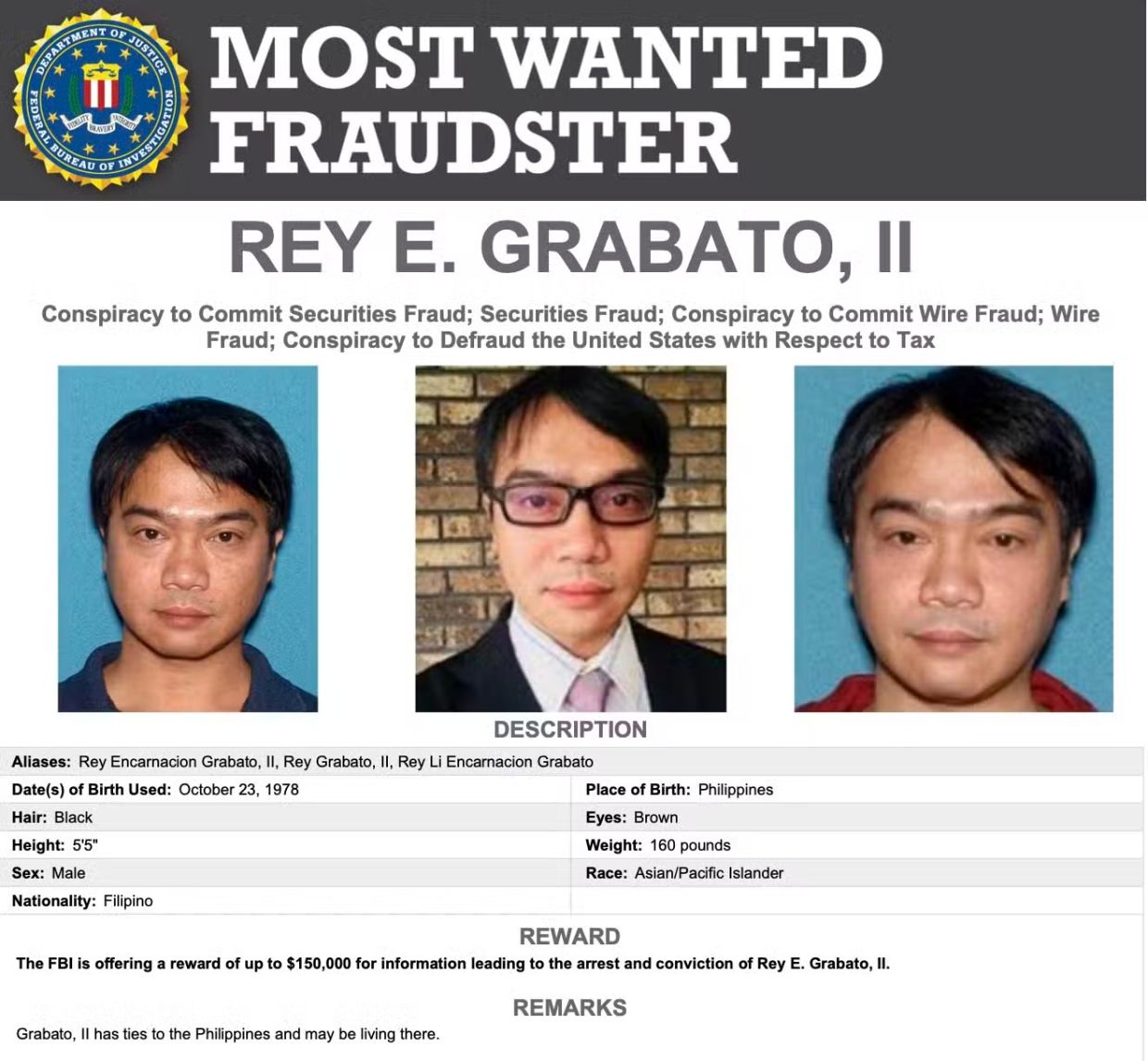
Rey E. Grabato II, the son of Mina Mayor Rey P. Grabato in Iloilo province, has been designated as one of the FBI's Most Wanted Fraudsters in connection with an elaborate investment scheme that authorities allege defrauded roughly 2,000 investors of more than US$650 million. The placement on the federal list underscores the increasingly transnational nature of investment fraud, with schemes originating from or involving operatives with ties to Southeast Asia targeting vulnerable Americans across multiple states.
Grabato II, who held the position of former president and majority owner of National Realty Investment Advisors LLC (NRIA), faces multiple serious federal charges including securities fraud, wire fraud, and conspiracy to defraud the United States through tax evasion schemes. The FBI has announced a reward of up to US$150,000 for credible information leading to his apprehension and conviction. His family background adds a layer of political complexity to the case: his mother, Lydia Encarnacion Grabato, has also previously served as mayor of the same municipality, raising questions about potential oversight and accountability mechanisms at the local level.
The fraudulent scheme operated between February 2018 and January 2022, during which Grabato II and his alleged co-conspirator Thomas Nicholas Salzano perpetrated what prosecutors characterize as a classic Ponzi operation. The scheme centred on NRIA Partners Portfolio Fund I LLC, ostensibly a real estate investment fund that promised significant returns to participants. To attract investors, the operation conducted an extensive marketing campaign spanning thousands of targeted emails alongside traditional media channels including television, radio, and billboard advertisements, along with investor presentations designed to build credibility and trust among potential participants.
Central to the fraud was a sophisticated misrepresentation campaign. Prospective and existing investors were systematically led to believe that NRIA maintained solid financial standing and generated substantial profits from its real estate operations. In reality, prosecutors allege that the company produced little to no genuine profit and instead operated as a classic wealth transfer mechanism wherein funds contributed by newly recruited investors were diverted to satisfy payment obligations and withdrawal demands from earlier investors—the defining characteristic of Ponzi schemes that eventually collapse when recruitment slows.
Beyond the basic investment fraud, federal authorities have identified a secondary criminal layer involving the misappropriation of investor funds. Grabato II and his associates are accused of siphoning millions of dollars from investor accounts for personal benefit or to service debt obligations unrelated to the fund's purported real estate investments. This dimension suggests a deliberate intention to convert investor capital into personal wealth rather than good-faith mismanagement or miscalculation.
Parallel to the investment scheme, Grabato II faces accusations of orchestrating a separate conspiracy to obstruct the Internal Revenue Service's collection efforts regarding approximately US$26 million in federal tax liabilities owed to the United States government. This tax obstruction scheme allegedly operated from November 2007 through August 2022, indicating a prolonged pattern of evasion that predates and extends beyond the primary investment fraud. The extended timeline raises troubling questions about how such activities escaped detection for such an extended period.
A federal arrest warrant was issued on October 12, 2022, following charges filed in the US District Court for the District of New Jersey in Newark. At the time of his indictment, authorities identified Grabato II as residing in Hoboken, New Jersey, with connections to the Philippines. Despite the federal charges, he evaded capture and remains at large, in contrast to his alleged co-conspirator Salzano, who was arrested in October 2022. The fact that one conspirator was apprehended while the principal architect escaped custody suggests either greater caution on Grabato II's part or possible assistance in evading detection.
Investigators have documented that Grabato II has operated under multiple aliases including Rey Encarnacion Grabato II, Rey Grabato II, and Rey Li Encarnacion Grabato, complicating efforts to track and apprehend him. The use of various names suggests a deliberate strategy to obscure his identity and complicate efforts by law enforcement agencies across different jurisdictions. This tactic is increasingly common among sophisticated financial fugitives operating across international borders.
Grabato II's placement on the FBI's Most Wanted Fraudsters list represents part of a broader initiative launched in June 2026 to heighten public awareness regarding major fraud fugitives. The list has attracted particular attention to individuals with Filipino and Filipino-American backgrounds involved in significant financial crimes. Other fugitives on the list include Michael Lizaso Marasigan, a dual Filipino-American citizen with established ties to Guam and the Philippines, who was convicted in May 2025 on charges involving illegal gambling operations, money laundering, and wire fraud.
Also listed are John Michael Dimitrion and his wife Julieanne Baldueza Dimitrion, who pleaded guilty in 2009 to operating a mortgage fraud scheme in Hawaii but subsequently failed to appear for sentencing in July 2010. The presence of multiple individuals with Philippine connections on the FBI's priority fraud list suggests a concerning pattern that warrants attention from both law enforcement and regulatory authorities across Southeast Asia.
The case has significant implications for Filipino and Southeast Asian diaspora communities in North America, where trust-based investment networks and referral systems can be exploited by sophisticated fraudsters. The geographic reach of NRIA's marketing campaign, particularly its concentration in New Jersey and surrounding states where Filipino immigrant communities maintain substantial investment capacity, suggests deliberate targeting of vulnerable populations potentially unfamiliar with American regulatory protections.
For Malaysian readers and regional observers, the case illustrates the cross-border nature of modern financial crimes and the importance of investment due diligence regardless of the credentials or family background of scheme operators. The involvement of a politically connected family member underscores how local political standing does not necessarily correlate with ethical business conduct, and investors must rely on verifiable regulatory oversight rather than social standing or family connections.
Individuals with information regarding Grabato II's whereabouts are encouraged to contact their nearest FBI field office or the closest United States embassy or consulate. The case remains under active investigation, and the substantial reward offer reflects the seriousness with which American law enforcement pursues transnational fraud conspirators who target domestic investors.

