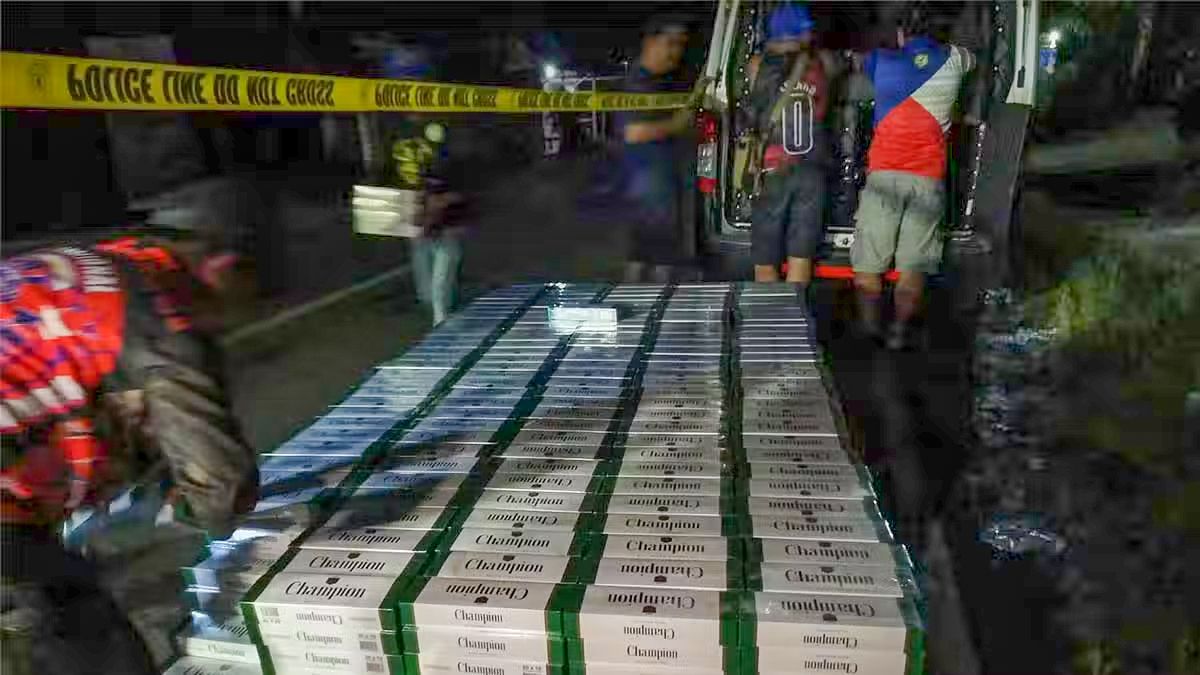
A police officer and businessman face charges in the Philippines after law enforcement officials intercepted a van carrying nearly P1.9 million in smuggled cigarettes during a routine checkpoint operation in Barangay Gatas, Kalawit, Zamboanga del Norte late on Friday, July 31. The joint operation, which began as a standard traffic inspection, uncovered what appears to be a significant smuggling operation involving an individual sworn to uphold the law, raising fresh concerns about corruption within the ranks of Philippine law enforcement.
The interdiction occurred at approximately 10:05pm when personnel from the 2nd Platoon of the Zamboanga del Norte 2nd Provincial Mobile Force Company, operating in coordination with other law enforcement agencies, positioned themselves at the checkpoint. According to Lt. Col. Edwin Verzon, who commands the force unit, officers attempted to stop a white Nissan van for routine inspection, following standard border and contraband control procedures common throughout the Philippines' conflict-affected regions where smuggling remains endemic.
When signalled to pull over, the driver of the vehicle displayed immediate resistance to the inspection process. Rather than complying with the checkpoint protocol, the operator accelerated the van and attempted to bypass the waiting officers entirely. This evasive maneuver triggered a pursuit operation, with authorities pursuing the fleeing vehicle over a short distance until they managed to intercept and apprehend it, with both occupants subsequently taken into custody.
Investigators identified the driver as a 34-year-old police officer assigned to Police Station 10 under the Zamboanga City Police Office, who maintains residence in Barangay Talon-Talon within Zamboanga City. The second suspect, a 36-year-old businessman, hails from Barangay Tumaga, also in Zamboanga City. The involvement of an active-duty police officer in the smuggling operation underscores a troubling pattern of law enforcement personnel participating in contraband activities, a recurring problem that undermines institutional credibility.
A thorough examination of the van's interior revealed the extent of the contraband operation. Authorities discovered a total of 1,630 reams of cigarettes deliberately concealed throughout the vehicle's cargo area. The systematic packing and large quantity suggest this was not an isolated incident but rather part of an organized smuggling network capable of moving substantial quantities of contraband across provincial boundaries within Mindanao.
The Bureau of Customs conducted a formal valuation of the intercepted goods, determining a market value of P1,867,980 based on the agency's established price index for tobacco products. This valuation reflects current retail cigarette prices in the Philippines and indicates the financial magnitude of the smuggling operation, demonstrating how illegal trade in cigarettes represents a significant economic loss to both the government through lost excise taxes and legitimate retailers competing against untaxed black-market products.
The case is particularly significant for Philippine law enforcement and customs authorities, as it demonstrates ongoing challenges in controlling illicit tobacco trafficking through Mindanao's porous borders and checkpoints. Smuggled cigarettes, typically originating from jurisdictions with lower taxation, undercut legitimate commercial outlets and represent lost revenue for the Philippine government. The involvement of a uniformed officer suggests that contraband networks may maintain connections within law enforcement agencies themselves, facilitating the movement of illegal goods through what should be the most secure points.
For Malaysia and other Southeast Asian nations, this incident highlights the broader regional challenge of cross-border contraband activity. Tobacco smuggling networks frequently operate across multiple countries in the ASEAN region, with goods flowing through various ports and land borders. The prevalence of such operations, combined with corruption risks within enforcement agencies, creates spillover effects that affect neighboring countries' tax revenues and legitimate business operations.
The arrest also reflects the Philippines' continuing efforts to strengthen customs enforcement and combat contraband smuggling, particularly in Mindanao regions where government control remains contested in some areas. Joint operations between different law enforcement units, as demonstrated in this case, represent an attempt to consolidate resources and improve interagency coordination. However, the participation of a serving police officer suggests that institutional reforms and integrity measures may need strengthening alongside operational improvements.
The suspects remain in custody pending further investigation and formal charges related to the smuggling operation. Such cases typically involve violations of customs laws and tobacco tax regulations, with penalties including substantial fines and imprisonment. The prosecution will likely examine whether the police officer facilitated other smuggling operations and whether systematic corruption exists within his assigned station, potentially leading to broader investigations into the police unit's integrity.

