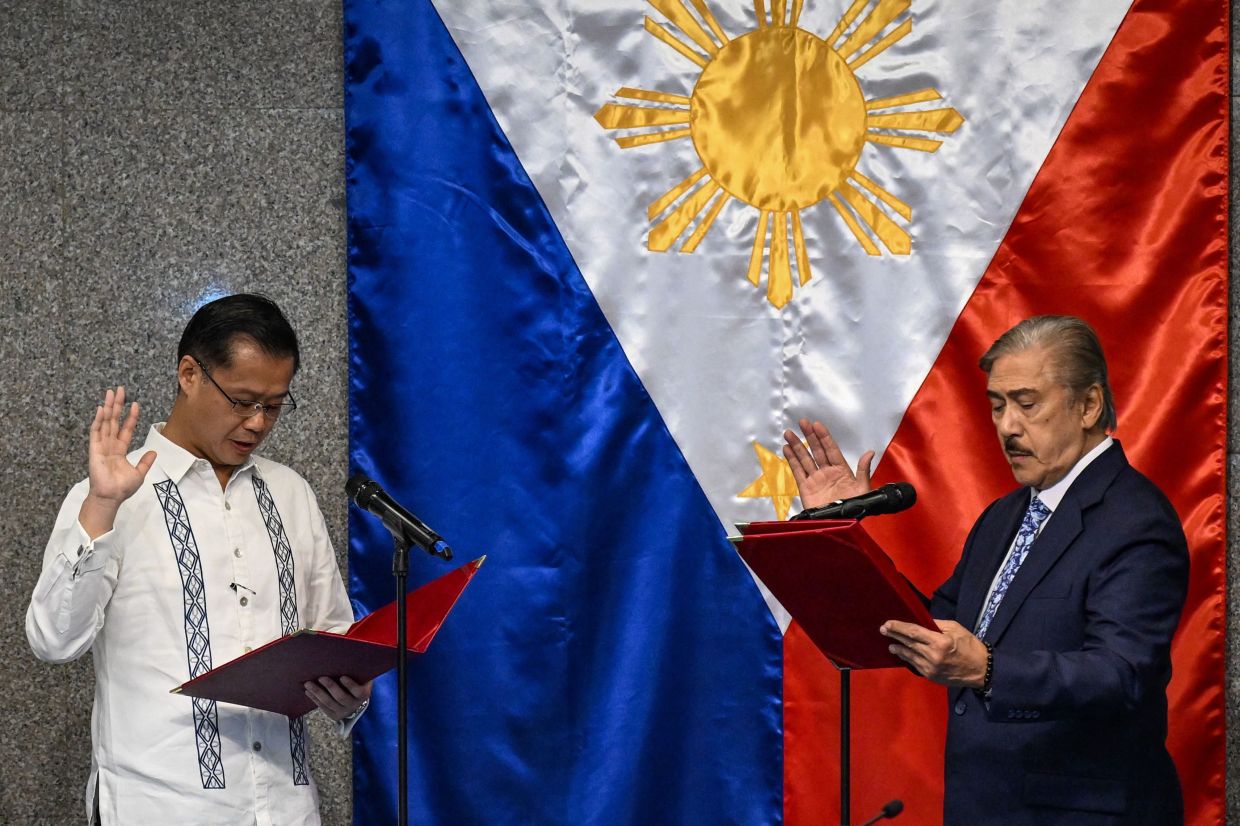
The Philippine Senate has resolved a prolonged internal power struggle by electing Senator Sherwin Gatchalian to the position of Senate president during a special session on Wednesday, June 17. The vote saw 13 senators converge on the chamber—precisely the minimum threshold required to execute such a significant institutional change—and unanimously support Gatchalian's elevation to the leadership of the 24-member upper house. This outcome concludes weeks of maneuvering and political recalculation that had cast uncertainty over the Senate's operational authority and exposed deeper fissures within the legislative chamber.
Gatchalian brings substantial legislative and executive experience to the role, having previously held the position of Mayor of Valenzuela City in Metro Manila, one of the sprawling metropolitan region's key municipalities. His political career extends across multiple government tiers, including prior service in the House of Representatives, where he accumulated considerable institutional knowledge and forged alliances that would prove instrumental in marshalling support for his presidential bid. The breadth of his background suggests a figure accustomed to navigating complex political ecosystems and managing diverse constituencies, experience that may prove valuable in leading an increasingly fractious Senate.
The pathway to Gatchalian's installation involved dramatic shifts in factional alignments within the chamber. Two weeks earlier, on June 3, a bloc of 12 senators had already moved to designate Gatchalian as Senate president pro tempore while simultaneously declaring that Alan Peter Cayetano—who had assumed the Senate presidency on May 11—had vacated the post. This manoeuvre, however, faced immediate contestation from Cayetano himself, who rejected the characterization and asserted his continued tenure as Senate president. Cayetano's pushback highlighted a critical procedural question: determining whether 12 senators possessed sufficient authority to dislodge a sitting Senate president, or whether the action required the participation of 13 members to constitute valid Senate business.
The political arithmetic shifted decisively on Tuesday, June 16, when Senator Joel Villanueva—a figure who had previously aligned with Cayetano's faction—crossed to support Gatchalian's coalition. This realignment proved consequential, effectively guaranteeing the threshold necessary for Gatchalian's formal election during the Wednesday session. Recognising the changed dynamics, Cayetano reportedly held a conversation with Villanueva and subsequently indicated his willingness to step aside, acknowledging that the numerical reality had shifted irreversibly against his continued occupancy of the position. The Senate president's decision to yield rather than escalate the conflict suggested a pragmatic assessment that further resistance would prove futile.
Underlying the leadership dispute was the peculiar vulnerability of the Philippine Senate's current composition. The chamber nominally comprises 24 members, yet only 22 senators are actively serving in their posts, creating a persistent operational constraint. Senator Jinggoy Estrada became unavailable to participate in Senate proceedings after surrendering to police earlier in June, and the Sandiganbayan—the Philippines' anti-graft court—subsequently issued an order on Tuesday mandating his suspension from office for 90 days pending resolution of his graft case. This suspension removes a potentially powerful voice from the chamber and weakens any bloc Estrada might otherwise have supported.
Complicated further is the absence of Senator Ronald Dela Rosa, whose whereabouts remain unknown as he evades an arrest warrant issued by the International Criminal Court. Dela Rosa's fugitive status places him beyond the reach of Philippine law enforcement and prevents his participation in Senate votes, effectively reducing the working membership available for legislative business. These cumulative absences mean that any Senate action requires mobilisation of nearly all remaining members, concentrating power among those physically present and willing to engage in contentious votes.
The leadership transition carries implications that extend beyond mere institutional choreography. The Senate president's authority encompasses agenda-setting, committee assignments, and the allocation of legislative resources—tools that shape which bills advance and which languish. Control of the chamber thus determines the trajectory of the Philippines' legislative programme and reflects the broader distribution of political power within the government. Gatchalian's ascension likely signals the consolidation of a particular factional alignment, though the tightness of the majority suggests that coalition stability remains precarious.
For observers in Southeast Asia and beyond, the Philippine Senate's instability underscores the challenges inherent in managing consensus-based legislative bodies where personal loyalty rather than party discipline frequently determines voting patterns. The ease with which Cayetano was displaced—and the sudden availability of the decisive Villanueva vote—illustrates the fluid nature of Philippine legislative coalitions, where individual senators' political calculations can rapidly transform institutional outcomes. This volatility complicates long-term legislative planning and may impede the Senate's capacity to pursue sustained policy initiatives.
Moving forward, Gatchalian must consolidate his support and navigate the constraints posed by reduced membership and endemic procedural uncertainties. His success in stabilising the Senate presidency and restoring institutional confidence will substantially influence the remainder of the administration's legislative agenda and test whether the new president possesses the political skill required to transform his narrow institutional victory into durable legislative leadership.