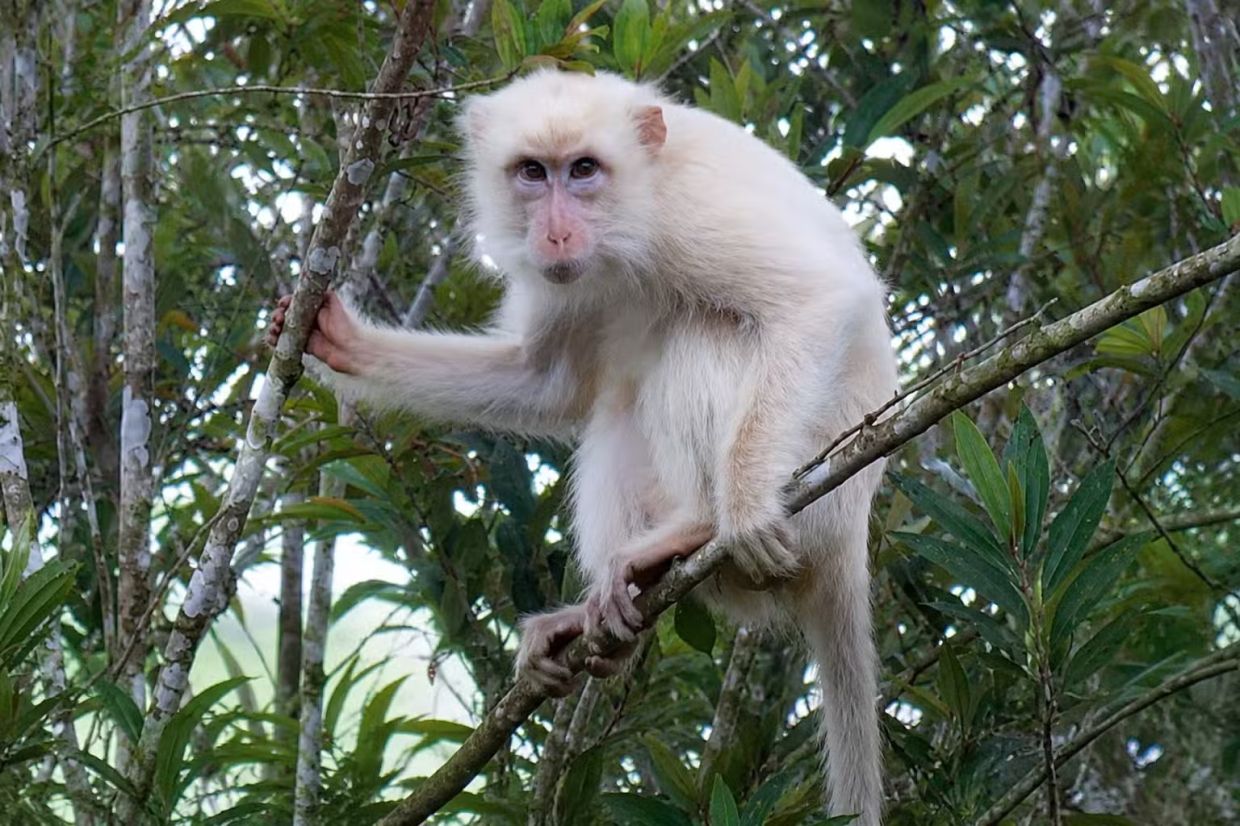
A striking white macaque that has inhabited a forested region of Sultan Kudarat province in the southern Philippines for nearly a decade has become the unexpected focal point of a coordinated conservation initiative. The primate's remarkable appearance—starkly different from its brown-furred relatives in the same forest ecosystem—remained largely unknown beyond the immediate community until recent months when digital photographs and videos circulated rapidly across social media platforms. This sudden online visibility has prompted regional environmental authorities and local municipal officials to mobilize protective measures, recognising that public attention, while well-intentioned, poses genuine biological and security threats to the animal.
The macaque has been provisionally identified as a Philippine long-tailed macaque, a subspecies native to the archipelago, but with an unusual pigmentation anomaly that accounts for its whitish coloration. Initial assessments by observers suggested the condition might be albinism, a complete absence of melanin pigmentation. However, when the Department of Environment and Natural Resources Region XII dispatched a composite monitoring team to conduct field validation in the animal's forest habitat, they observed that the macaque possessed distinctly brown to dark brown eyes. This observation pointed toward alternative genetic conditions such as leucism, which produces reduced pigmentation while preserving normal eye coloration, or other related pigmentation disorders. DENR officials have emphasised that definitive scientific identification of the condition requires formal technical evaluation by wildlife geneticists and specialists, work that remains ongoing.
According to Armando, a long-time local resident, the unusual primate has been a familiar presence in the area since at least 2016, frequenting particular sections of secondary forest without attracting significant external attention. The animal's decade-long presence without incident suggests successful adaptation to its habitat and coexistence with the broader macaque population in the region. The problem emerged not from the macaque's behaviour but from the velocity and reach of social media amplification. As posts accumulated views and shares, environmental officials grew increasingly concerned about potential consequences. The heightened visibility created multiple risks: opportunistic hunters or wildlife collectors might be drawn to the area, overseas traffickers seeking exotic animals for illegal wildlife markets could become aware of the specimen's location, and irresponsible visitors seeking photographs or viral content could disrupt the macaque's natural patterns and stress the animal through unwanted contact.
The DENR's field team documented that despite human interest in the animal, its immediate forest environment remains ecologically sound. The secondary forest vegetation surrounding the macaque's regular territory provides adequate natural food sources and appropriate shelter, supporting not only this individual primate but the broader resident macaque population. This positive environmental assessment provided some reassurance that habitat degradation was not an imminent threat, allowing authorities to concentrate their protective efforts on managing human access and preventing extraction of the animal from its native ecosystem.
In response to the conservation threat, Senator Ninoy Aquino municipality and the Department of Environment and Natural Resources have implemented immediate access restrictions to the specific forest locations where the macaque is frequently observed. The temporary closure serves multiple purposes: it prevents casual visitors from approaching the animal, it creates a buffer against poachers and wildlife traffickers, and it reduces the cumulative stress on the primate from repeated human encounters. These measures represent a precautionary approach while longer-term institutional protections are being developed.
Barangay Bugso, the smallest administrative division where the macaque resides, is advancing the drafting of a dedicated ordinance that would establish permanent legal protection for the white macaque, its immediate habitat, and the broader forest ecosystem in which it lives. This localised legal framework would complement existing national wildlife protection legislation and create specific enforcement mechanisms tailored to the community's conservation objectives. Pending formal enactment of the ordinance, the barangay has maintained prohibition of unauthorised entry into the vicinity where the animal has been sighted, establishing a de facto protected zone even before legislative measures take effect.
Beyond restriction and prohibition, local authorities are pursuing active habitat enhancement and biodiversity conservation programmes. Barangay Bugso has organised tree-planting initiatives and forest restoration activities designed to strengthen the ecological resilience of the macaque's home territory and promote the overall health of the forest ecosystem. These projects serve the dual purpose of genuine environmental improvement while also channelling community energy and local support toward conservation goals. Simultaneously, officials are exploring the potential for responsible ecotourism development that would allow controlled, sustainable visitor engagement with the forest environment and its wildlife without compromising protection of the primate itself.
The Republic Act No. 9147, the Wildlife Resources Conservation and Protection Act, already provides comprehensive legal framework for wildlife defence across the Philippines. The law establishes that all native wildlife species are protected by default, prohibiting hunting, capture, collection, possession, transportation, trading, or deliberate disturbance without government-issued permits. Violation of these provisions carries criminal and administrative penalties. DENR officials have reminded the broader public that these legal protections apply absolutely to the white macaque, regardless of its unusual appearance or the interest it has generated online.
Recognising that social media has become a primary vector through which wildlife locations become compromised, environmental authorities have launched a public awareness campaign urging photographers, videographers, journalists, social media users, and residents to exercise responsibility in how they share wildlife observations. Specifically, DENR has appealed to content creators to avoid revealing precise geographic coordinates of species sightings, refrain from posting geotagged photographs that would allow others to pinpoint animal locations, and generally treat information about rare wildlife encounters as sensitive conservation data rather than entertainment content to be maximised for engagement and reach.
Looking forward, the Department of Environment and Natural Resources Region XII will formally submit comprehensive documentation regarding the white macaque to the national Biodiversity Management Bureau for expert technical evaluation and formal classification of the pigmentation condition. Simultaneously, regional authorities have committed to ongoing habitat monitoring to track the animal's health and behaviour, maintain coordination with municipal and barangay officials to ensure consistent implementation of protective measures, and conduct intensified public education campaigns designed to build community understanding of the value of wildlife protection and the practical steps individuals can take to support conservation objectives.
The white macaque's emergence from obscurity into the spotlight of social media attention illustrates a contemporary conservation paradox: visibility that generates public interest and potential support also creates vulnerability to exploitation and harm. What was once simply an unusual resident of Sultan Kudarat's forests has become a symbol around which local authorities, environmental agencies, and residents are attempting to rebuild a culture of wildlife respect and sustainable coexistence. Whether these coordinated efforts succeed in keeping the animal safe while allowing responsible appreciation of its ecological significance will likely offer lessons applicable to other rare species throughout the Philippines and broader Southeast Asia, where comparable pressures from digital connectivity are reshaping human-wildlife relationships.

