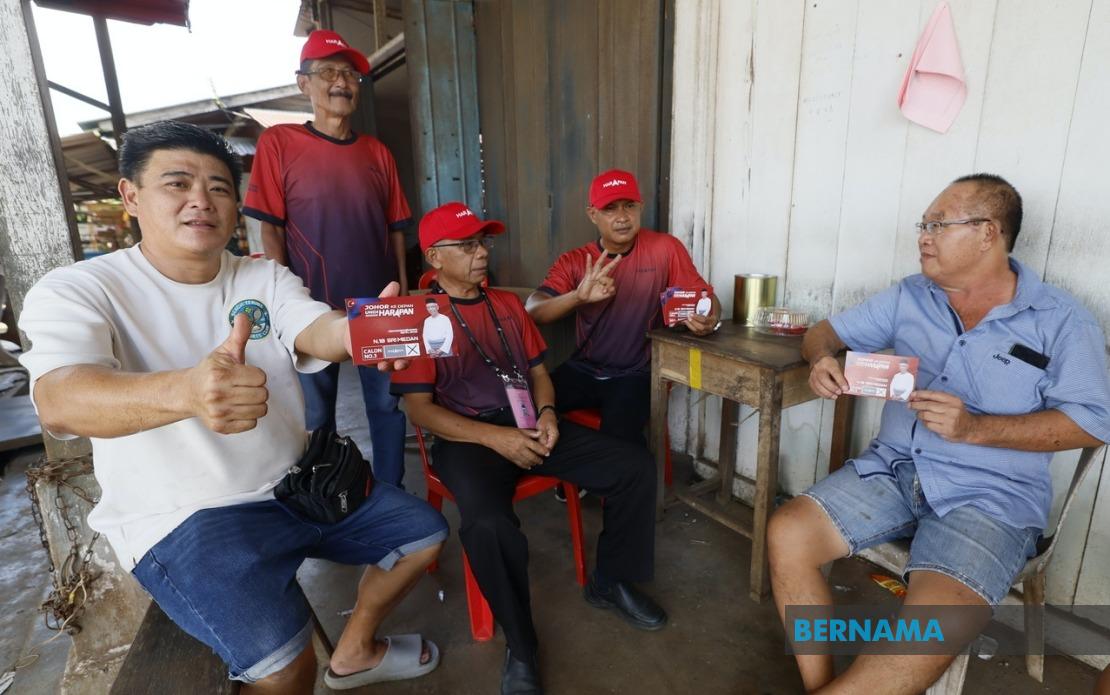
The Pakatan Harapan campaign in the Sri Medan state constituency is taking shape around the candidacy of Hishamudin @ Misrin Ishak, a former mathematics teacher who has built his political platform on direct engagement with residents and the principle of delivering results before making promises. With polling day set for July 11 in the 16th Johor State Election, Ishak has entered the final phase of campaigning with a grassroots strategy that emphasises listening to community grievances and responding with tangible action.
Known locally as "Cikgu Misrin", Ishak's approach reflects a deliberate attempt to differentiate the PH campaign from the established dominance of Barisan Nasional in what is traditionally regarded as a stronghold for the ruling coalition. His emphasis on a people-first agenda is not merely rhetorical—the candidate has specifically committed to tackling the recurring flood problems that have chronically affected residents in Sri Medan, an issue that touches directly on quality of life and government responsiveness. This focus on practical problem-solving addresses a legitimate source of frustration that has likely persisted through multiple election cycles.
The candidate's background as a village head provides him with administrative experience in managing community needs at the grassroots level, though moving from local village governance to state assembly representation represents a significant step up in political responsibility. Ishak frames this transition as a natural progression, leveraging his track record in community service to build credibility with voters sceptical of political newcomers. His stated commitment to serve all residents regardless of party affiliation suggests an attempt to appeal beyond traditional opposition supporters, particularly in a constituency where BN voters likely constitute the majority of the electorate.
Economic opportunity and youth development feature prominently in Ishak's campaign messaging, reflecting concerns shared across many Malaysian constituencies where younger voters worry about stagnating local economies and limited career prospects. His intention to organise programmes focused on Technical and Vocational Education and Training demonstrates awareness that not all school leavers pursue university education, and that skilled vocational pathways require targeted support and exposure. This commitment to digital education further acknowledges the necessity of preparing young people for an increasingly technology-driven employment landscape.
The candidate's emphasis on strengthening small and medium enterprises addresses another concern that resonates across regional Malaysia. By committing to help local entrepreneurs expand beyond dependence on purely local markets, Ishak is tackling a genuine structural weakness in many district economies. SMEs that rely solely on neighbourhood demand face stagnation, while access to wider markets requires infrastructure, networks, and support services that individual businesses cannot typically develop alone. This represents a more sophisticated understanding of economic development than simple promises of investment.
Balanced infrastructure development across urban, semi-urban, and rural areas forms another pillar of Ishak's platform. This reflects awareness that concentrating resources in town centres creates grievances in peripheral areas, a pattern that has historically fuelled opposition support in rural constituencies. By explicitly committing to equitable resource distribution, he is signalling responsiveness to the specific needs of different community segments within the Sri Medan electorate.
The phrase "work first, talk later" encapsulates Ishak's campaign narrative—a rejection of what he implicitly characterises as empty political rhetoric in favour of demonstrated results. This rhetorical stance is particularly potent in Malaysian politics, where voters have developed considerable scepticism toward unfulfilled election promises. However, translating this principle into actual governance requires not only commitment but also the political capital and bureaucratic leverage that comes with serving in government, resources that backbenchers in opposition parties often lack.
Running against both Barisan Nasional incumbent Datuk Zulkurnain Kamisan and Perikatan Nasional candidate Ahmad Rosdi Bahari, Ishak faces a three-way contest in what appears to be a divided opposition field. This configuration potentially advantages the BN incumbent, as opposition votes split between PH and PN candidates. The early voting opportunity on July 7 preceding the main polling date on July 11 introduces an additional variable in campaign strategy and voter mobilisation efforts.
The candidate's characterisation of voter response as "encouraging" during the early campaign period should be read cautiously—such optimism is standard for candidates in active campaigning, and Sri Medan's historical voting patterns suggest that overcoming BN's structural advantage will require exceptional circumstances or significant shifts in voter sentiment. That Ishak continues to emphasise remaining "positive" while acknowledging the constituency's BN stronghold status suggests realistic awareness of the challenge ahead, tempered by determination to contest seriously rather than yield to the incumbent.
The distinction Ishak draws between his position as a "fresh face" and the established presence of the incumbent is a double-edged strategy. While new candidates can benefit from not being associated with previous political failures or unpopular policies, they also lack a proven track record in state assembly work. Voters in established strongholds often prioritise demonstrated effectiveness in securing resources and services over the appeal of novelty, which may explain why opposition candidates struggle in such constituencies regardless of their personal qualities.
For PH at the state level in Johor, the Sri Medan campaign represents one component of a broader attempt to make electoral inroads in a state where the coalition faces significant structural disadvantages. The campaign's emphasis on concrete local issues—flooding, youth employment, business development, infrastructure equity—reflects a strategic choice to compete on practical governance competence rather than grand ideological narratives. Whether this ground-level approach generates sufficient momentum to overcome incumbency advantage and split opposition voting remains uncertain as the election approaches.

