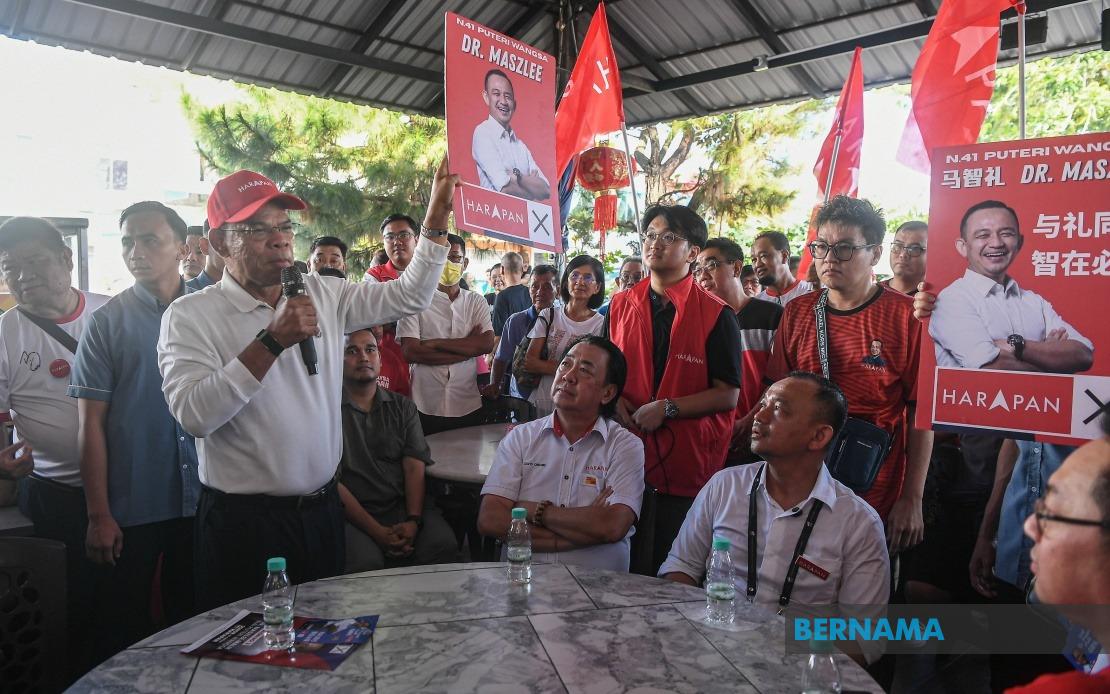
Pakatan Harapan is experiencing a notable surge in public backing for the Johor state election, with party leadership attributing the momentum to a sophisticated, constituency-by-constituency campaign strategy that prioritizes resources based on real-time support patterns on the ground. The coalition's approach reflects a more granular understanding of electoral dynamics, moving beyond blanket messaging to address the specific concerns and political composition of each of the 56 contested seats.
Datak Seri Saifuddin Nasution Ismail, serving as both PH's secretary-general and PKR's joint election director, outlined the mechanics of this strategy during a campaign engagement with Chinese community leaders in Johor Bahru. Rather than treating all constituencies as equal, PH has developed a tiered rating system that categorizes seats into priority clusters, enabling the coalition to deploy campaign resources, candidate attention, and messaging with surgical precision. This approach recognizes that constituencies such as Puteri Wangsa and Johor Lama operate under vastly different political contexts, demographic compositions, and voter priorities that demand tailored engagement strategies.
The method signals a departure from traditional Malaysian campaign approaches, which have historically relied on more uniform, top-down messaging strategies. By acknowledging internal diversity within the state's electoral landscape, PH's campaign apparatus suggests an institutional capacity to process voter sentiment data and adjust tactical deployment accordingly. For Malaysian observers, this represents a notable evolution in how major political coalitions operationalize campaign machinery, particularly among opposition-aligned parties that have historically labored under resource constraints compared to ruling administrations.
Beyond its internal campaign refinement, PH's momentum has been inadvertently amplified by strategic missteps from competing political forces. Saifuddin Nasution highlighted PAS's decision to contest only eleven of the 56 seats while effectively directing supporters toward Barisan Nasional in remaining constituencies as a significant factor working against the latter's electoral prospects. This move has created political space for PH to position itself as the unified, credible alternative to the traditional BN governing model. The contrast is rendered more stark by PH's comprehensive approach of fielding candidates across all seats, signaling confidence and commitment to Johor voters rather than conceding territory.
Transparency in seat allocation has become a tangible campaign asset for the coalition. Where rival parties have engaged in complex negotiations that confuse voters about coalition coherence and direction, PH has published its seat distribution plainly: PKR contesting twenty seats, Amanah nineteen, and DAP seventeen. This clarity extends to the coalition's manifesto commitments, which party leadership describes as realistic and implementable rather than aspirational rhetoric detached from governance realities. For voters weary of political posturing, such directness appears to carry electoral value in an environment where public trust in political institutions remains fragile across Malaysia.
The presence of Datuk Dr Mohd Puad Zarkashi, a former UMNO Supreme Council member, at recent talks with Prime Minister Datuk Seri Anwar Ibrahim in Felda Ulu Tiram underscores another dimension of PH's campaign positioning. The participation of established figures previously associated with dominant political structures provides reassurance to swing voters concerned that PH represents radical or destabilizing change. This cross-party engagement, orchestrated at the highest level, signals institutional stability and suggests that PH's governance would incorporate experienced technocrats rather than relying exclusively on relative newcomers to executive administration. For Malaysian voters with memories of previous political transitions, such signals matter considerably.
The candidate profile for PH's Puteri Wangsa seat exemplifies the coalition's calibrated approach to constituency representation. Dr Maszlee Malik, described by Saifuddin Nasution as a qualified candidate and strategic asset, brings professional credentials that extend beyond typical party loyalist profiles. This emphasis on candidate quality, regardless of party affiliation, suggests PH's leadership recognizes that winning the Johor election requires appealing beyond core supporters to uncommitted voters evaluating which coalition can credibly deliver competent governance at state level.
The electoral mathematics of the Johor state election underscore its significance for Malaysian political trajectories. With one hundred seventy-two candidates contesting across fifty-six seats, the polling exercise will determine whether PH can consolidate its federal electoral coalition into durable state-level dominance. The result will provide crucial data on whether PH's 2022 federal breakthrough represents enduring realignment or temporary voter protest against BN's dominance. For investors, business communities, and ordinary Malaysians watching political stability indicators, Johor's outcome will signal whether Malaysia's political system is transitioning toward more competitive two-coalition dynamics or reverting toward previous patterns.
Polling day is scheduled for July 11, with early voting occurring July 7. The compressed election timeline reflects Malaysia's constitutional framework and the bargained political settlement that enabled the coalition government's formation. Unlike the uncertain delays that sometimes characterize Malaysian electoral administration, the published schedule provides all contending parties with clear timelines for final campaign pushes and voter mobilization. This clarity itself represents an understated institutional improvement over previous administrations that sometimes weaponized electoral scheduling uncertainty.
For Southeast Asian political observers, the Johor election represents a test case of how opposition-led coalitions deploy modern campaign techniques within institutional frameworks designed historically to advantage incumbent parties. PH's prioritization strategy, transparency approach, and recruitment of cross-party figures reflect adaptations to operating as a governing force rather than merely an opposition formation. The coalition must now demonstrate whether its campaign sophistication translates into state administrative performance that justifies voters' electoral gambles and sustains the political realignment that began with the 2022 federal election.

