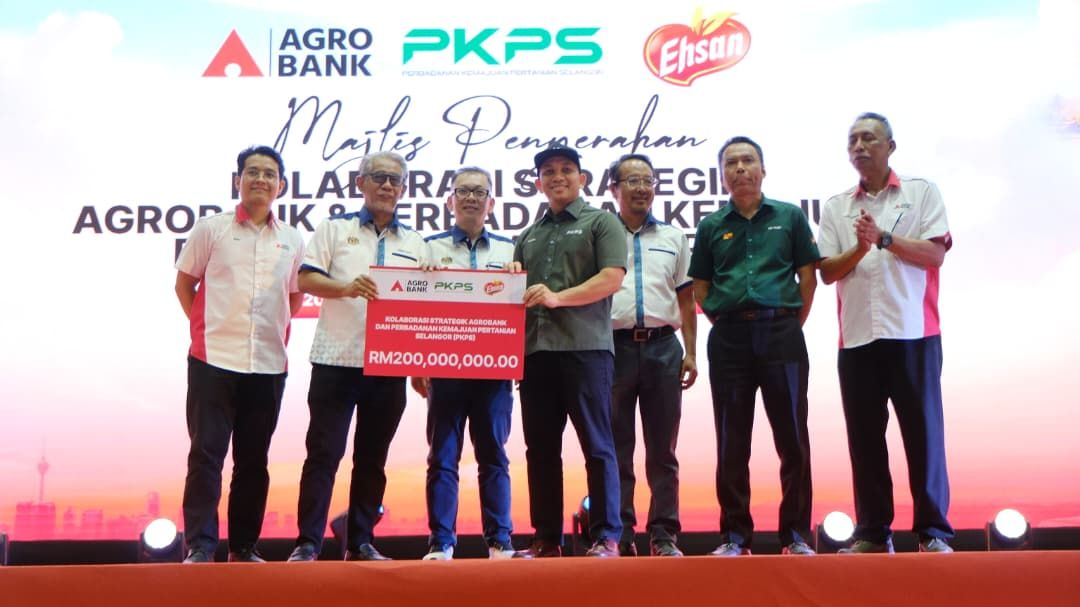
A RM200mil financing arrangement between the Selangor Agricultural Development Corporation (PKPS) and Agrobank marks a significant step in strengthening the state's food production and distribution capabilities. Formalised at the Malaysia Agriculture, Horticulture and Agrotourism Exhibition (MAHA) 2026, the partnership targets infrastructure expansion, operational funding and research initiatives designed to make Selangor's agrifood ecosystem more efficient and resilient against future supply chain disruptions.
The facility addresses a critical gap in agricultural financing for large-scale infrastructure projects. Agrobank group president and chief executive officer Datuk Tengku Ahmad Badli Shah Raja Hussin presented the arrangement to PKPS group chief executive officer Datuk Dr Mohamad Khairil Mohamad Razi during a symbolic handover ceremony at Malaysia Agro Exposition Park Serdang on August 29, with Deputy Agriculture and Food Security Minister Datuk Chan Foong Hin in attendance. The formal activation is scheduled for March 2027, allowing both institutions time to refine operational procedures and establish disbursement protocols.
The centrepiece of this initiative is construction of a state-of-the-art halal food warehouse complex. This facility will function as a critical logistics and storage hub, consolidating Selangor's food handling and distribution operations in compliance with halal standards. For Malaysian businesses, halal certification represents not merely religious compliance but a significant competitive advantage in regional and international markets. By establishing dedicated halal infrastructure, PKPS strengthens Selangor's position as a reliable supplier to Muslim-majority markets across Southeast Asia and beyond, directly supporting export-oriented agribusinesses.
Beyond the flagship warehouse, the financing structure encompasses several complementary ventures that form an integrated agrifood ecosystem. A halal chicken processing centre will modernise poultry handling and value addition, while an Ehsan product processing facility will develop ready-to-eat and ready-to-heat offerings under the state's established brand. These ventures reflect evolving consumer preferences toward convenience foods and processed products, particularly in urban markets. Central distribution warehouses across Selangor's districts will enhance last-mile logistics, reducing waste and ensuring fresher produce reaches retailers and consumers more rapidly.
The partnership's scope extends significantly beyond bricks and mortar. Approximately RM200mil will fund operational requirements including working capital for PKPS's day-to-day activities, research initiatives and human capital development. The Ehsan Agricultural Research Centre will intensify smart agriculture research, leveraging technologies such as precision farming, data analytics and climate-adaptive crop varieties. These research efforts position Selangor farmers to adopt more sustainable practices while improving yields, directly addressing Malaysia's broader food security objectives amid climate uncertainty and shifting global trade patterns.
Workforce development forms an integral pillar. The Ehsan Agricultural Training Centre will build technical capacity among agricultural practitioners, processors and logistics personnel. As Malaysia's agrifood sector becomes increasingly technology-dependent, investments in human capital prove as essential as physical infrastructure. Training programmes aligned with industry standards ensure workers can operate modern processing equipment, implement food safety protocols and manage supply chain data systems effectively.
Agritourism development at the Ehsan Resort and Convention Centre represents an innovative cross-sector approach. By combining agricultural production with tourism and hospitality services, PKPS creates additional revenue streams while raising public awareness about sustainable farming practices. For Malaysian tourists and regional visitors, agritourism experiences offer educational value and authentic encounters with local food production systems, while generating income for farming communities.
The financing mechanism itself reflects best practices in development banking. Disbursements will occur in stages tied to project progress, ensuring disciplined capital management and preventing resource wastage. This structured approach protects both PKPS and Agrobank by maintaining transparency throughout the partnership period and creating accountability checkpoints. For Malaysian policymakers observing the arrangement, this model demonstrates how public agricultural corporations and financial institutions can collaborate effectively to channel capital toward productive, measurable outcomes.
The timing aligns strategically with national food security priorities. Malaysia faces structural challenges including land scarcity, competing land uses and dependence on food imports. Selangor, as the nation's most developed state and economic engine, carries disproportionate responsibility for feeding its dense population. By concentrating investment in agrifood infrastructure and modernisation, PKPS and Agrobank address supply chain vulnerabilities identified repeatedly in government assessments. Enhanced local production capacity reduces reliance on imports and buffers against international price volatility and supply disruptions.
The partnership's framing around MAHA 2026's theme—"Value Creation for Food Security"—emphasises sustainable investment and technological advancement rather than exploitative agricultural expansion. This distinction matters increasingly in Southeast Asia, where environmental degradation and resource depletion threaten long-term agricultural viability. By promoting smart agriculture, research-driven innovation and efficient logistics, PKPS positions itself within global agricultural megatrends favouring sustainability and resilience.
For Malaysian agribusinesses operating in Selangor, the facility opens access to institutional financing previously concentrated in general-purpose bank channels. Processors, distributors and farmers aligned with PKPS initiatives can access capital for modernisation and expansion under terms reflecting agricultural sector realities, including seasonal cash flows and extended project timelines. This targeted financing reduces barriers to upgrading production and handling capabilities.
Regionally, Selangor's enhanced agrifood capacity strengthens ASEAN food security. As supply chains diversify away from traditional concentrated sources, states developing resilient domestic production gain strategic importance. Malaysian businesses supplying halal products, processed foods and agricultural technology to neighbouring economies benefit from demonstrated investment in quality infrastructure and standards compliance.
Looking forward, the PKPS-Agrobank partnership establishes a template for scaling agricultural development financing. Success at Selangor could prompt similar arrangements involving other state agricultural corporations and financial institutions, progressively addressing Malaysia's food security challenge through coordinated infrastructure investment. The March 2027 launch will provide early evidence of execution capability and project delivery under this partnership model, informing broader adoption across Malaysian agriculture.

