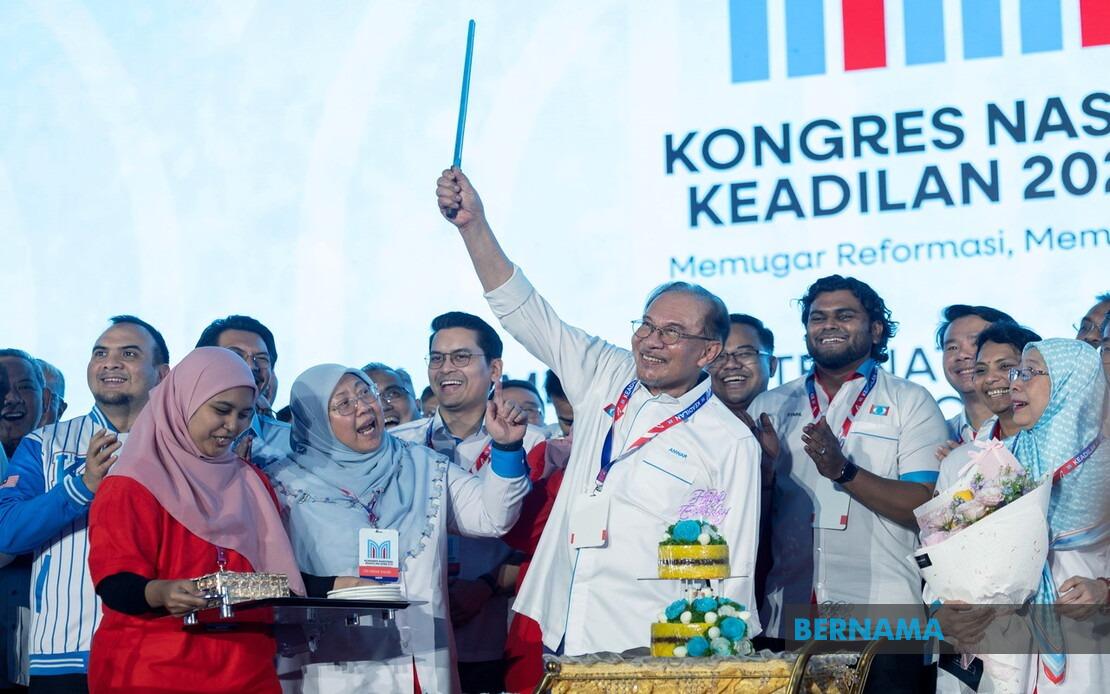
The People's Justice Party (PKR) concluded its 2026 national congress in Melaka on August 16 with senior party figures emphasising that maintaining political stability under the current Unity Government need not come at the expense of the party's foundational reform credentials. The two-day gathering brought together party delegates to articulate PKR's strategic positioning as both a stabilising force within the governing coalition and a vehicle for systemic change, a balancing act that has defined the party's governing tenure since 2022.
Party president Datuk Seri Anwar Ibrahim, addressing the congress in his closing remarks, committed PKR to defending the multi-party cooperation framework that underpins the Unity Government, framing political equilibrium as essential to sustained economic expansion and improved living standards. Anwar, who also chairs Pakatan Harapan, signalled that his personal stance favours continuity of the coalition arrangement, though he candidly acknowledged that the trajectory of this partnership ultimately rests with UMNO's and Barisan Nasional's strategic choices. This frank articulation reflects the precarious nature of Malaysia's current political settlement, where the dominant party in the ruling alliance retains substantial discretionary power over the coalition's longevity.
Anwar issued a pointed warning to all coalition partners against unilateral actions that might jeopardise the government's stability, characterising the Unity Government as a product of pragmatic political maturity and national-interest calculations rather than ideological affinity or electoral arithmetic alone. The emphasis on restraint suggests underlying tensions within the broad coalition, signalling to dissenting voices within each party that adventurism could imperil the entire arrangement. This cautionary tone underscores how fragile consensus-based governance can be when forged among historically antagonistic political forces.
PKR deputy president Nurul Izzah Anwar articulated a crucial challenge facing the party: sustaining its reform identity while shouldering the responsibilities of executive power. She contended that PKR must advance structural and policy reforms across the party, state administration, and government programmes to preserve the transformative ideals that motivated PKR's founding, ensuring these principles remain a living framework rather than historical artifact. To illustrate this commitment, she cited the repeal of the Universities and University Colleges Act (AUKU) 1971, a longstanding PKR objective achieved after the party entered government—a tangible example of how governing power can advance reform objectives when wielded strategically.
Anwar elaborated on the AUKU matter, pledging that the government would not substitute the repealed act with successor legislation imposing fresh restrictions on student activism and campus expression. Instead, he argued, existing criminal law provisions already furnish adequate tools to address misconduct, with students subject to identical legal scrutiny as all citizens. This stance represents PKR's assertion that genuine liberalisation—rather than merely reshuffling regulatory frameworks—embodies the reform spirit the party champions. The position also signals to the party's base and civil society constituencies that PKR's influence within government is being deployed to resist the re-imposition of control mechanisms, even as the party moderates some of its more radical rhetoric.
Education Minister Fadhlina Sidek, serving also as PKR's women's chief, pressed the party to maintain organisational vigour and readiness across all political scenarios, avoiding complacency regardless of parliamentary timelines or electoral uncertainty. She simultaneously called for amplified female participation in senior party and government roles, recognising that governance quality and legitimacy benefit from broader representation. Fadhlina further advocated for cultivating a culture within party and ministerial structures where criticism is welcomed and incorporated, positioning openness to feedback as a governance principle rather than an organisational weakness.
The congress also shone a spotlight on youth and emerging-sector priorities through the Angkatan Muda Keadilan (AMK) platform, which highlighted efforts to expand Bumiputera participation in cutting-edge technology domains including artificial intelligence, semiconductor manufacturing, and biotechnology. This focus reflects recognition that Malaysia's economic resilience increasingly depends on developing homegrown capacity in sectors that will define the next generation's prosperity. Alongside sectoral development, AMK raised contemporary workplace and social concerns: formalising protections for gig economy participants, strengthening social safety nets for precarious workers, establishing skills pathways aligned with labour-market transformation, and addressing mental health and broader psychosocial well-being among young Malaysians—issues that national policy has historically underweighted.
The congress proceedings illustrated PKR's deliberate effort to project organisational readiness independent of external political triggers, signalling to members and observers that the party maintains its own strategic agency rather than passively awaiting parliamentary dissolution announcements or electoral timetables set by other actors. This posture carries significance within Malaysia's coalition government, where internal party preparedness can influence the timing and terms of political realignments. By emphasising that PKR operates from a position of organisational strength and forward planning, the party seeks to establish that any future political adjustments would occur on terms reflecting PKR's interests, not merely accommodation to pressures from larger coalition partners.
The gathering ultimately conveyed PKR's calculation that the party can discharge governing responsibilities while preserving a reform-oriented identity and advancing measurable policy changes. Whether this simultaneity proves sustainable depends substantially on circumstances beyond PKR's control—particularly economic performance, inter-coalition dynamics, and the patience of the party's base for incremental versus transformative change. The congress messaging suggests PKR is preparing its membership for a prolonged period of coalition governance, institutionalising the party's role within the existing framework while maintaining that this arrangement need not foreclose meaningful reform or progressive policymaking.

