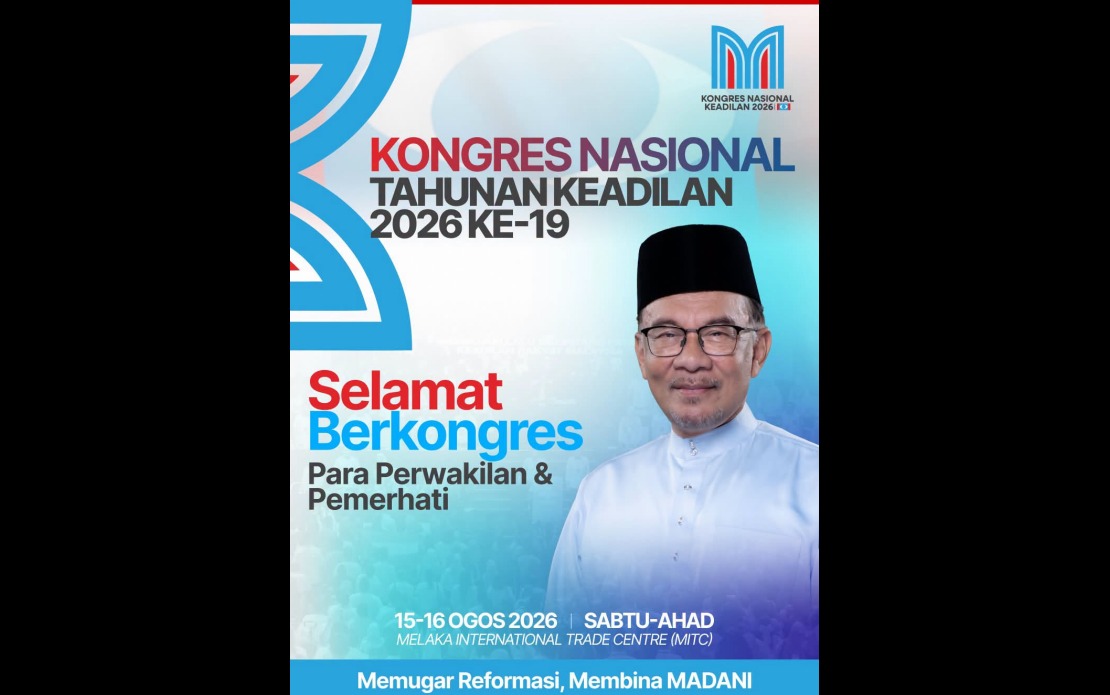
Prime Minister Datuk Seri Anwar Ibrahim has issued a forthright reminder to Parti Keadilan Rakyat that the party's core mission must transcend electoral ambitions, insisting instead that PKR should function as a genuine mass movement anchored to integrity, social justice and public trust. Speaking ahead of the party's National Congress 2026, Anwar emphasised that these foundational values remain essential as Malaysia navigates an increasingly complex political terrain and that the party's identity cannot be reduced to a mere vehicle for capturing votes.
The PKR president articulated his vision through a Facebook statement released on August 14, framing the upcoming congress as a critical juncture for the party to recalibrate its direction. Anwar's message carries particular weight given his dual role as both party leader and sitting Prime Minister, positioning his remarks not merely as internal party guidance but as a statement of national political philosophy. The emphasis on maintaining PKR's character as a mass movement reflects ongoing tensions within Malaysian politics around whether political parties should prioritise grassroots mobilisation and ideological consistency or adapt pragmatically to electoral realities.
The two-day PKR National Congress 2026 is scheduled to commence at the Melaka International Trade Centre in Ayer Keroh, with the Congress operating under the thematic banner "Memugar Reformasi, Membina MADANI"—a deliberate invocation of both the historical reformasi movement that birthed PKR and the current MADANI framework that characterises the administration's broader policy direction. This thematic choice signals an intentional effort to reconnect the party with its foundational narrative whilst simultaneously tethering that legacy to contemporary governance priorities. The congress has been positioned by party officials as an indispensable platform for organisational renewal and strategic consolidation at a moment when Malaysian politics remains volatile.
Anwar's insistence that PKR must function as a mass movement rather than merely an electoral apparatus addresses a perennial challenge facing governing parties across Southeast Asia. Once liberation or reform movements enter government, they frequently face pressure to compromise their original principles to maintain coalitional relationships and administrative effectiveness. In Malaysia's case, PKR's involvement in the Pakatan Harapan coalition and subsequent participation in various government formations has tested the party's ability to maintain ideological coherence whilst managing the pragmatic demands of governing. Anwar's statement can be read as an acknowledgement of these tensions and an attempt to recalibrate the party's internal culture.
The congress serves as a venue for what Anwar characterised as organisational introspection, allowing party delegates to evaluate achievements accumulated thus far and fortify commitment to the reformasi agenda that remains central to PKR's identity. This introspective function proves particularly valuable given that Malaysian political landscapes shift rapidly, with parties regularly reconfiguring their alliances and policy positions. By creating space for such internal reflection, congress delegates can reassess whether current strategies align with founding principles and whether adaptations remain authentic to core values or represent problematic compromises.
Anwar's invocation of social justice and dignity as central party pillars is noteworthy in contemporary Malaysian politics, where discussions around these concepts often become compartmentalised into specific constituencies or policy domains. By positioning these values as fundamental to PKR's identity rather than merely policy preferences, Anwar attempts to elevate them to the status of constitutional principles that should guide the party's behaviour across all domains. This framing suggests that questions of social justice should inform not merely welfare policy but also internal party governance, candidate selection, and coalition-building decisions.
The congress timing also carries significance for Malaysia's broader political trajectory. With electoral cycles approaching and various state-level considerations, the congress provides an opportunity for PKR to project unity and ideological clarity to both internal membership and the broader electorate. In a political environment where voter confidence has been periodically eroded by perceptions of opportunism or unprincipled coalition-building, reaffirming commitment to foundational values serves important legitimacy functions. For Malaysian voters sceptical of political parties generally, such reaffirmations offer potential grounds for renewed engagement, though their credibility ultimately depends on observable alignment between rhetoric and practice.
The congress agenda reflects broader regional trends in how political movements negotiate the tension between revolutionary or reformist origins and governing responsibilities. Across Southeast Asia, parties born from anti-establishment movements—whether Indonesia's PKB, Thailand's various democracy-oriented parties, or the Philippines' reform movements—face similar pressures. The Malaysian case offers instructive lessons about how sitting leaders can use party forums to reassert ideological commitment whilst maintaining governmental effectiveness. Anwar's approach, emphasising internal renewal rather than reactive adaptation, potentially offers a model for balancing these competing demands.
Anwar's scheduled delivery of a policy speech during the congress represents the substantive dimension of his message. Rather than merely articulating principles in abstract terms, the Prime Minister will articulate specific strategic agendas and programmatic directions that presumably demonstrate how PKR's foundational values translate into concrete governance priorities. This speech will prove crucial in determining whether his emphasis on mass movement principles carries practical implications for party operations or remains rhetorical positioning. Malaysian political observers will scrutinise whether announced strategies genuinely prioritise social justice and popular mobilisation or whether they accommodate predominantly elite-centric governance preferences.
For Malaysia's broader political development, PKR's positioning as either a mass movement or electoral machine carries implications beyond party internal dynamics. The character of governing parties influences the overall quality of democratic practice, accountability mechanisms, and policy responsiveness. If PKR successfully maintains its mass movement character whilst governing, it potentially models an alternative to the party-as-electoral-machine approach that characterises some other Malaysian political entities. Conversely, if principled commitments prove difficult to sustain under governance pressures, the congress may represent an aspirational moment whose ideals become compromised through subsequent implementation.
The gathering also reflects broader considerations about Malaysia's political maturation and institutional development. As democratic societies age, early movements' capacity to remain true to founding principles whilst managing complex governance responsibilities becomes increasingly significant. PKR's congress therefore transcends party-specific importance and speaks to larger questions about how Malaysia navigates the relationship between idealism and pragmatism in its political development. The congress's deliberations and outcomes will likely influence how subsequent Malaysian political movements balance similar tensions.

