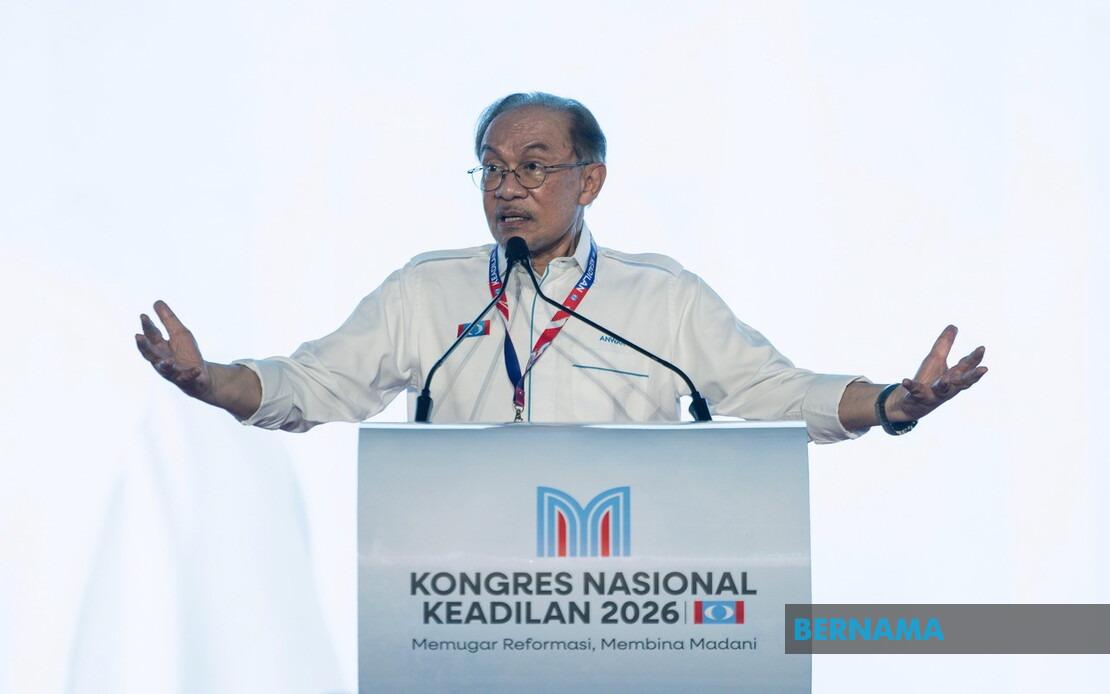
Prime Minister Datuk Seri Anwar Ibrahim has unveiled a new initiative allocating an additional RM1 million to every parliamentary constituency across Malaysia, marking a significant shift in how the government channels development funding to the grassroots level. The announcement, made during his closing address at the 2026 PKR National Congress at the Melaka International Trade Centre, signals the MADANI Government's intention to accelerate the delivery of assistance to address pressing community concerns without being impeded by complex administrative procedures. This direct allocation mechanism seeks to empower local parliamentary representatives to respond more swiftly to welfare needs, basic infrastructure deficiencies, and other immediate community priorities that would ordinarily require lengthy approval processes.
The additional funding complements a broader social safety net that the government has constructed over recent years. Anwar, speaking simultaneously in his capacity as Finance Minister, emphasised that existing initiatives including Sumbangan Tunai Rahmah (STR) and Sumbangan Asas Rahmah (SARA) have collectively mobilised RM16 billion in direct and targeted assistance. Rather than replacing these established programmes, the new RM1 million constituency allocation is designed to work alongside them, providing flexibility for local decision-making that better reflects the specific circumstances and vulnerabilities within each electoral division. This layered approach acknowledges that national poverty statistics, while showing improvement, obscure pockets of acute need that require community-level understanding to address effectively.
The government has emphasised its progress in poverty reduction, with the hardcore poverty rate now standing at 0.09 per cent. However, this macroeconomic achievement has prompted debate about whether such gains have adequately translated into tangible improvements in the lived experience of ordinary Malaysians, particularly given persistent cost-of-living pressures. Anwar framed the latest initiative as a bridge between headline economic indicators and microeconomic realities experienced at the household and community level, suggesting that government success must ultimately be measured by whether citizens can afford food, housing, and essential services. The allocation therefore represents an acknowledgment that conventional top-down resource distribution may not optimally address the heterogeneous needs across Malaysia's diverse constituencies.
By lodging decision-making authority at the constituency level, the government is effectively redistributing a degree of spending power away from federal bureaucracies towards elected representatives with direct voter accountability. This structural shift carries implications for how politicians engage with their constituents and how resources are prioritised across competing local interests. Parliamentary representatives now possess both the opportunity and responsibility to demonstrate tangible benefits to their voters, potentially intensifying local political competition based on the effectiveness of resource deployment. For constituencies represented by opposition members, this framework may generate pressure to justify spending decisions to constituents who may harbour partisan concerns about fair allocation.
The timing of this announcement, delivered at a PKR party congress rather than in Parliament or through a formal government statement, reflects the political context within which the MADANI Government operates. As an Anwar-led administration governing with coalition support, the government faces persistent scrutiny regarding its commitment to addressing grassroots economic anxieties that feature prominently in public discourse and opinion polling. By positioning this allocation as evidence of tangible government commitment to ordinary Malaysians, the Prime Minister signals responsiveness to complaints that development benefits remain concentrated in urban areas or benefit only certain demographic groups. The measure implicitly acknowledges that perception gaps exist between what the government believes it has achieved and what citizens feel they have experienced.
The announcement also reflects broader trends across Southeast Asia regarding decentralisation and grassroots development funding. Countries throughout the region have experimented with direct allocation mechanisms designed to bypass traditional bureaucratic channels and enhance local agency in development prioritisation. Malaysia's initiative echoes similar experiments with community-directed development funds, though questions persist about whether such mechanisms genuinely empower local communities or primarily benefit connected local elites who navigate resource distribution. The effectiveness of the RM1 million allocation will ultimately depend on transparency mechanisms, oversight procedures, and whether mechanisms exist to ensure that vulnerable populations—rather than better-organised or better-connected groups—benefit from disbursements.
Anwar's remarks emphasised the importance of party machinery mobilising at branch and grassroots levels to explain government initiatives and ensure that assistance reaches intended beneficiaries. This framing acknowledges an implementation gap that exists in many developing democracies: citizens frequently remain unaware of available support or lack knowledge about access procedures. The PKR leader explicitly called upon party structures to bridge this information asymmetry, suggesting that the government views political party organisations as crucial conduits for welfare distribution. This reliance on party machinery raises questions about whether assistance reaches recipients based on administrative efficiency or partisan affiliation, concerns that have historically complicated welfare distribution in Malaysia's political economy.
The government's broader poverty-reduction strategy encompasses multiple policy instruments targeting different income groups. References to school assistance, subsidised Rahmah sales, and housing financing support indicate an attempt at comprehensive coverage spanning bottom-40 (B40) and middle-40 (M40) income groups. This inclusive framing suggests policy-makers recognise that economic vulnerability extends beyond absolute poverty into precariat populations struggling to maintain middle-class status amid inflation and wage stagnation. By articulating support across income segments rather than concentrating exclusively on the poorest households, the government signals an understanding that electoral coalitions require addressing anxieties across a broader swath of the population than traditional poverty-focused programmes would reach.
For Malaysian readers across diverse economic circumstances, the RM1 million per-constituency allocation carries different meanings depending on local context. Urban constituencies with larger populations may view the sum as modest relative to concentrated needs, while rural divisions might regard it as substantial development capital. Sectoral allocation—whether funds prioritise education, infrastructure, welfare, or economic development—will determine actual impact on communities. The absence of specified allocation guidelines suggests flexibility for local determination, which could either enhance responsiveness or enable misuse depending on governance quality and oversight capacity at the parliamentary constituency level. As this initiative unfolds, scrutiny of how individual constituencies deploy funds will provide empirical evidence regarding the effectiveness of grassroots-level direct allocation as a poverty-reduction and service-delivery mechanism.

