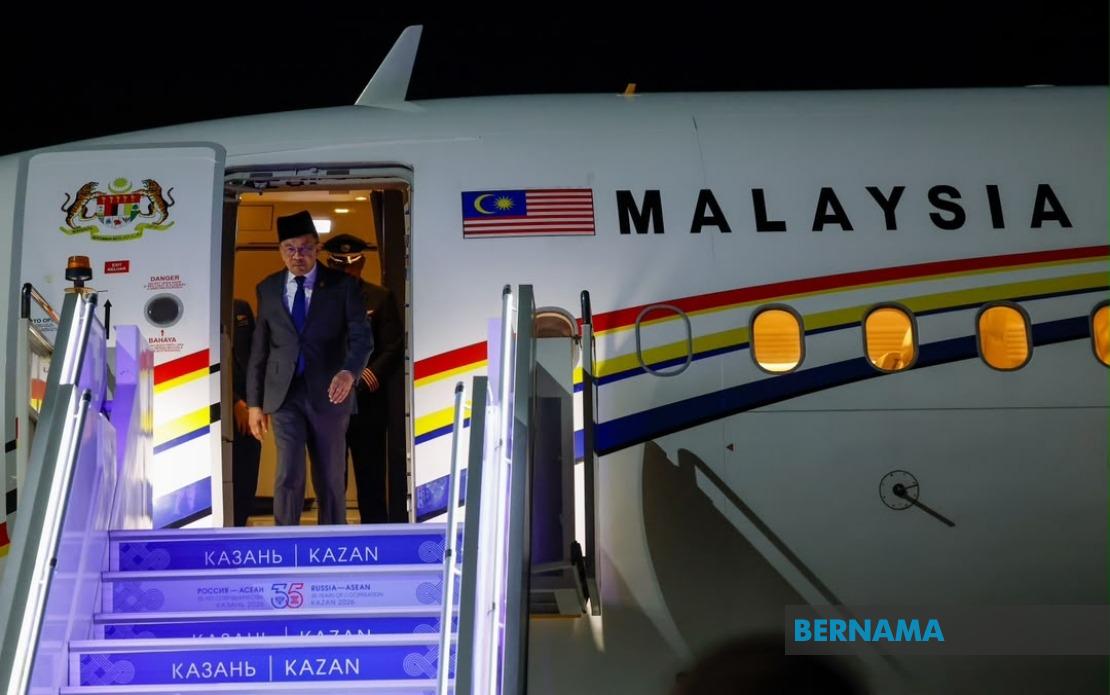
Prime Minister Datuk Seri Anwar Ibrahim has touched down in Kazan to participate in a milestone diplomatic gathering that underscores Malaysia's pivotal role in shaping Southeast Asia's relationship with Russia. The prime minister's aircraft landed at Kazan International Airport late on June 16, positioning him for the two-day ASEAN-Russia Commemorative Summit beginning June 17. This engagement comes at a juncture when regional geopolitics is increasingly complex, making forums bringing together ten Southeast Asian nations and Moscow more significant than ever for building understanding and cooperation across traditional divides.
The delegation accompanying Anwar reflects the multifaceted nature of the discussions expected in Kazan. Alongside him are Minister of Investment, Trade and Industry Datuk Seri Johari Abdul Ghani and Minister of Economy Akmal Nasrullah Mohd Nasir, signalling that Malaysia intends to pursue tangible economic outcomes from the summit. The presence of these economic portfolios suggests discussions will extend beyond ceremonial gestures into substantive areas where Southeast Asian nations and Russia can identify mutual advantage. Malaysia's Ambassador to Russia Datuk Cheong Loon Lai received Anwar upon arrival, while the Russian reception committee included Ilya Nachvin, Minister of Digital Development of Tatarstan, and Kazan Mayor Ilsur Metshin, reflecting the host republic's commitment to the engagement.
The summit gains particular significance as it marks 35 years since ASEAN and Russia formalised diplomatic relations in Kuala Lumpur during 1991. Three decades of engagement have seen the relationship evolve from Cold War-era suspicion to structured cooperation across numerous sectors. This anniversary provides ASEAN an opportunity to assess how effectively the bloc has leveraged its relationship with a major Eurasian power, particularly as the regional organisation positions itself as the fulcrum of Indo-Pacific stability. For Malaysia, which holds significant influence within ASEAN consensus-building processes, the summit presents a platform to shape dialogue frameworks that serve broader Southeast Asian interests.
According to the Ministry of Foreign Affairs, substantive discussions will encompass an expansive agenda addressing contemporary regional and global challenges. Trade and investment cooperation sits at the forefront, reflecting mutual recognition that economic interdependence can anchor stability. Energy security represents another critical dimension, particularly relevant as Southeast Asian nations navigate complex supply dynamics amid geopolitical tensions. Food security cooperation also features prominently, acknowledging that agricultural supply chains and commodity markets increasingly transcend bilateral concerns to affect regional food price stability and consumer welfare. The digital economy and technological advancement round out economic priorities, areas where cooperation can generate spillover benefits for smaller economies within ASEAN.
Beyond commerce, the summit will address soft power dimensions including cultural exchanges, educational partnerships and people-to-people connectivity. These dimensions often escape headline attention but constitute the connective tissue preventing diplomatic relationships from becoming transactional or brittle. Science and technology collaboration offers pathways for knowledge transfer that can elevate Southeast Asian research capacity and innovation ecosystems. Tourism cooperation, particularly through visa facilitation and promotion initiatives, can generate economic benefits while fostering grassroots understanding. Educational exchanges create long-term relationships among future policymakers and business leaders, embedding mutual comprehension into institutional fabric.
The summit is expected to produce four outcome documents that will chart ASEAN-Russia engagement through 2030. The Kazan Declaration commemorating 35 years of relations will establish a narrative frame for future cooperation. Separate joint statements on energy and cultural cooperation will provide sectoral roadmaps, while the comprehensive implementation plan through 2030 commits both sides to concrete deliverables rather than aspirational rhetoric. These documents collectively signal a determination to move beyond episodic diplomacy toward sustained, institutionalised engagement. For Malaysia, contributing to these frameworks reinforces the country's commitment to ASEAN Centrality, the principle that the regional bloc should steer its own diplomatic destiny rather than being managed by external powers.
Anwar's itinerary extends beyond plenary sessions. Bilateral meetings with Russian President Vladimir Putin and the Rais of Tatarstan will allow Malaysia to pursue specific national interests while contributing to broader ASEAN positioning. In these discussions, Anwar is expected to advocate dialogue and peaceful resolution of disputes, a position reflecting Malaysia's diplomatic tradition and its stakes in maintaining stable sea lanes and predictable regional order. Supporting economic resilience will likely feature as Anwar emphasises how regional cooperation mechanisms can cushion Southeast Asian economies against external shocks. Energy security and food security advocacy reflects practical concerns of Malaysian policymakers responsible for national welfare, while deepening people-to-people links acknowledges that sustainable partnerships require cultural resonance beyond governmental transactions.
This Kazan visit represents Anwar's third engagement with Russia since his November 2022 assumption of office, demonstrating consistency in prioritising Russian relations despite regional geopolitical tensions surrounding Moscow. His September 2024 attendance at the Eastern Economic Forum in Vladivostok and May 2025 official visit to Moscow established foundations for sustained engagement. During his Moscow visit, discussions ranged across trade, investment, agriculture, education, aerospace and energy sectors, painting a picture of diversified bilateral interests. These accumulated interactions suggest Malaysia is methodically building a multidimensional relationship with Russia that transcends transactional diplomacy.
The broader context for this summit involves ASEAN navigating complex great power competition while maintaining equidistance principles. The regional bloc comprises nations with varying security alignments and economic dependencies, making consensus positions inherently challenging. However, Russia's designation as a Dialogue Partner reflects ASEAN's commitment to engaging major external actors on terms emphasising mutual respect and non-interference. Kazan represents an opportunity for Southeast Asia to demonstrate that it can maintain substantive partnerships with diverse powers while preserving its autonomy and centrality in regional affairs. For Malaysia specifically, the visit underscores commitment to strategic autonomy—engaging Russia on merits while remaining anchored to ASEAN consensus and regional stability imperatives that ultimately serve Malaysian interests.
The geopolitical significance of this summit extends to broader Eurasian developments. As Western-Russia tensions persist in Europe, Moscow's engagement with ASEAN and Southeast Asia reflects strategic interest in cultivating partnership with a dynamic region where Western influence, while substantial, remains contested. ASEAN nations occupy critical positions along global trade routes and possess energy resources; they represent consequential actors that Russia benefits from engaging constructively. For Southeast Asia, Russia represents a counterbalancing power and alternative partner, particularly valuable as regional nations seek to avoid exclusive alignment with any single bloc. This reciprocal interest in engagement creates foundations for sustained cooperation despite inevitable disagreements on some international issues.
Looking ahead, the documents anticipated from Kazan will establish frameworks through 2030, a decade during which Southeast Asia's geopolitical importance will likely intensify. Energy transition, digital economy advancement and food security challenges will remain central concerns. The ASEAN-Russia Strategic Partnership, materialised through concrete mechanisms in Kazan, provides institutional channels through which both sides can address these challenges cooperatively. For Malaysia, contributing to these frameworks while advancing specific national interests through bilateral engagement represents effective multilateral diplomacy—leveraging regional forums to amplify voice while pursuing particularistic objectives through bilateral channels.
The visit ultimately reflects Malaysia's sophisticated approach to regional diplomacy. Rather than viewing ASEAN relations with major powers as zero-sum exercises, Anwar's administration seeks to expand cooperation space while maintaining strategic balance. The Kazan summit, marking 35 years of ASEAN-Russia relations, provides occasion to acknowledge accumulated achievements while charting paths toward sustainable partnership. As regional complexities intensify, such forums and the relationships they instantiate become increasingly valuable for countries seeking to secure interests within a multipolar environment where no single power dominates decision-making and genuine agency remains possible for middle powers willing to engage strategically across divides.