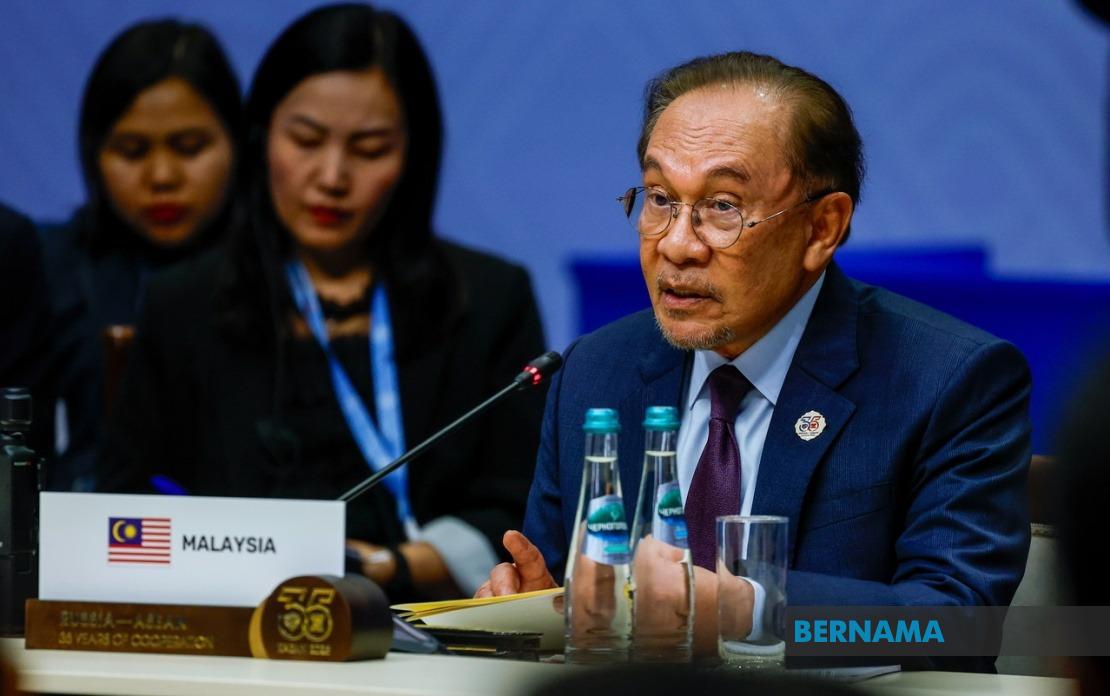
Prime Minister Datuk Seri Anwar Ibrahim has called on ASEAN and Russia to deepen strategic cooperation across multiple sectors, underlining the critical importance of maintaining diplomatic channels and peaceful dialogue to navigate an increasingly volatile global landscape. Speaking during the plenary session of the ASEAN-Russia Commemorative Summit in Kazan on June 18, Anwar positioned the gathering as a crucial platform for both regional blocs to pursue collaborative initiatives amid mounting geopolitical uncertainties and international tensions that threaten stability across Asia, Europe, and the Middle East.
The prime minister's emphasis on dialogue reflects Malaysia's longstanding foreign policy doctrine that sustainable peace and stability can only be achieved when nations prioritise negotiation, mutual understanding, and adherence to international law over confrontation or unilateral action. This messaging carries particular resonance given the deteriorating security environment in several global hotspots and the rising risk of miscalculation between major powers. Anwar's call for continued diplomatic engagement represents a deliberate counterweight to more hawkish international voices that have grown increasingly influential in recent years.
Across a range of strategic domains, Anwar outlined specific areas where ASEAN and Russia should intensify collaboration. These include bolstering bilateral trade and investment flows, accelerating digital transformation and technological exchange, advancing artificial intelligence capabilities, diversifying and securing energy supplies, strengthening food security frameworks, promoting halal industry standards, and facilitating people-to-people connections. Each sector reflects both the immediate economic interests of ASEAN nations and the longer-term strategic imperative to build resilience against external shocks. For Malaysia particularly, deeper Russian partnerships in energy and technology could help diversify its economic and security relationships beyond traditional Western partners.
The trade and investment dimension assumes added significance as ASEAN economies seek to rebalance their external engagement following years of heavy dependence on Western markets and Chinese supply chains. Russian participation in ASEAN's economic ecosystem, though currently modest compared to larger trading partners, offers an alternative avenue for market access and capital flows. The emphasis on digital and AI cooperation recognises that technological sovereignty is becoming as important as energy independence for developing nations, and collaborative frameworks can help smaller countries avoid being marginalised in the rapidly evolving digital economy.
Food security cooperation between ASEAN and Russia holds particular strategic value for the region. Russia ranks among the world's largest exporters of grains and fertilisers, commodities essential for sustaining the livelihoods of ASEAN's 650 million people. Formal mechanisms for agricultural cooperation and supply chain stabilisation could help buffer the region against global price shocks and supply disruptions, which have repeatedly destabilised food costs across Southeast Asia in recent years.
Turning to Middle Eastern geopolitics, Anwar reiterated Malaysia's principled stance on the Gaza conflict, demanding an immediate halt to violence and unhindered humanitarian assistance for civilian populations caught in the crossfire. He further condemned the expansion of Israeli military operations into Lebanese territory and called for respect for the United Nations Interim Force in Lebanon, reflecting ASEAN's broader commitment to defending international peacekeeping mandates and protecting civilian infrastructure. These statements carry significance beyond ceremonial language, as Malaysia has consistently positioned itself as a voice for the Global South on Palestinian rights and humanitarian law, sometimes at diplomatic cost.
The Kazan summit marks the 35th anniversary of ASEAN-Russia diplomatic relations, which formally commenced in 1991 in Kuala Lumpur during a pivotal moment when the Soviet Union was collapsing and Southeast Asian nations were navigating the post-Cold War transition. This three-decade partnership, though less visible than ASEAN ties with Western powers or China, has quietly developed institutional depth through various dialogue mechanisms and working groups. The commemorative dimension of the current gathering underscores both the maturity of the relationship and the participating nations' desire to refresh and revitalise cooperation for the next phase.
The summit brought together Philippine President Ferdinand Marcos Jr, who currently holds ASEAN's rotating chair, alongside other regional leaders and high-level representatives. This broad participation demonstrates the collective ASEAN commitment to elevating ties with Russia despite geopolitical pressures and sanctions regimes imposed by Western capitals following Russia's military actions in Ukraine. The decision to hold such a high-level gathering in Kazan, Russia's major city in the Tatarstan region, reflects mutual respect and commitment to substantive engagement rather than performative diplomacy.
Looking forward, the summit is expected to produce four key outcome documents that will shape ASEAN-Russia relations through the remainder of this decade. The Kazan Declaration will commemorate the 35-year partnership milestone and articulate shared principles. Separate joint statements on energy and cultural cooperation will provide thematic focus, while a comprehensive plan of action covering 2026 to 2030 will establish specific programmes, timelines, and measurable objectives. These instruments represent more than symbolic gestures; they create accountability mechanisms and provide roadmaps that working-level officials and specialised agencies can operationalise in practical terms.
For Malaysia specifically, deepening ASEAN-Russia cooperation aligns with the country's broader strategic objective of maintaining an independent foreign policy that does not align exclusively with any single power. By actively promoting substantive engagement with Russia across multiple domains, Malaysia reinforces ASEAN's centrality in regional architecture and its capacity to serve as a bridge between different global constituencies. This approach strengthens Malaysia's diplomatic hand when negotiating with major powers and demonstrates to smaller nations that viable alternatives to hegemonic relationships exist.
The timing of this summit reflects international realities that transcend electoral cycles or temporary policy shifts. Climate change, pandemics, cyber threats, and resource scarcity increasingly demand multilateral solutions that cannot be achieved through bilateral channels alone. ASEAN's geographic position, straddling critical sea lanes and connecting major population centres, makes it an indispensable player in any serious international cooperation architecture. Russia's vast resources in energy, minerals, and agricultural products, combined with its technological capabilities in certain sectors, create natural complementarities with ASEAN's development imperatives.
The emphasis on people-to-people exchanges deserves particular attention, as cultural and educational connections form the bedrock of sustained strategic partnerships. Tourism flows, student exchanges, academic collaborations, and cultural festivals create constituencies within both regions that have personal stakes in maintaining friendly relations. Such grassroots connections often prove more durable than top-down government agreements, especially when political winds shift or new administrations take office with different priorities.
As global tensions continue to mount and the international system fragments along competing lines, ASEAN's ability to maintain productive relationships with multiple great powers will determine its relevance and influence in coming decades. Prime Minister Anwar's call for strengthened ASEAN-Russia cooperation, grounded in dialogue and mutual benefit rather than ideological confrontation, articulates a vision of international relations that many in the Global South increasingly find compelling. Whether this vision can be translated into concrete economic and security gains for Malaysia and its ASEAN partners will depend on sustained political will and the ability to translate diplomatic rhetoric into tangible results that benefit ordinary citizens across the region.