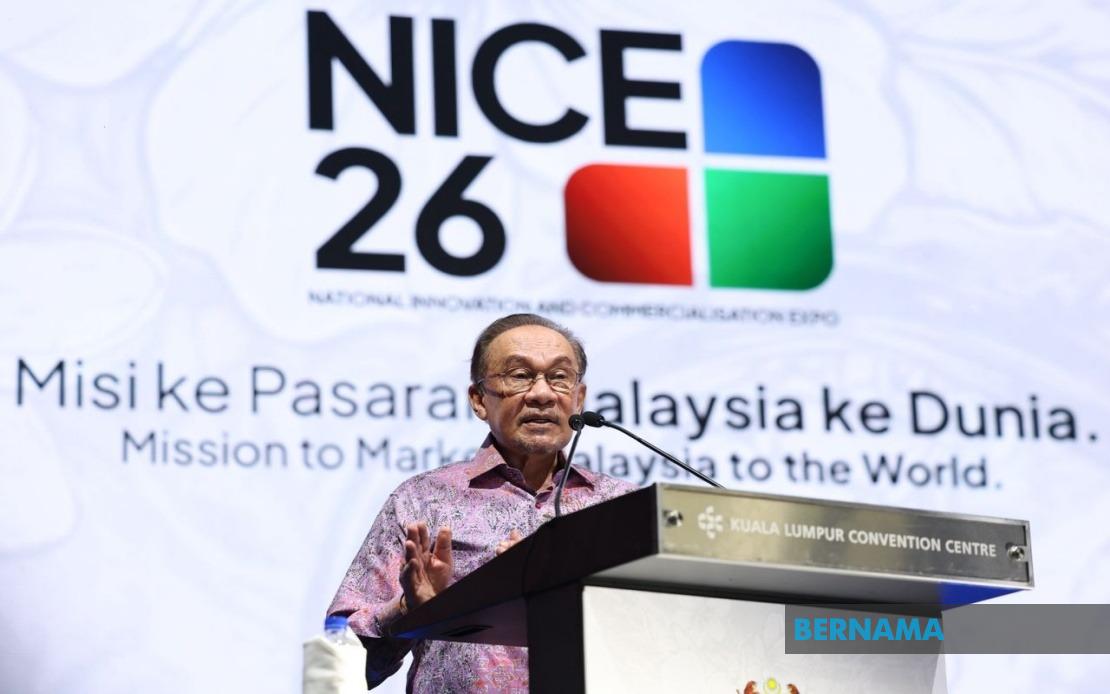
Prime Minister Datuk Seri Anwar Ibrahim has intensified calls for a fundamental restructuring of Malaysia's administrative systems, arguing that traditional approval mechanisms are incompatible with the speed and agility required in today's innovation-driven economy. Speaking at the National Innovation and Commercialisation Expo (NICE) 2026 at the Kuala Lumpur Convention Centre, he stressed that cumbersome procedures inherited from an earlier era of governance are now actively hampering the nation's technological advancement and competitive positioning in the global marketplace.
The government's frustration with bureaucratic slowness has crystallised around concrete examples of how delays compromise Malaysia's strategic objectives. Anwar highlighted the recent establishment of Artificial Intelligence faculties across local universities as a model for what expedited decision-making can achieve. These facilities were operationalised within three months, a dramatic compression compared to the conventional timeline of approximately one year that would typically apply under existing protocols. This stark contrast underscores the Prime Minister's core argument: that adherence to inherited systems of multiple senate approvals, council deliberations, and sequential authorisation stages is fundamentally misaligned with contemporary innovation requirements.
The tension Anwar identifies reflects a broader challenge facing many developing economies attempting to transition into knowledge-based sectors. Malaysia's universities and research institutions operate within governance frameworks designed for stability and consensus-building in traditional academic environments, yet these same mechanisms become liabilities when institutions must respond rapidly to emerging technologies like artificial intelligence, biotechnology, and advanced manufacturing. The Prime Minister's intervention suggests growing impatience within the cabinet with the pace of institutional adaptation, particularly as regional competitors like Singapore and South Korea continue accelerating their technology commercialisation efforts.
Centrally, Anwar's directive targets the Ministry of Science, Technology and Innovation (MOSTI) and allied government agencies, effectively instructing them to abandon the assumption that all procedural requirements remain equally necessary. His language—acknowledging that "we need to achieve a level of speed and efficiency in this post-normal world"—frames the issue not as a minor adjustment but as a fundamental recalibration of how government operates. This framing is significant for Malaysian bureaucrats accustomed to operating within clearly defined hierarchies and approval chains. The Prime Minister is essentially asking them to accept that some established processes, however well-intentioned their original design, now constitute obstacles rather than safeguards.
For Malaysian higher education institutions, this represents both opportunity and uncertainty. Universities gain explicit permission to move faster in establishing technology-focused programmes, potentially allowing them to compete more effectively for talented academics and innovative research partnerships. However, the lack of clarity about which processes remain mandatory and which can be streamlined creates an implementation challenge. Institutions must balance the Prime Minister's directive to accelerate against their responsibility to maintain academic standards and proper governance. The three-month AI faculty example may have worked smoothly, but scaling such speed across multiple institutions and disciplines will require more detailed guidance about where flexibility is permissible.
The commercial sector stands to benefit substantially from this shift if properly implemented. Faster approval of new academic programmes means universities can more quickly prepare graduates with skills aligned to emerging market demands. Similarly, streamlined commercialisation pathways for university-developed technologies could accelerate the translation of research into viable business ventures. Malaysia's standing as a regional innovation hub depends partly on such acceleration. Currently, the time lag between technology development and commercialisation represents a competitive disadvantage, particularly when institutional structures themselves become sources of delay rather than facilitators of progress.
Anwar's intervention also carries implications for Malaysia's regional positioning. Singapore and South Korea have demonstrated the advantages of agile government responses to technological change. If Malaysia can successfully reduce bureaucratic friction, it creates a genuine competitive differentiator, particularly for attracting multinational technology companies seeking R&D locations and for retaining locally-developed talent. The message to investors is essentially that Malaysia is willing to modernise its institutional operating systems, not merely its physical infrastructure or tax incentives.
However, the Prime Minister's call raises legitimate questions about oversight and accountability. Reducing procedural steps inherently reduces the number of checkpoints where concerns about quality, ethics, or alignment with broader national objectives can be raised. The challenge for Malaysian policymakers will be designing streamlined processes that maintain essential scrutiny while eliminating genuinely redundant steps. This requires distinguishing between procedures that exist for defensible reasons—such as ensuring programmes maintain academic rigor—and those that perpetuate themselves primarily through institutional inertia.
Implementing this directive will test the reform capacity of Malaysia's civil service. Ministry officials must reinterpret their roles from guardians of process consistency to facilitators of legitimate acceleration. This cultural shift is harder than issuing directives. Career bureaucrats who have spent decades demonstrating competence within existing frameworks may resist instructions to work outside them, fearing that departures from established procedures could expose them to criticism if outcomes prove suboptimal. Overcoming this institutional conservatism requires not merely the Prime Minister's endorsement but active management and clear protections for officials who take calculated risks in service of accelerated innovation timelines.
The significance of Anwar's intervention extends beyond procedural efficiency to reflect a broader strategic choice. By publicly championing speed and flexibility at the NICE 2026 event, he is signalling to Malaysia's innovation ecosystem that government is committed to removing institutional barriers. Yet the gap between rhetoric and implementation remains substantial. The real test will be whether specific ministries and universities can translate the Prime Minister's vision into concrete operational changes that demonstrably reduce the time required to commercialise research, establish new academic programmes, and scale technological ventures without compromising essential standards or public interest protections.

