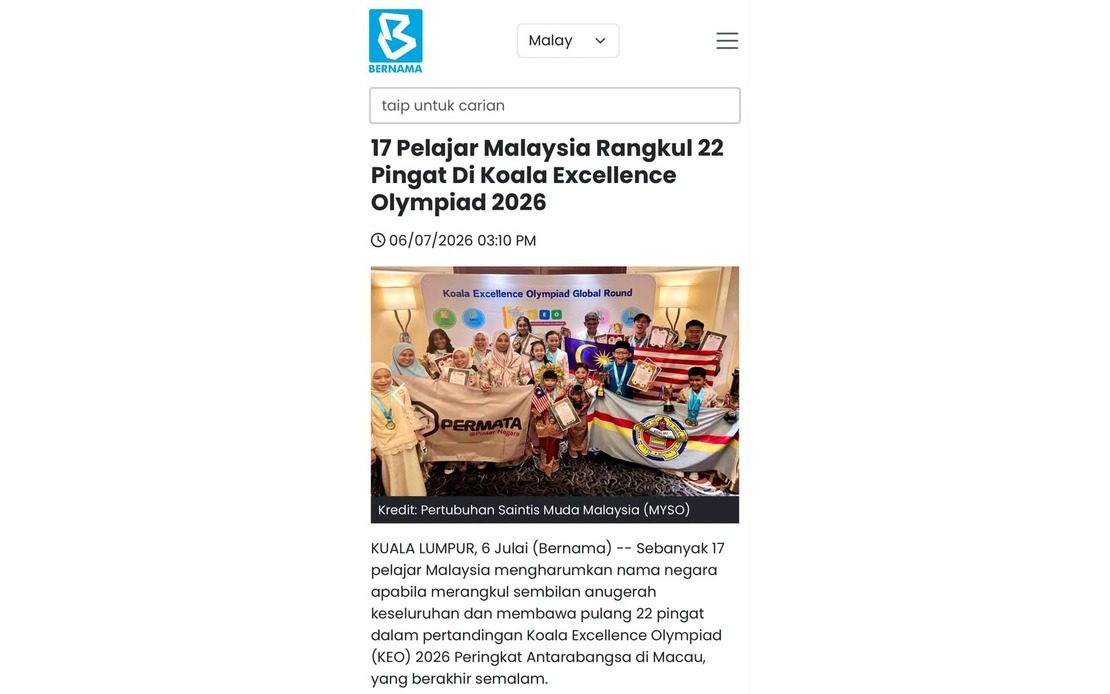
Prime Minister Datuk Seri Anwar Ibrahim has publicly praised 17 Malaysian students for their exceptional showing at the 2016 Koala Excellence Olympiad (KEO) Global Finals in Macau, where the contingent captured nine overall awards alongside 22 medals across multiple disciplines. The PM's congratulatory message, shared on social media platform X, underscores the government's recognition of young Malaysians' competitive edge in international academic arenas and reflects broader policy emphasis on nurturing excellence among the nation's youth.
The Malaysian delegation's medal tally comprised five gold, six silver, and eleven bronze medals, according to Aidah Misran, coordinator of the Malaysia Young Scientists Organisation (MYSO) and head of the Malaysian contingent dispatched to the Macau competition. This diverse medalist distribution demonstrates consistent high performance across the participating Malaysian students rather than reliance on isolated standout performers, suggesting robust preparation and systematic talent development within the country's academic framework.
The KEO Global Finals represents a significant platform for Malaysian students to benchmark themselves against international peers in an increasingly competitive knowledge economy. The competition framework encompasses four distinct olympiad categories—English, Mathematics, Science, and Arts—allowing participants to demonstrate versatility and breadth of intellectual capability beyond narrow specialisation. This multidisciplinary approach aligns with contemporary educational philosophy emphasising well-rounded intellectual development and cross-disciplinary problem-solving skills essential in modern professional environments.
Developed by a consortium of Australian educational experts and graduates, the Koala Excellence Olympiad has established itself as a structured international competition mechanism facilitating student exchange of ideas and fostering global academic networks. The platform's emphasis on English language proficiency, quantitative reasoning, scientific inquiry, and creative expression reflects preparation requirements increasingly demanded by higher education institutions and multinational employers seeking candidates with comprehensive intellectual portfolios.
MYSO's role as the coordinating body in Malaysia demonstrates the critical importance of national organisations in mobilising talent, providing mentorship, and facilitating international participation opportunities for gifted students. Such intermediary structures enable identification and development of academically advanced youth who might otherwise lack access to competitive international forums, thereby democratising pathways to global recognition and educational advancement. The partnership between MYSO, KEO organisers, and Miss Man International Group illustrates how cross-sector collaboration can expand Malaysian students' exposure to world-class academic competition.
For Malaysia, consistent success in international olympiads carries implications extending beyond immediate achievement recognition. Such performances contribute to the nation's soft power narrative and educational reputation, potentially attracting foreign investment in research institutions, enhancing the country's standing in global university rankings, and elevating Malaysia's positioning as a knowledge-intensive economy within Southeast Asia. When Malaysian students demonstrate competitive capacity against international cohorts, it signals to global academic and commercial stakeholders the quality of talent produced by the national education system.
The PM's public commendation also carries significance in reinforcing government commitment to supporting extracurricular academic pursuits and recognising student achievement beyond conventional examination frameworks. This messaging encourages pursuit of excellence among Malaysian youth and signals that exceptional intellectual performance receives political acknowledgement and encouragement, potentially motivating future generations to seek similar competitive platforms and ambitious academic targets.
International olympiad participation offers Malaysian students transformative personal experiences beyond medal accumulation. Exposure to peers from diverse cultural and educational backgrounds, engagement with novel problem-solving approaches, and navigation of international academic environments cultivate adaptability, cross-cultural competence, and confidence essential for participation in globalised professional spheres. These soft skills frequently prove as valuable as subject-specific knowledge in determining long-term career success and contribution to national development objectives.
The continued participation and success of Malaysian contingents in international academic competitions reflects underlying investments in talent identification, coaching infrastructure, and financial support mechanisms facilitating student participation. Sustained results suggest systematic approaches to nurturing academically gifted youth rather than sporadic achievement, indicating the education ecosystem's capacity for producing internationally competitive cohorts across multiple disciplines and ability levels.
Looking forward, maintaining and building upon this trajectory requires continued institutional focus on identifying gifted students early, providing targeted mentorship, securing adequate funding for international participation, and creating incentive structures encouraging pursuit of academic excellence. Regional collaboration within Southeast Asia could amplify such initiatives, facilitating resource pooling and establishing development pathways for talented youth across ASEAN nations.

