Prime Minister Datuk Seri Anwar Ibrahim has stressed that Malaysia's reform agenda must be anchored in the collective spirit of Hijrah—the Prophet Muhammad's migration to Madinah—rather than driven by individual ambition or isolated initiatives. Speaking during Maal Hijrah 1448H celebrations, he articulated a vision of transformation rooted in consensus and unity across diverse communities, positioning these principles as non-negotiable prerequisites for advancing justice, truth, prosperity and security. His remarks signal an attempt to frame the government's reform trajectory within a broader religious and historical framework that resonates with Malaysia's Muslim-majority population while appealing to inclusive governance.
The historical narrative Anwar invoked carries significant weight in contemporary Malaysian politics. The Hijrah represents more than a geographical migration; it symbolises a pivotal moment when an emerging Islamic community transcended tribal divisions to establish a functioning state based on shared values and mutual cooperation. By drawing explicit parallels between this seventh-century transformation and modern Malaysia's developmental challenges, the Prime Minister sought to position current governance initiatives within a continuum of civilisational achievement. This rhetorical strategy acknowledges that Malaysia's diverse polity—encompassing Muslims and non-Muslims, various ethnic groups, and competing political factions—requires foundational principles that transcend partisan boundaries to succeed.
Central to Anwar's message was a deliberate rejection of what he termed superficial approaches to reform. He explicitly cautioned against relying solely on "rhetoric, slogans and individual effort," suggesting implicit criticism of political movements that deploy inflammatory messaging without substantive institutional change. This positioning reflects awareness of Malaysian political culture's vulnerability to personality-driven politics and empty proclamations. By emphasising that "success will not come merely through rhetoric" and must instead be "achieved together with patience towards victory," Anwar attempted to establish a standard by which his administration's performance could be evaluated—and against which rival political actors might be judged.
A notable dimension of Anwar's commentary was his recognition of diverse contributions to the original Hijrah narrative. His specific mention of youth representation through Saidina Ali Abi Talib, women's agency exemplified by Asma Abu Bakar, and the broader participation of companions underscored that successful transformation depends on mobilising multiple segments of society. For Malaysian readers, this resonates with ongoing national conversations about youth employment, women's economic participation, and inclusive governance structures. The invocation of these historical figures suggests that contemporary reform initiatives should similarly draw upon talent and commitment across generational, gender, and social boundaries.
The practical challenge Anwar acknowledged—that "embodying the spirit of Hijrah in the current reality is not easy"—deserves careful consideration. Malaysia faces a complex landscape where consensus-building must navigate not merely religious difference but also entrenched political interests, bureaucratic inertia, and competing visions of national development. The statement implicitly concedes that rhetorical appeals to unity, however historically grounded, do not automatically dissolve structural obstacles to reform. This candour distinguishes his message from purely aspirational political speech, though questions remain about whether existing institutional mechanisms can facilitate the cross-cutting consensus he advocates.
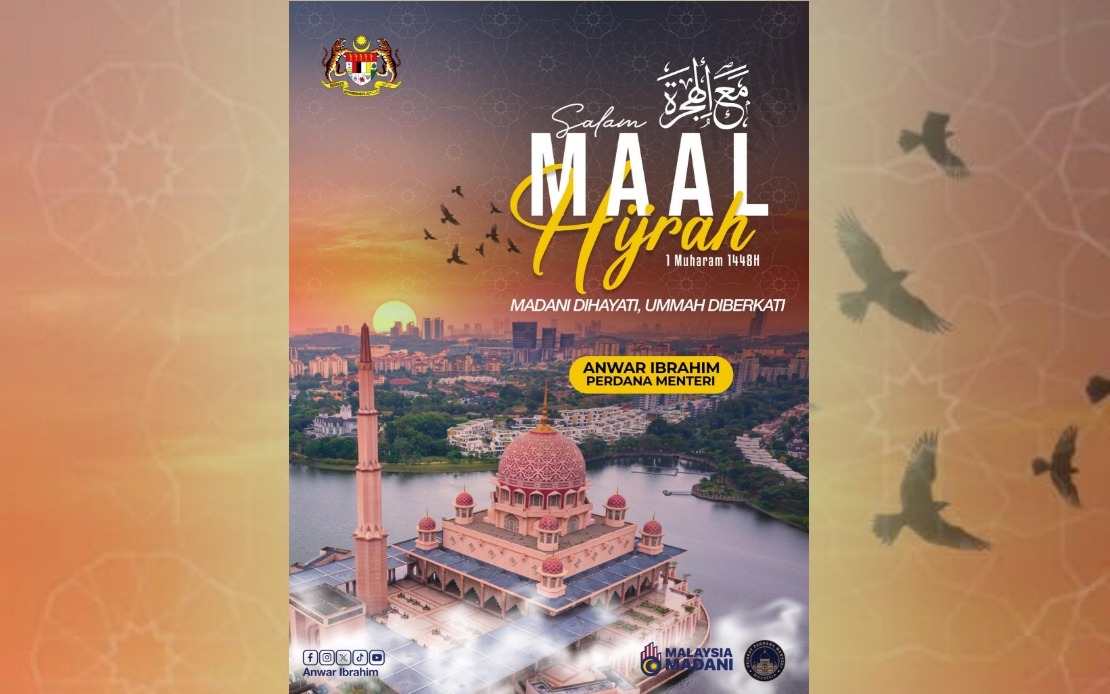
The Department of Islamic Development Malaysia's selection of "MADANI Dihayati, Ummah Diberkati" (MADANI Embraced, The Ummah Blessed) as the theme for the National Maal Hijrah Celebration 1448H/2026M reinforces the government's attempt to weave Islamic principles throughout its governance framework. MADANI—an acronym encompassing Madani, Aspirational, Driven, Authoritative, Nuanced, and Inclusive—represents the administration's stated governing philosophy. By directly linking this framework to Hijrah's historical significance as the foundation for Islamic civilisational development, officials attempted to position modern Malaysia as continuing an unbroken legacy of community-oriented institution-building.
For Southeast Asian observers, Anwar's emphasis on consensus and unity carries particular resonance given the region's experience with both successful and fractured reform efforts. Countries across Southeast Asia have struggled with similar tensions between reform imperatives and political fragmentation. Malaysia's multiethnic and multireligious composition makes consensus-building simultaneously more essential and more difficult than in more homogeneous neighbours. Anwar's articulation of reform through Hijrah principles potentially offers a framework that transcends narrow communal interests by appealing to shared historical narrative and religious values—though sceptics might question whether such framing genuinely bridges divisions or merely overlays them with religious language.
The emphasis on collective sacrifice and struggle inherent in Anwar's interpretation of Hijrah—"Hijrah is sacrifice, Hijrah is struggle, Hijrah is brotherhood"—implicitly demands patience from constituencies seeking rapid transformation. This messaging appears calibrated to manage expectations among reform advocates who might otherwise interpret slow institutional change as evidence of insufficient commitment. By framing patience as integral to the Hijrah narrative itself, Anwar attempted to redefine expectations about reform timelines within a religio-historical context.
The quotation of Surah An-Nisa verse 100 regarding rewards for those who migrate in Allah's path adds theological depth to political messaging, though scholars might debate whether invoking Quranic verses about spiritual migration appropriately applies to contemporary governance reform. This layering of scriptural authority onto policy frameworks represents a distinctly Malaysian political practice, where religious legitimacy carries weight in public discourse. Whether such authority actually facilitates implementation remains contested.
Ultimately, Anwar's Maal Hijrah remarks reflected an administration attempting to mobilise historical and religious narratives to build political consensus for its reform agenda. The explicit rejection of individualistic approaches and insistence on collective effort acknowledge that meaningful transformation in a complex, diverse polity requires sustained cooperation across traditionally fractious groups. Whether Malaysia's political institutions, bureaucratic structures, and civil society organisations can translate these principles into coordinated action remains the substantive question underlying rhetorical appeals to Hijrah's spirit. The coming years will demonstrate whether consensus-based reform proves achievable beyond the symbolic realm of speeches and religious observances.