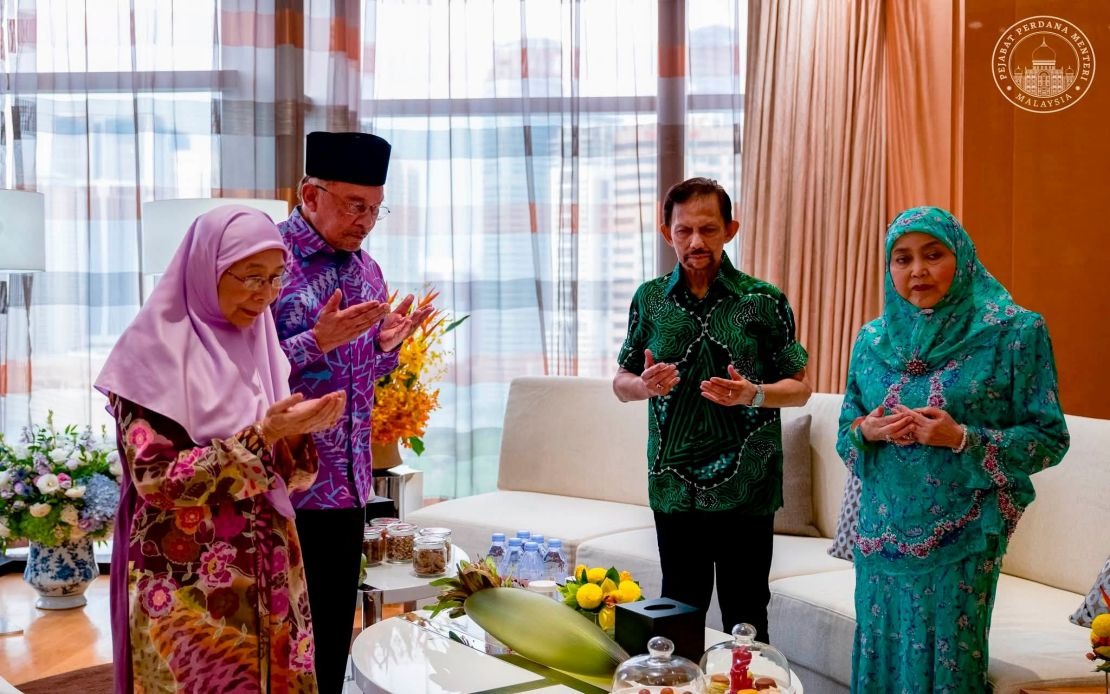
Prime Minister Datuk Seri Anwar Ibrahim marked the 80th birthday of Brunei's reigning monarch, Sultan Hassanal Bolkiah, with a public message of felicitations shared across social media platforms. The gesture, delivered on behalf of the Malaysian Government and citizenry, underscores the diplomatic warmth maintained between the two neighbouring Southeast Asian nations despite the competitive dynamics that sometimes characterise regional relationships.
Through his Facebook post, Anwar expressed the hope that Sultan Hassanal Bolkiah would continue steering the Sultanate with the wisdom and careful judgement that have become hallmarks of his lengthy reign. The Prime Minister's remarks carried implicit recognition of the constitutional role the Sultan plays in Brunei's governance structure, where the monarchy remains the centrepiece of the nation's political framework. This acknowledgement is particularly significant given Malaysia's own constitutional monarchy system, which shares historical and cultural parallels with Brunei's governance model.
Central to Anwar's message was an explicit commitment to deepening bilateral ties between Kuala Lumpur and Bandar Seri Begawan. He articulated the conviction that strengthened cooperation would yield mutual benefits for both governments and their respective populations. This framing reflects a broader strategic understanding that Malaysia and Brunei, despite their different economic trajectories and political structures, possess complementary interests in regional stability, maritime security, and economic development within the broader Southeast Asian context.
The biographical significance of the occasion cannot be overlooked. Sultan Hassanal Bolkiah, born on July 15, 1946, in what was then Bandar Brunei, ascended to the throne in 1967 as the nation's 29th Sultan during a period of significant regional transformation. His seven-decade reign has witnessed Brunei's evolution from a British protectorate to a fully sovereign nation, the discovery and exploitation of vast hydrocarbon reserves that transformed the sultanate's economic fortunes, and the development of a distinctive model of Islamic governance that has attracted both admiration and scrutiny from international observers.
A watershed moment in the Sultan's historical standing arrived in September 2022, following the death of Queen Elizabeth II. With that passing, Sultan Hassanal Bolkiah assumed the distinction of being the world's longest-reigning currently reigning monarch. This title carries symbolic weight not merely for Brunei but for the broader Islamic world and the Commonwealth, positioning the Sultan as a bridge figure between different geopolitical traditions and alliances. For Malaysia specifically, this development elevates the prestige of a neighbouring kingdom and reinforces regional recognition of Brunei's stability and continuity.
The Sultan's longevity on the throne reflects a careful balancing act between tradition and cautious modernisation. Throughout his reign, he has navigated the challenges of oil-dependent economics by investing heavily in sovereign wealth diversification, particularly through the Brunei Investment Agency. These financial strategies have enabled the sultanate to maintain its reputation as one of Asia's wealthiest nations on a per-capita basis, despite the volatility of global energy markets.
From Malaysia's perspective, Brunei's stability and measured governance approach represent important anchors in Southeast Asia. The two countries share the Limbang territorial dispute, a longstanding maritime disagreement that has never escalated into serious conflict, demonstrating that even territorial disagreements need not destabilise bilateral relations. Intelligence sharing, customs cooperation, and informal security dialogues continue between the two nations' defence establishments, contributing to overall regional peace.
The Sultan's commitment to Islamic governance, reflected most notably in Brunei's implementation of Sharia law in criminal matters, represents a distinctive approach that differs markedly from Malaysia's secular constitutional framework, even as Malaysia incorporates Islamic law into its dual legal system. This philosophical divergence has never prevented practical cooperation, and indeed Malaysia has shown respect for Brunei's sovereign choices in matters of internal governance.
Looking forward, Anwar's birthday greeting can be read as an affirmation that Malaysia remains invested in preserving and strengthening the cordial bilateral relationship that has historically characterised Malaysia-Brunei ties. As both nations navigate complex regional dynamics involving great power competition, pandemic recovery, and the evolving architecture of Southeast Asian integration through ASEAN, maintaining strong links with immediate neighbours remains strategically prudent. The Sultan's continued leadership, now extending into his ninth decade, provides a stabilising force that Malaysia can confidently build upon in pursuing shared regional objectives.

