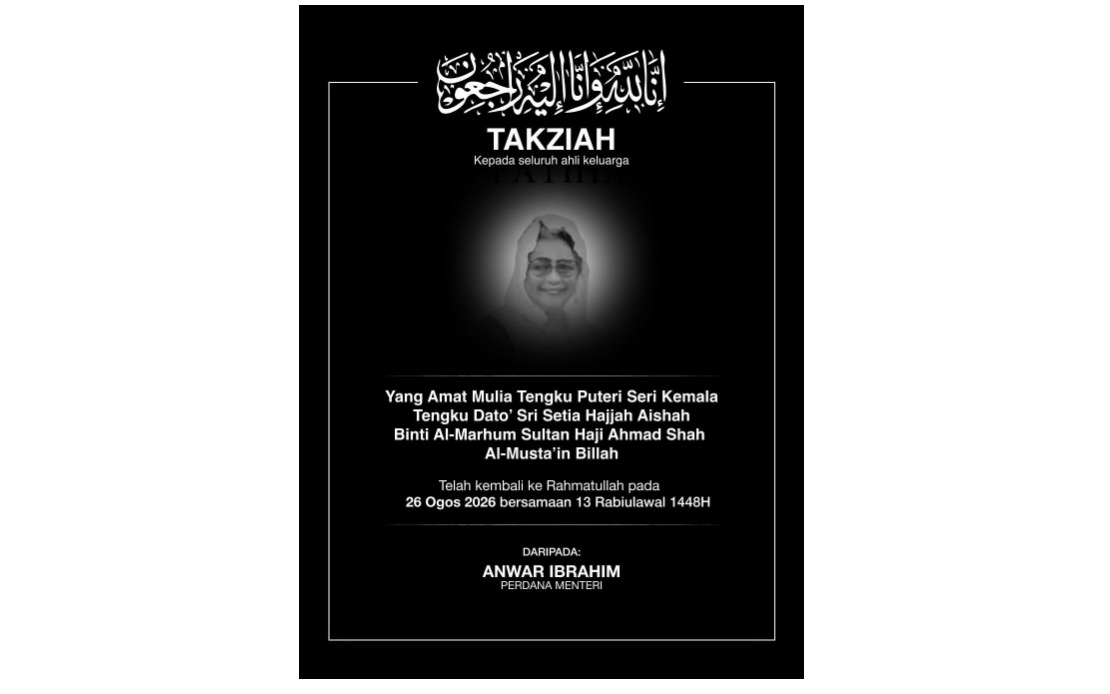
Prime Minister Datuk Seri Anwar Ibrahim has offered his sympathies to Al-Sultan Abdullah Ri'ayatuddin Al-Mustafa Billah Shah and members of the Pahang Royal Family following the death of Tengku Datuk Seri Aishah, the Sultan's elder sister, on Tuesday evening.
Through a statement posted on social media, the Prime Minister invoked divine blessings and mercy upon the departed soul, requesting forgiveness of her sins and that she be granted a place among the righteous in the hereafter. The gesture represents the customary expression of respect shown by Malaysia's political leadership towards the royal families of constituent states, reflecting the constitutional position of hereditary rulers within the nation's system of governance.
Tengku Datuk Seri Aishah, who carried the full title Tengku Puteri Seri Kemala Tengku Datuk Seri Aishah Almarhum Sultan Ahmad Shah, passed away at a private medical facility in the capital at 9:15 pm on Tuesday. Her demise marks the end of a significant chapter in Pahang's royal lineage, as she was the sibling of the reigning monarch and represented a living link to the state's royal heritage stretching back several generations.
The Prime Minister's message also extended prayers for Al-Sultan Abdullah and Tengku Ampuan of Pahang Tunku Azizah Aminah Maimunah Iskandariah, seeking divine strength and fortitude for them and all members of the extended royal household as they navigate their period of mourning. Such expressions of sympathy from the Prime Minister's office underscore the formal bonds between the federal executive and state rulers, a relationship enshrined in the Malaysian Constitution.
Funeral arrangements proceeded with traditional royal protocols, with the remains scheduled to be interred at the Pahang Royal Mausoleum located in Pekan, the royal town that serves as the ceremonial capital of the state. The choice of burial location reflects the customary practice of members of ruling families being laid to rest within designated royal burial grounds, preserving the continuity of ancestral traditions that span centuries.
For Malaysian readers, the passing of prominent members of royal families often triggers broader reflections on the constitutional monarchy system that underpins the nation's political framework. While Malaysia's federal structure grants significant autonomy to state rulers in matters affecting their respective territories, moments of royal bereavement unite the nation in shared respect for these institutions. The public condolences extended by political leaders, including the Prime Minister, demonstrate how the personal and constitutional dimensions of royalty intersect within Malaysian public life.
The incident also illuminates the dual role that members of royal families occupy within Malaysia's social fabric. Beyond their ceremonial functions, many royal relatives maintain private lives and contribute to charitable and cultural endeavours within their states. The passing of an elder sibling of a reigning Sultan represents a loss not only to the immediate family but to the broader constituency that views the royal household as an embodiment of national identity and continuity.
In the Southeast Asian context, the strength of monarchical institutions in Malaysia stands in contrast to the more attenuated roles of royalty in some neighbouring nations. The constitutional recognition and public reverence accorded to sultans and their families reflects a unique political settlement reached at independence, wherein hereditary rulers retained substantial formal authority and social prominence in exchange for accepting a constitutional framework that distributed power between federal and state governments.
The Prime Minister's engagement with this matter also reflects the contemporary expectation that senior political office-holders will acknowledge and participate in the rituals surrounding royal life, including moments of loss and mourning. Such participation reinforces the symbolic unity between the elected government and the institutional monarchy, a relationship that, despite occasional tensions, has generally proven stable throughout Malaysia's post-independence history.
For observers of Malaysian politics and governance, these ceremonial occasions serve as reminders of the layered nature of authority within the constitutional system. Whilst the Prime Minister leads the federal government and exercises significant executive power, the sultans retain prerogatives that cannot be overridden by federal action, including those relating to Islam, royal protocol, and certain state-level matters. This balance has generally been accepted as a core feature of Malaysia's political identity.
The passing of Tengku Datuk Seri Aishah also underscores the generational transitions occurring within Malaysia's royal households. As elder members of these families reach the end of their natural lifespans, their deaths provide occasions for the public to reflect on the evolving role of monarchy in a rapidly modernising society. Yet the continued observance of traditional funeral rites and the expressions of national sympathy suggest that reverence for these institutions remains deeply embedded within Malaysian culture.

