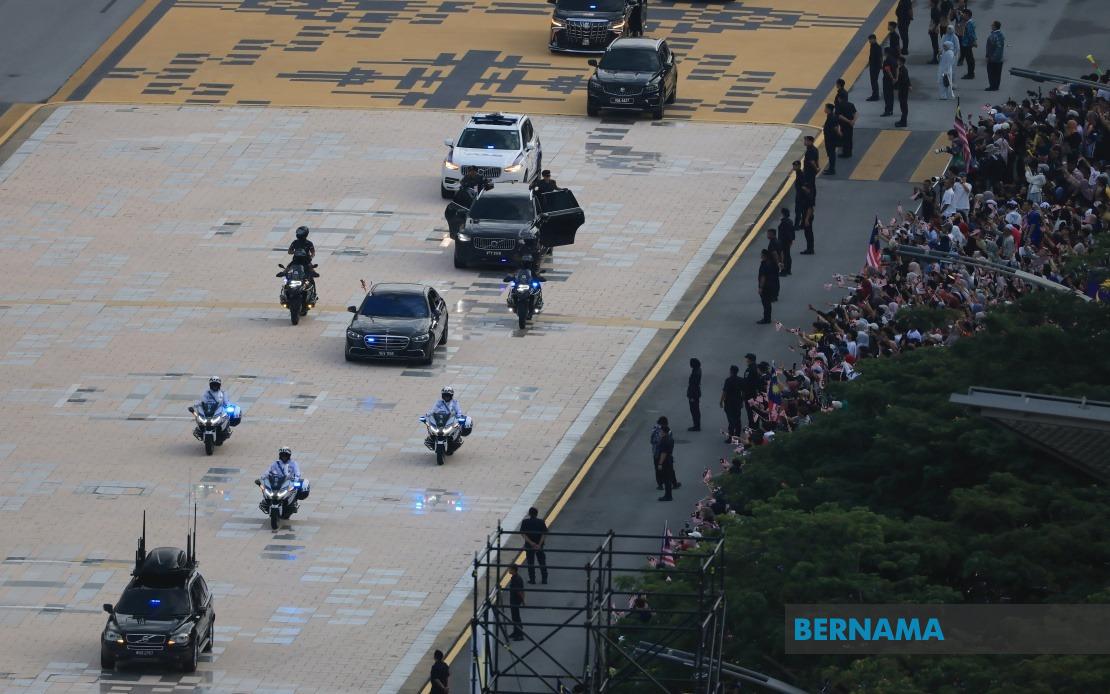
Prime Minister Datuk Seri Anwar Ibrahim and his Cabinet colleagues assembled at Dataran Putrajaya on August 31 to preside over the nation's 69th National Day celebrations, joining a crowd of thousands of Malaysians in marking the milestone occasion. The Finance Minister and his wife Datuk Seri Dr Wan Azizah Wan Ismail took their positions at the royal stage at 7.53 am as the ceremonial Hormat Perdana anthem resonated across the grounds, establishing the formal tenor for the day's proceedings.
Deputy Prime Minister Datuk Seri Dr Ahmad Zahid Hamidi had arrived earlier at 7.45 am to oversee arrangements and greet arriving dignitaries. Alongside them stood a formidable contingent of the nation's top leadership, including Communications Minister Datuk Seri Fahmi Fadzil, who carries the additional responsibility of chairing the main organising committee for the 2026 National Day and Malaysia Day celebrations. Home Minister Datuk Seri Saifuddin Nasution Ismail and Defence Minister Datuk Seri Mohamed Khaled Nordin were among the senior Cabinet ministers present, projecting a unified display of governmental commitment to the national observance.
The gathering extended well beyond the immediate Cabinet circle. Deputy ministers of various portfolios joined the proceedings, as did local and foreign dignitaries representing friendly nations and international partners. The presence of foreign delegates underscored Malaysia's place within the broader regional and global community, a significance not lost on observers tracking the nation's diplomatic positioning in an increasingly complex geopolitical environment.
This year's celebration operated under the unifying theme of "Malaysia MADANI: Kesejahteraan Dinikmati"—a phrase encapsulating the government's vision of shared prosperity and well-being for all Malaysians. The thematic emphasis reflects the administration's development agenda and its focus on inclusive growth, a message the government has consistently reinforced across domestic policy discussions and international forums throughout the year.
The scale of the 69th National Day parade demonstrated the logistical ambition underlying such ceremonies. Organisers marshalled 10,819 participants drawn from 76 distinct contingents, representing various government agencies, civil society organisations, community groups, and military units. Twenty-two marching bands provided musical accompaniment throughout the procession, their coordinated performances contributing to the pageantry characteristic of such state occasions.
The military dimension of the celebration was particularly prominent. Planners incorporated 328 separate assets across land, sea, and air domains, showcasing Malaysia's defence capabilities and logistical reach. These included vehicles, naval vessels, and aircraft, each meticulously positioned to demonstrate the nation's military readiness and technological sophistication. Additionally, 112 working animals—predominantly horses and canines employed in ceremonial and operational roles—participated in the parade, maintaining a tradition that bridges contemporary military practice with historical convention.
A notable innovation in this year's celebrations was the inclusion of 22 electric vehicle assets, reflecting Malaysia's increasing embrace of environmental sustainability and clean energy technologies. This integration signalled governmental commitment to advancing green initiatives even within national ceremonial frameworks, aligning symbolic national identity with practical environmental responsibility—a concern growing in prominence among Malaysian policymakers and the general public alike.
Elevating the modern character of the parade, eleven specially decorated vehicles processed through Dataran Putrajaya, each designed to illustrate different aspects of national achievement, cultural heritage, or development priorities. These mobile displays served both aesthetic and communicative functions, transforming the parade into a moving narrative of national identity and governmental accomplishment.
For Malaysia's leadership, the National Day parade represents more than ceremonial obligation. It constitutes a crucial opportunity to articulate governmental vision, reinforce national unity across Malaysia's diverse population, and demonstrate state capacity and organisational effectiveness. The involvement of senior ministers across defence, home affairs, and communications portfolios reflected the multidimensional security and social considerations embedded within national celebrations, particularly in a Southeast Asian context where symbolic demonstrations of state authority and cohesion carry substantive political meaning.
The timing and scope of the 69th National Day observance arrives at a juncture when Malaysia navigates complex economic pressures, regional geopolitical shifts, and domestic political consolidation. Such national ceremonies provide platforms through which governments communicate continuity, competence, and commitment to national development aspirations. The participation of the Prime Minister and his full Cabinet contingent underscored organisational unity at the apex of government, a message deliberately calibrated for both domestic and international audiences monitoring Malaysia's political trajectory and administrative coherence.

