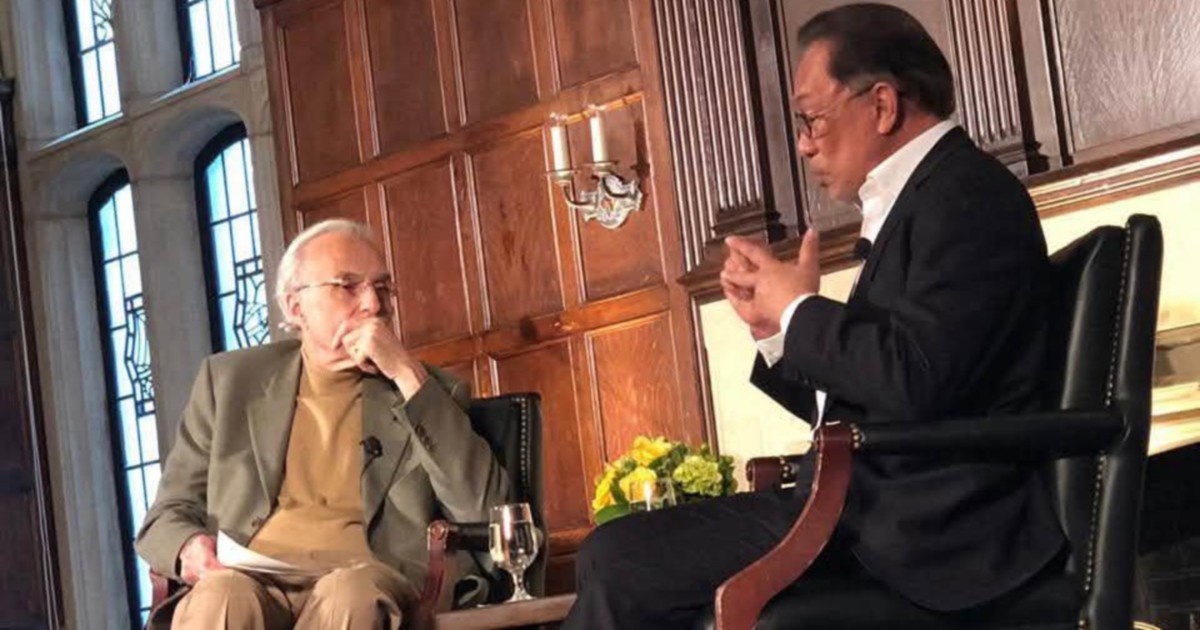
Prime Minister Datuk Seri Anwar Ibrahim has conveyed his condolences following the death of Professor John L. Esposito, a towering academic figure who spent decades shaping international understanding of Islam and its relationship with the modern world. The loss marks the end of an era for Islamic scholarship, with Esposito having wielded considerable influence in bridging academic discourse and policy conversations across Western capitals.
Esposito's contributions to Islamic studies extended far beyond the conventional boundaries of religious scholarship. Throughout his career, he worked to challenge prevailing misconceptions about Islam in Western academic circles and public discourse, positioning himself as an advocate for nuanced, historically grounded analysis rather than oversimplified narratives. His role was particularly significant during periods when geopolitical tensions made such balanced scholarship increasingly difficult to maintain without controversy.
The Georgetown University professor founded the Prince Alwaleed Bin Talal Center for Muslim-Christian Understanding, an institution that reflected his commitment to fostering dialogue between different faith traditions and civilisations. This centre became instrumental in hosting scholars, policymakers, and intellectuals from across the Muslim world and the West, creating spaces where substantive conversations could occur away from inflammatory rhetoric. The initiative represented a deliberate effort to humanise discourse around Islam at a moment when othering and stereotyping had become disturbingly common.
For Muslim-majority nations like Malaysia, Esposito's scholarly work carried particular resonance. His extensive research into Islam's compatibility with democracy, pluralism, and modernisation challenged the notion that Islamic governance and secular liberal values were inherently incompatible. This body of work provided intellectual ammunition to reformists and progressive voices arguing for coexistence between different value systems within diverse societies. Southeast Asian scholars and policymakers frequently drew upon his frameworks when articulating their own visions of Islamic democracy and pluralistic nation-building.
Esposito's influence extended into policy circles, where his analyses shaped how Western governments understood Muslim-majority regions and communities. His nuanced treatment of topics such as political Islam, the relationship between religion and governance, and the diversity within Islamic thought offered alternatives to purely security-focused perspectives that had dominated American foreign policy discourse. This academic gravitas lent credibility to voices arguing against crude generalisations and for differentiated approaches to countries and movements across the Islamic world.
The scholar's prolific output—including over fifty books and countless articles—created a comprehensive intellectual archive that academics, students, and policymakers continue to consult. His willingness to engage with controversial topics without retreating into ideological certainty meant his work retained relevance across changing geopolitical landscapes. From post-9/11 analyses to contemporary discussions about Islamophobia, Esposito's careful scholarship provided reference points for measured discussion.
In the Malaysian context, Esposito's legacy intersects with ongoing conversations about Islam's role in a plural democracy. His work affirmed that Islamic governance structures and religious scholarly traditions could coexist with constitutional democracy and minority protections—frameworks increasingly important as Malaysian society grapples with how to balance religious concerns with secular institutional requirements. His scholarship offered intellectual support to those advocating for inclusive interpretations of Islam that accommodate multiple worldviews.
The passing of such a prominent figure in Islamic studies also underscores a generational transition in academia. As founding scholars retire or pass away, younger researchers must continue the work of producing rigorous, contextualised analysis of Islam in contemporary societies. The void left by Esposito's departure may be felt particularly acutely in Western universities, where institutional commitments to Islamic studies have sometimes wavered amid political pressures.
For Prime Minister Anwar, whose own intellectual biography has been shaped by Islamic thought and reform movements, Esposito represented a particular category of Western scholar—one who approached Islam with intellectual seriousness and refused to treat Muslim-majority societies as mere objects of study divorced from agency and complexity. The expression of condolences reflects not merely formal protocol but acknowledgment of a scholarly legacy that mattered deeply to how Muslims and non-Muslims understand each other.
The legacy that Esposito leaves behind remains relevant precisely because the challenges he sought to address—bridging civilisational divides, countering stereotypes, promoting sophisticated analysis—remain unresolved. His institutional innovations, scholarly output, and commitment to dialogue provide enduring resources for those committed to similar projects. In an era of rising polarisation and renewed geopolitical tensions, the absence of voices as measured and learned as Esposito's makes his contributions to the scholarly record all the more precious.

