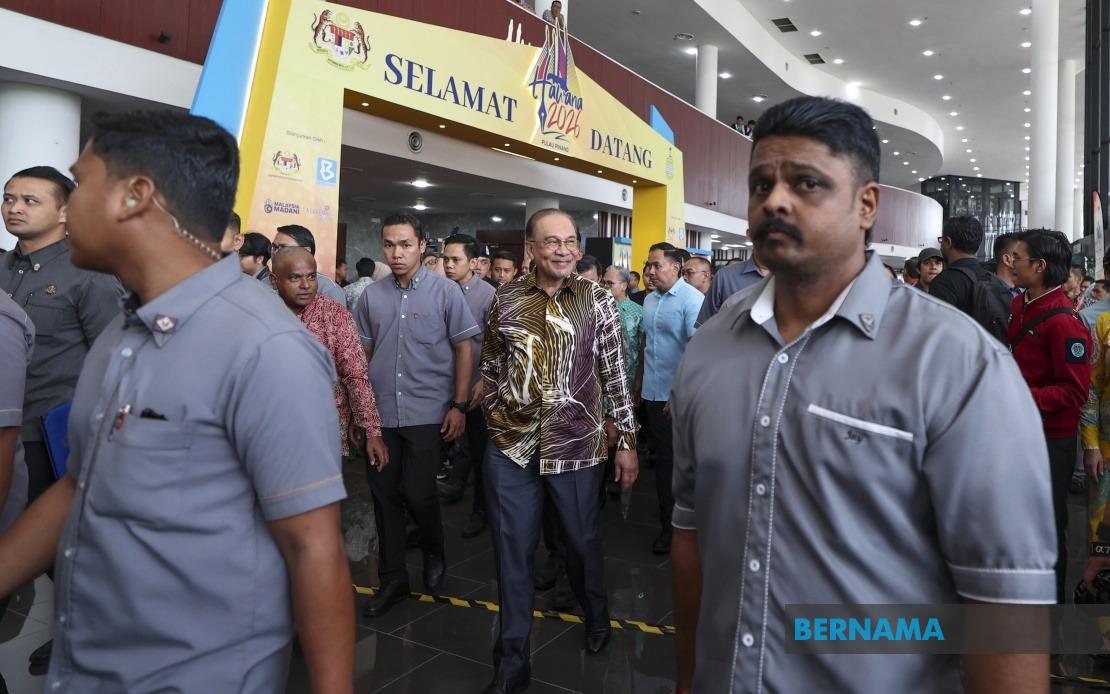
Prime Minister Datuk Seri Anwar Ibrahim arrived at the PICCA Convention Centre @ Butterworth Arena on June 20 to preside over the main event of Malaysia's 2026 National Journalists' Day celebration, underscoring the government's commitment to recognising the vital role of the media in a functioning democracy. His arrival at 2.40 pm was marked by a ceremonial reception involving Penang Chief Minister Chow Kon Yeow, Communications Minister Datuk Fahmi Fadzil, and senior officials from the Communications Ministry, reflecting the significance accorded to the occasion at both federal and state levels.
Before proceedings commenced, the Prime Minister took time to tour the exhibition booths and the HAWANA 2026 Photo Gallery housed within the convention centre's foyer, engaging directly with the displays and materials prepared for the gathering. This informal engagement provided an opportunity to observe firsthand the work and initiatives being showcased by various media organisations and communications stakeholders throughout the country.
The high-profile attendance of Malaysian National News Agency (Bernama) leadership, including chairman Datuk Seri Wong Chun Wai and chief executive officer Datin Paduka Nur-ul Afida Kamaludin, demonstrated the central role played by Malaysia's national news agency in organising and executing the event. The event also drew senior editorial figures including editor-in-chief Arul Rajoo Durar Raj and project director Mohd Shukri Ishak, ensuring comprehensive coordination across Bernama's operations.
The gathering took on a distinctly regional and international character with the presence of ASEAN delegations, reflecting Malaysia's broader engagement with neighbouring countries on matters of media standards and journalism excellence. Timor-Leste's Secretary of State for Social Communication Expedito Loro Dias Ximenes, Cambodia's Undersecretary of State at the Ministry of Information Prak Thaveak Amida, and Laos' Permanent Secretary at the Cabinet Office of the Ministry of Technology and Communications Phuangpasert Keosouvanh attended as representatives of their respective governments. Additionally, senior officials from Timor-Leste's news agency, Agencia Noticiosa de Timor-Leste (TATOLI), including president Noemio Mateus Soares Falcao, participated in the proceedings.
Beyond ASEAN representatives, the event attracted delegates from major international news agencies and journalist associations, including Indonesia's Antara News Agency, the Vietnam News Agency, Xinhua News Agency, and the Indonesian Journalists Association (PWI), as well as the Malaysia-Indonesia Journalists Solidarity Association. This international representation transformed HAWANA 2026 into a platform for cross-border dialogue on journalism standards, media integrity, and the evolving challenges facing news organisations across Asia and beyond.
The centrepiece of the Prime Minister's role involved presenting the HAWANA Award and Special HAWANA Award to individuals whose contributions to journalism have substantially advanced public discourse and journalistic excellence. The awards ceremony served both to recognise outstanding achievement and to reinforce the government's valuation of professional journalism as essential to societal development. Simultaneously, the Prime Minister distributed contributions from the Kasih@HAWANA Fund to veteran media professionals, acknowledging the need for welfare support within the journalism community.
Organised under the thematic framework of 'Media Integrity Strengthens Credibility', the HAWANA 2026 celebration assembled approximately 1,000 media practitioners from Malaysia and internationally, creating a substantive gathering dedicated to advancing journalism standards. This theme carries particular resonance in the contemporary information environment, where public trust in media institutions faces persistent challenges from misinformation, disinformation, and the fragmentation of news consumption patterns. By positioning media integrity at the centre of the discourse, HAWANA 2026 addresses fundamental questions about journalism's role in democratic societies and the conditions necessary for credible public information.
The strategic value of HAWANA as a platform extends beyond ceremonial recognition. The gathering functioned as a venue for generating fresh perspectives on journalism practice, establishing networks among practitioners, and collectively shaping the direction of contemporary media in response to technological disruption and changing audience expectations. For Malaysian journalists and news organisations, the event provided structured opportunity to benchmark practices against international standards and engage with regional counterparts facing similar operational and ethical challenges.
Implemented by the Communications Ministry with Bernama as the executing agency, HAWANA represents a formalised government commitment to elevating journalism through recognition and dialogue. The decision to host the 2026 iteration in Penang, Malaysia's northern gateway with significant historical importance to the nation's development, symbolised the government's intent to distribute high-profile national events across the country rather than concentrating them exclusively in the capital. This geographical choice also facilitated greater participation from journalists and media organisations based in northern Malaysia and southern Thailand who might otherwise face accessibility barriers to attending centrally-located events.
The presence of the Prime Minister at HAWANA 2026 conveyed substantive messaging about the government's relationship with the media sector. Rather than approaching journalism as a constraining force requiring management, the official participation signalled receptiveness to media as a constructive element within the broader governance and public communication framework. This stance aligns with international best practices in democracies that acknowledge professional journalism as essential to informed citizenry and accountable governance structures.
Looking forward, the HAWANA framework demonstrates Malaysia's commitment to maintaining journalism as a serious professional discipline worthy of institutional support and recognition. The integration of ASEAN and international media professionals into the celebration suggests emerging momentum for regional cooperation on media standards, the sharing of best practices among news organisations operating across national boundaries, and the development of collective responses to shared challenges including technological disruption, economic pressures on newsrooms, and the spread of false information.
%22%2F%3E%3C%2Fpattern%3E%3C%2Fdefs%3E%3Crect%20width%3D%22100%25%22%20height%3D%22100%25%22%20fill%3D%22url(%23ph4da0ug)%22%2F%3E%3Crect%20width%3D%22100%25%22%20height%3D%22100%25%22%20fill%3D%22url(%23ph4da0up)%22%2F%3E%3Ctext%20x%3D%2250%25%22%20y%3D%2250%25%22%20text-anchor%3D%22middle%22%20dominant-baseline%3D%22central%22%20fill%3D%22rgba(255%2C255%2C255%2C0.95)%22%20font-family%3D%22Georgia%2C%20'Times%20New%20Roman'%2C%20serif%22%20font-weight%3D%22700%22%20font-size%3D%22320%22%20letter-spacing%3D%22-0.02em%22%3ERare%3C%2Ftext%3E%3C%2Fsvg%3E)
%22%2F%3E%3C%2Fpattern%3E%3C%2Fdefs%3E%3Crect%20width%3D%22100%25%22%20height%3D%22100%25%22%20fill%3D%22url(%23phm749g)%22%2F%3E%3Crect%20width%3D%22100%25%22%20height%3D%22100%25%22%20fill%3D%22url(%23phm749p)%22%2F%3E%3Ctext%20x%3D%2250%25%22%20y%3D%2250%25%22%20text-anchor%3D%22middle%22%20dominant-baseline%3D%22central%22%20fill%3D%22rgba(255%2C255%2C255%2C0.95)%22%20font-family%3D%22Georgia%2C%20'Times%20New%20Roman'%2C%20serif%22%20font-weight%3D%22700%22%20font-size%3D%22320%22%20letter-spacing%3D%22-0.02em%22%3EPM%3C%2Ftext%3E%3C%2Fsvg%3E)
%22%2F%3E%3C%2Fpattern%3E%3C%2Fdefs%3E%3Crect%20width%3D%22100%25%22%20height%3D%22100%25%22%20fill%3D%22url(%23phgab1g)%22%2F%3E%3Crect%20width%3D%22100%25%22%20height%3D%22100%25%22%20fill%3D%22url(%23phgab1p)%22%2F%3E%3Ctext%20x%3D%2250%25%22%20y%3D%2250%25%22%20text-anchor%3D%22middle%22%20dominant-baseline%3D%22central%22%20fill%3D%22rgba(255%2C255%2C255%2C0.95)%22%20font-family%3D%22Georgia%2C%20'Times%20New%20Roman'%2C%20serif%22%20font-weight%3D%22700%22%20font-size%3D%22170%22%20letter-spacing%3D%22-0.02em%22%3EMalaysia%3C%2Ftext%3E%3C%2Fsvg%3E)