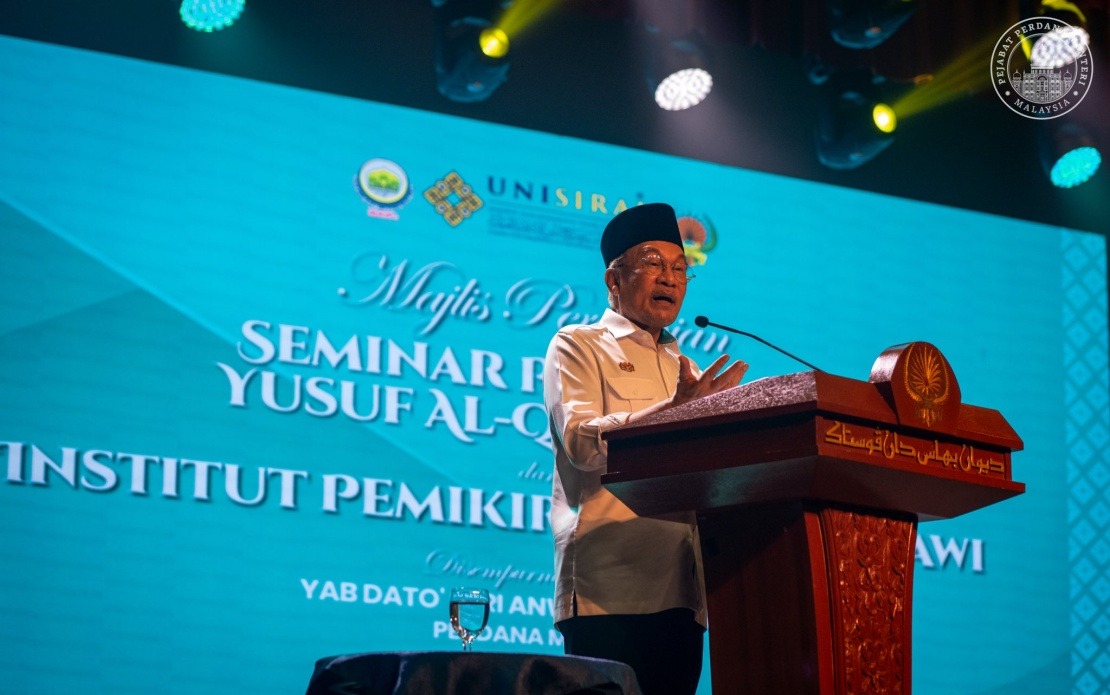
Prime Minister Datuk Seri Anwar Ibrahim unveiled a RM2 million allocation from the MADANI Government to establish the Al-Qaradawi Thought Institute, reinforcing the administration's commitment to advancing Islamic scholarship and intellectual discourse in Malaysia. The announcement came during the opening ceremony of the Yusuf Al-Qaradawi Thought Seminar and the Al-Qaradawi Thought Institute held at Wisma Dewan Bahasa dan Pustaka in Kuala Lumpur on July 21.
The institute will focus on developing comprehensive research programmes examining Sheikh Dr Yusuf Al-Qaradawi's intellectual contributions and their application to contemporary Islamic challenges. According to Anwar's remarks shared via social media, the funding initiative aims to strengthen scholarly work that documents and extends Al-Qaradawi's influence on modern Islamic thought. The Prime Minister expressed his personal appreciation for the scholar, noting that Al-Qaradawi's impact on his own intellectual formation warrants sustained institutional support.
Anwar's tribute to Al-Qaradawi carried deeper significance, revealing the philosophical foundations underpinning the MADANI administration's governance approach. The Prime Minister recalled his formative years with the Malaysian Islamic Youth Movement (ABIM), during which Al-Qaradawi provided critical guidance that shaped his understanding of Islam's relationship with contemporary society. This personal testimony illuminates how classical Islamic scholars continue to influence Malaysia's political leadership and policy direction.
The scholar's most significant contribution to ABIM during the early 1980s Islamic resurgence was his encouragement that the movement maintain intellectual openness and avoid ideological rigidity. Al-Qaradawi's counsel against hardline positions proved transformative, steering ABIM toward wasatiyyah—the Islamic principle of moderation—at a pivotal moment when various currents of religious thought competed for influence. For Anwar, this intervention exemplified Al-Qaradawi's role as a reformist voice capable of navigating complex theological terrain without compromising Islamic authenticity.
The establishment of this institute reflects broader trends in Southeast Asian governance, where Islamic intellectual frameworks increasingly inform policy-making. By institutionalising the study of Al-Qaradawi's work, Malaysia positions itself as a centre for Islamic scholarship that emphasises contextual reasoning and flexible application of religious principles. This contrasts with more doctrinaire approaches that resist adaptation to changing circumstances.
Funding Islamic research institutions also carries implications for regional soft power. As Malaysia seeks to influence Islamic discourse across Southeast Asia and beyond, supporting centres dedicated to moderate, intellectually rigorous Islamic thought serves diplomatic and cultural objectives. The institute will likely attract scholars from neighbouring countries, enhancing Malaysia's standing as an intellectual hub within the Muslim world.
The timing of this announcement is noteworthy given contemporary debates across Southeast Asia regarding the relationship between Islamic practice and democratic governance. Anwar's explicit emphasis on Al-Qaradawi's advocacy for openness and receptivity to diverse viewpoints suggests the government views wasatiyyah not merely as a religious principle but as a governance philosophy applicable to Malaysia's plural society. This framing may offer reassurance to non-Muslim communities regarding the administration's commitment to inclusive policymaking.
The RM2 million allocation, while modest in budgetary terms, carries symbolic weight by prioritising intellectual infrastructure over purely administrative expenditure. This approach reflects an underlying belief that sustained cultural and intellectual influence depends on supporting institutions that produce scholarship, train future thinkers, and preserve important intellectual legacies. For Malaysia, investing in Islamic thought institutions addresses a strategic gap in the regional ecosystem.
Al-Qaradawi's historical significance extends beyond his influence on individual Malaysian politicians. His prolific writings on Islamic jurisprudence, ethics, and contemporary applications of Sharia principles shaped Islamic discourse across the Arab world, South Asia, and Southeast Asia. By sponsoring an institute dedicated to his work, Malaysia acknowledges his regional importance while creating a platform for examining how his methodologies address pressing issues from economic justice to environmental stewardship.
The institute will also serve educational functions, potentially offering graduate programmes and producing scholarly publications that reach academic and policy audiences. Such infrastructure helps ensure that Al-Qaradawi's ideas remain intellectually alive rather than merely historical. For Malaysian students and scholars, access to dedicated research facilities and international collaborations expands opportunities for meaningful engagement with Islamic intellectual traditions.
The establishment of this institute sits within Malaysia's broader strategic positioning in global Islamic affairs. As nations with significant Muslim populations compete for influence within international Islamic organisations and networks, maintaining centres of Islamic excellence becomes increasingly important. Malaysia's track record of producing moderate, intellectually sophisticated Islamic scholarship enhances its credibility in these forums and its capacity to influence theological debates affecting Muslim-majority regions.
Looking forward, the institute's success will depend on its ability to attract world-class researchers, maintain intellectual independence while receiving government support, and produce scholarship that influences both academic and policy circles. The challenge lies in creating an institution that honours Al-Qaradawi's legacy of critical thinking while remaining relevant to contemporary Malaysian and Southeast Asian concerns.

