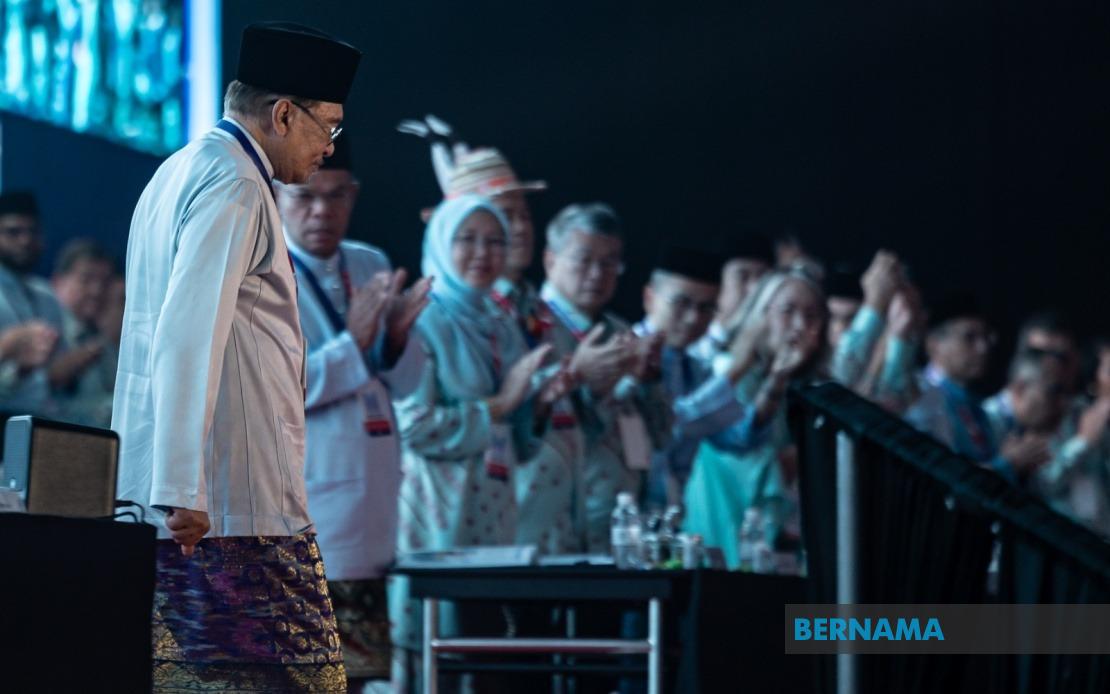
Prime Minister Datuk Seri Anwar Ibrahim moved swiftly to counter emerging criticism that the MADANI Government has treated some states unequally, delivering his rebuttal during the 2026 PKR National Congress in Melaka on Thursday. Speaking before party delegates at the Melaka International Trade Centre in Ayer Keroh, Anwar argued that apparent disparities in state funding reflect strategic policy choices rather than deliberate exclusion, and that absolute spending levels have climbed across the board since his administration assumed office.
The Prime Minister's remarks arrive amid occasional regional grumbling over development priorities and resource distribution, a perennial tension in Malaysian federalism where states governed by opposition parties sometimes voice frustration over centre-state relations. Anwar's defensive posture suggests the government recognizes the political sensitivity of budgetary allocation, particularly in states where the federal government faces entrenched local opposition. By presenting concrete figures, the premier sought to anchor his defence in quantifiable evidence rather than abstract assurances.
Anwar highlighted Sabah's trajectory as his opening illustration, noting that federal expenditure there has climbed by 35 per cent during his three-year tenure, rising from RM13 billion in 2022 to RM17.6 billion in the current budget year. He implicitly challenged opposition figures in the state to explain why such grievances surfaced only under his watch, suggesting they had accepted lower growth rates under previous administrations without comparable complaint. This rhetorical move attempts to reframe the debate from whether states receive enough to whether the rate of increase represents genuine progress.
Sarawak experienced even steeper proportional growth, with allocations jumping nearly half, increasing from RM10.2 billion in 2022 to RM15.1 billion representing a 48 per cent expansion. Peninsular states also featured prominently in Anwar's narrative. Terengganu's allocation nearly doubled, climbing from RM6 billion in 2022 to RM8.1 billion currently, whilst Johor received substantially larger increases, progressing from RM10.2 billion to RM14.6 billion by 2026. Kedah, Kelantan, and Perlis likewise saw budget improvements, though Anwar provided less granular detail for these jurisdictions.
The Prime Minister's emphasis on diverse regional examples underscores an administration-wide strategy to present development as geographically distributed rather than concentrated in particular favoured constituencies. By cataloguing increases across opposition-held territories like Terengganu and Kelantan alongside coalition-friendly states, Anwar attempted to demonstrate that partisan considerations do not dictate resource distribution. This narrative choice becomes significant given Malaysia's fractious state-level politics, where federal funding sometimes becomes weaponized in intra-coalition disputes.
However, the defence raises underlying questions about baseline allocation methodologies that Anwar did not directly address. If certain states began from lower funding floors in 2022, percentage increases may reflect catch-up rather than preferential treatment, a distinction rarely appreciated in public discourse. Conversely, if some states receive proportionally smaller increments despite identical growth percentages, accumulated disadvantage might persist regardless of year-on-year improvements. Anwar's presentation technique, emphasizing both absolute figures and percentage gains, strategically muddies such analytical clarity.
The timing of this address within a party congress setting carries particular significance for internal PKR constituencies. Delegates from various states would naturally monitor whether their regions received adequate recognition within the premier's remarks, and Anwar's comprehensive itemization served both a public relations and intra-party management function. By naming multiple jurisdictions and providing specific numbers, he ensured representatives could carry tangible evidence of investment to their constituents, strengthening party messaging ahead of potential electoral contests.
The broader context involves Malaysian voters increasingly expecting transparent, equitable treatment across state lines, particularly as devolution discussions gain traction and regional inequalities face greater scrutiny. The MADANI administration, positioned as reformist, faces heightened accountability standards regarding fair distribution. Critics nevertheless point out that spending figures alone cannot capture quality, efficiency, or whether allocated funds translate into meaningful improvements for ordinary citizens. Infrastructure projects might be announced extensively yet implemented sluggishly, or funds might concentrate on prestige developments disconnected from grassroots needs.
Anwar's statement implicitly acknowledges that perception problems exist, otherwise no rebuttal would prove necessary. Opposition parties and rival factions have apparently circulated sufficient narratives of regional neglect to prompt the Prime Minister's direct intervention. This defensive posture, whilst backed by statistical ammunition, inadvertently validates that the government recognizes vulnerability on this issue. Future months will reveal whether these budgetary increases translate into visible developmental momentum that quiets complaints, or whether allegations resurface as implementation timelines extend.
Looking forward, the government's reliance on numerical justification suggests awareness that Malaysian federalism increasingly demands demonstration of equitable regional investment as a legitimacy marker. Whether allocation percentages or absolute spending levels capture proper fairness remains contested terrain. Anwar's solution—provide bigger numbers across all states—offers short-term messaging advantage but leaves unresolved the fundamental equity questions that animate regional discontent. For states and constituencies evaluating governance performance, whether their federal allocations represent proportionate investment relative to population, development needs, and revenue contributions will continue shaping political calculations and electoral behaviour.

