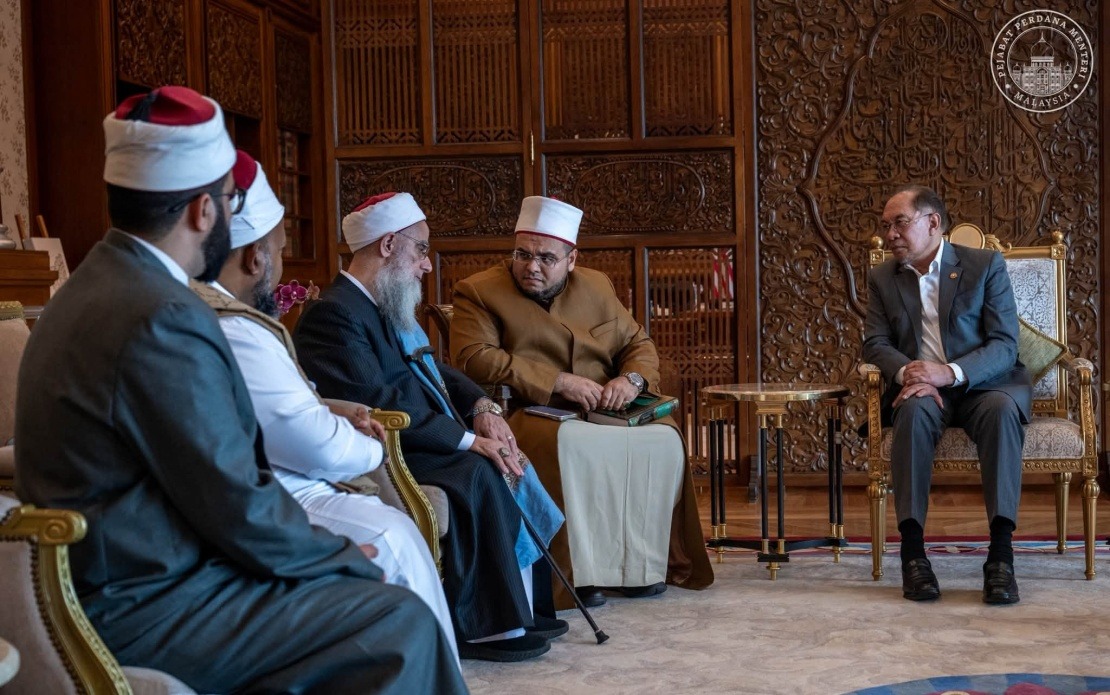
Prime Minister Datuk Seri Anwar Ibrahim received Sheikh Dr Mustafa An-Nadwi Al-Hasani Mansurah, a distinguished Egyptian Islamic scholar, at his official residence in Putrajaya on Friday. The meeting underscored the continued engagement between Malaysian leadership and prominent Islamic intellectuals from the broader Muslim world, reflecting the nation's commitment to fostering dialogues around scholarship and moral philosophy.
In marking the occasion through social media, Anwar highlighted Sheikh Dr Mustafa's scholarly credentials and his particular expertise in hadith studies, the body of teachings and practices attributed to Prophet Muhammad. The Prime Minister characterised the Egyptian scholar as an intellectual figure whose work exemplifies the prioritisation of ethical principles, profound wisdom and rigorous knowledge acquisition—qualities he suggested are increasingly rare in contemporary discourse dominated by sensationalism and superficial engagement.
Sheikh Dr Mustafa traces his intellectual lineage to Sheikh Abul Hasan Ali al-Nadwi, one of the twentieth century's most influential Islamic thinkers and preachers whose works shaped Islamic thought across South Asia, the Arab world and beyond. This genealogy of knowledge positions Sheikh Dr Mustafa within a respected scholarly tradition that emphasises balanced interpretation of Islamic teachings and their application to modern challenges. For Malaysian audiences, this connection carries significance given the country's own engagement with moderate Islamic scholarship and the role prominent Muslim intellectuals have played in shaping regional discourse.
The Prime Minister's characterisation of contemporary intellectual life as overshadowed by sensationalism reflects broader concerns within Islamic circles about the dominance of entertainment-driven media and the marginalisation of substantive learning. Anwar's framing of knowledge and wisdom as arriving "like the morning dew, quiet, gentle, yet capable of bringing life" suggests a philosophical approach emphasising the transformative power of authentic scholarship over dramatic or attention-seeking discourse. This imagery resonates with traditional Islamic pedagogical values emphasising contemplation and gradual enlightenment.
During their meeting, both figures discussed ongoing matters affecting Malaysia and the global community, though specific details of their conversations remain private. The timing of Sheikh Dr Mustafa's Malaysian visit, occurring during a week when he was conducting knowledge sessions with local audiences, indicates a broader engagement extending beyond governmental circles. Such knowledge-sharing initiatives reflect the transnational nature of Islamic intellectual networks and Malaysia's role as a hub for Islamic learning in Southeast Asia.
Anwar's public acknowledgment of the meeting carries diplomatic significance. By elevating the encounter to the level of official recognition through his office and social media platforms, the Prime Minister signals Malaysia's receptiveness to international Islamic scholarship and intellectual exchange. This approach aligns with his previously stated commitments to promoting moderate Islam and engaging with respected voices within the global Islamic community.
The Prime Minister extended gratitude to Sheikh Dr Mustafa for counsel offered during their discussion and particularly for prayers extending blessings upon Malaysia's continued cohesion and prosperity. This reciprocal exchange of blessings reflects the spiritual dimension of diplomatic engagement between Islamic leaders, where invocations for divine protection and favour constitute important dimensions of state relations within Islamic diplomatic protocols.
Anwar concluded by offering prayers for Sheikh Dr Mustafa's continued health, the expansion and blessing of his scholarly work, and his ongoing capacity to provide guidance rooted in wisdom, moderation and compassion. This formulation—emphasising moderation and compassion alongside wisdom—echoes key themes in Anwar's own intellectual and political positioning, suggesting alignment between his vision for Malaysia's Islamic engagement and the values represented by his Egyptian guest.
For Malaysia, such meetings reflect the country's positioning as a bridge between diverse Islamic intellectual traditions and its role in the broader Muslim world. The engagement demonstrates continuity in Malaysia's approach toward fostering relationships with respected Islamic scholars from other regions, an effort that has both cultural and strategic dimensions. As Malaysia navigates complex challenges including religious harmony, social cohesion and its place within evolving global geopolitical dynamics, interactions with international Islamic intellectuals contribute to the nation's intellectual resources and soft power.
The visit also underscores the continued vitality of personal scholarly networks and face-to-face intellectual exchange despite globalisation and digital connectivity. Sheikh Dr Mustafa's presence in Malaysia and his knowledge sessions suggest that traditional modes of Islamic learning and transmission remain valued channels for spreading ideas and fostering understanding. For Malaysian Islamic scholars and students, such visits provide opportunities for direct engagement with internationally recognised intellectual figures and exposure to different schools of Islamic thought.
Looking forward, this meeting exemplifies how governments and civil society can facilitate meaningful cross-cultural and inter-Islamic dialogue. By creating space for such exchanges, Malaysia reinforces its image as an open, intellectually engaged society committed to substantive engagement with the Islamic world. The Prime Minister's public embrace of the encounter sends signals about the value placed on scholarship, wisdom and the pursuit of knowledge within Malaysian governance circles.

