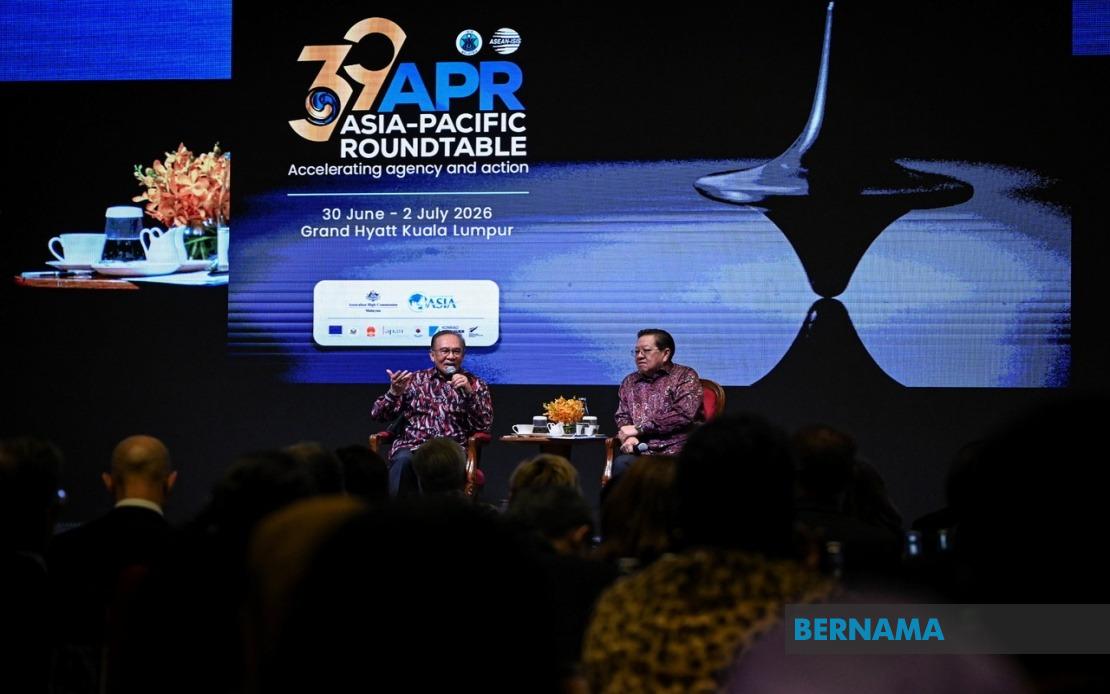
Prime Minister Datuk Seri Anwar Ibrahim has firmly rejected the notion that armed conflict in the South China Sea represents an inescapable outcome, instead championing dialogue, mutual trust, and respect for international law as the genuine pathways toward safeguarding peace and stability across the region. Speaking during a question-and-answer session at the 39th Asia-Pacific Roundtable in Kuala Lumpur on Thursday, Anwar articulated Malaysia's pragmatic approach to one of the world's most sensitive geopolitical flashpoints, underscoring that anxieties about inevitable confrontation do not reflect the reality of on-the-ground relations or diplomatic progress.
The Malaysian leader's comments come against a backdrop of heightened international concern regarding overlapping maritime claims, military activities, and competing strategic interests in the contested waters. Anwar's intervention at this forum—bringing together policymakers, academics, and strategic thinkers from across Asia-Pacific—represents an effort to recalibrate the narrative away from zero-sum assumptions and toward constructive engagement. His remarks carry particular weight given Malaysia's own significant interests in the waters and its role within ASEAN as a voice for consensus-based approaches to regional challenges.
Drawing on his personal diplomatic experience, Anwar emphasized that Malaysia has sustained substantive and productive engagement with China notwithstanding the maritime disputes that formally exist between them. The Prime Minister disclosed that he has discussed these sensitive matters directly with President Xi Jinping and Premier Li Qiang, relationships he characterized as excellent and fundamentally free from the kind of major flashpoints that typically ignite geopolitical tensions. This framing is significant as it suggests that official channels remain open and that higher-level political commitment exists to compartmentalize disputes from broader bilateral relations.
Anwar highlighted China's stated commitment to the United Nations Convention on the Law of the Sea (UNCLOS), an international framework that theoretically provides binding mechanisms for resolving maritime claims and managing ocean resources. He also referenced the ongoing negotiations surrounding the ASEAN-China Code of Conduct in the South China Sea, a multilateral initiative aimed at establishing agreed behavioral norms and peaceful dispute-resolution mechanisms. For Malaysia and other claimant states, the successful conclusion of such a code would represent tangible progress toward institutionalizing restraint and creating enforceable protocols for managing disagreements.
Critically, the Prime Minister cautioned against what he termed excessive preoccupation with warfare scenarios and conflict predictions. Such narratives, Anwar suggested, can become self-fulfilling by creating psychological conditions that push decision-makers toward adversarial postures and military preparedness rather than diplomatic solutions. His warning aligns with broader academic arguments about how threat perceptions can paradoxically increase conflict risks through spiral dynamics, where defensive measures by one party trigger counter-measures by others, gradually escalating tensions. In this light, his emphasis on maintaining diplomatic commitment and engagement serves both practical and symbolic functions.
REGIONAL diplomacy, according to Anwar, ultimately rests upon the strength of personal relationships between ASEAN leaders. He credited decades of relative peace in Southeast Asia to the habits of regular, direct communication among national leaders who prioritize resolving differences through dialogue before tensions metastasize into more serious confrontations. This observation underscores how informal institutional mechanisms—the repeated meetings, phone calls, and bilateral visits that constitute the backbone of ASEAN's consensus culture—can prove as important as formal legal structures in preventing conflict. The Malaysian government's continued emphasis on these relationships reflects confidence in ASEAN's collective capacity to manage internal and external pressures through established frameworks.
Beyond the South China Sea itself, Anwar extended his diplomatic philosophy to other regional disputes, notably the long-standing Cambodia-Thailand border tensions. He welcomed both nations' stated commitment to continued negotiations, characterizing many border disagreements across Asia as inheritances from the colonial period rather than products of contemporary competition. This historical perspective provides useful context for Malaysian readers, many of whom understand the country's own border complexities with Thailand and Brunei as similarly rooted in legacy agreements and administrative demarcations that predate modern nation-states. By framing such disputes as legacies requiring patient resolution rather than existential threats, Anwar implicitly argues for tempering expectations about immediate settlements while maintaining pressure for gradual progress.
Anwar's confidence in sustained dialogue and mutual trust as vehicles for eventual peaceful settlement reflects an underlying optimism about rational interests and the capacity for compromise. Whether this confidence is empirically justified remains contested among strategic analysts, some of whom worry that deepening economic interdependence and military modernization may paradoxically increase conflict risks if political relationships deteriorate. Nevertheless, from Malaysia's perspective, maintaining this optimistic framing serves domestic and international audiences by signaling stability, attracting foreign investment, and positioning the country as a responsible voice for regional peace rather than as an alarmist or provocateur.
The Prime Minister's remarks also implicitly addressed ASEAN's broader role as a forum for managing great power competition. By rejecting conflict inevitability and reaffirming commitment to dialogue, Anwar reinforced ASEAN's central diplomatic mission: preserving space for smaller and medium-sized nations to maintain relationships with multiple major powers without being forced into zero-sum alignments. For countries like Malaysia, which maintain substantial interests across China, the United States, India, and Europe, this balancing act remains essential to national autonomy and economic prosperity. Anwar's intervention at the Asia-Pacific Roundtable served to publicly affirm this principle and discourage external pressures that might force ASEAN members into more exclusive strategic partnerships.
Looking forward, the question remains whether dialogue and institutional mechanisms can sustain regional peace as military capabilities expand and strategic competition intensifies. Anwar's advocacy for UNCLOS compliance, the Code of Conduct negotiations, and direct leader-to-leader communication represents Malaysia's bet on the durability of these approaches. Whether coupled with practical confidence-building measures, transparency mechanisms, and tangible economic incentives for cooperation, such diplomatic tools may indeed prevent the worst-case scenarios that preoccupy strategic planners. In advocating against conflict narratives while simultaneously pushing for concrete institutional progress, the Prime Minister articulated a position that many regional stakeholders share: that Southeast Asia's peace and prosperity depend upon sustained commitment to multilateral engagement over military confrontation.

