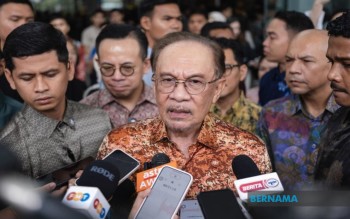
Prime Minister Datuk Seri Anwar Ibrahim has drawn a clear line on taxation policy, declaring that the government will not resurrect the core principles of the Goods and Services Tax despite ongoing discussions about reforming Malaysia's consumption tax regime. Speaking at the TikTok Shop Summit 2026 in Kuala Lumpur, Anwar, who also holds the Finance Ministry portfolio, stressed that any future tax adjustments must remain faithful to the MADANI government's founding commitment: protecting the poorest segments of society from bearing increased tax burdens.
The statement represents a decisive response to mounting pressure from various quarters suggesting that Malaysia should consider reintroducing aspects of the GST to strengthen government revenue and meet fiscal targets. Since abandoning the GST in 2018 following intense public backlash over cost-of-living pressures, Malaysia has relied on the Sales and Service Tax as its primary consumption tax mechanism. That transition resonated deeply with voters who viewed the broad-based GST as regressive, and Anwar's comments indicate this political lesson remains embedded in government thinking.
Anwar's nuanced position acknowledges that the current SST framework may benefit from modernisation without fundamentally reversing the 2018 decision. He indicated the government could explore selective modifications to how SST operates or examine certain components of the GST model if they served the goal of greater progressivity and implementation efficiency. This measured approach reflects the administration's desire to balance fiscal needs against its redistributive ideology, recognising that revenue shortfalls demand creative solutions beyond simply resurrecting unpopular taxes.
The timing of Anwar's clarification follows recent government exploration of alternative revenue mechanisms, including proposals for taxation on electronic payment transactions designed to widen the tax base without directly raising rates on essential goods and services. Such measures exemplify how policymakers are attempting to resolve Malaysia's chronic revenue challenges—estimated deficits running several billion ringgit annually—through lateral thinking rather than blunt instruments like GST reintroduction. This incremental approach may prove more politically viable while still generating additional resources for government spending.
The GST debate carries particular significance for Malaysian consumers and businesses grappling with economic uncertainty. When the previous government introduced GST at six per cent in 2015, it triggered sustained public discontent, contributing to electoral consequences that eventually culminated in regime change. By explicitly disavowing GST's foundational logic, Anwar signals that his administration has internalised this voter sentiment. The decision reflects an understanding that tax policy cannot be divorced from political sustainability, particularly in a nation where cost-of-living concerns dominate household conversations across income levels.
For Malaysia's business community, the Prime Minister's remarks provide conditional reassurance. Rather than facing sudden imposition of broad-based taxation that would necessitate significant compliance infrastructure adjustments, companies can anticipate evolution of existing SST mechanisms. This continuity allows businesses to plan investment and pricing strategies with greater predictability, though the prospect of electronic payment taxation or other innovative levies means complete certainty remains elusive. Companies operating across Southeast Asia, meanwhile, may view Malaysia's commitment to consumption tax stability as a competitive advantage in attracting regional investment.
The distinction between GST's principle and specific technical components offers analytical flexibility that Anwar appears positioned to exploit. Certain GST design elements—such as input tax credit mechanisms or exemption structures—might theoretically be incorporated into an enhanced SST framework without formally reintroducing the tax that triggered the 2018 consumer uprising. This allows policymakers to pursue efficiency gains while maintaining political cover. Whether voters would accept such technical borrowing from GST methodology, however, remains an open question that could prove consequential in future electoral cycles.
Regional comparisons underscore the challenge facing Malaysian decision-makers. Singapore's seven per cent GST and Thailand's seven per cent VAT coexist with broader social safety nets than Malaysia currently provides, suggesting that consumption tax levels depend partly on complementary welfare spending. If Malaysia were to expand redistributive programmes significantly—a priority under the MADANI framework—public acceptance of consumption taxation might shift. Conversely, without such complementary measures, GST or similar mechanisms will likely face continued resistance, constraining revenue-raising options.
The government's revenue imperative, however, cannot be ignored indefinitely. Malaysia's fiscal deficit, persistently above three per cent of GDP, reflects structural imbalances between spending commitments and tax collection that cannot be addressed solely through administrative efficiency or economic growth. Electronic payment transaction taxes, wealth taxes, improved property taxation, and other measures being considered represent practical responses to this bind. Anwar's rejection of GST, therefore, should be understood not as abandonment of tax reform but rather as channelling reform efforts toward mechanisms perceived as more equitable or politically acceptable.
Looking ahead, the tension between fiscal necessity and political constraint will define taxation policy throughout Anwar's tenure. The government must simultaneously convince markets of its fiscal seriousness while reassuring voters that their purchasing power and living standards will not be eroded. This balancing act requires sustained economic growth, improved tax compliance, and selective revenue innovation—a complex equation with limited margin for error. The Prime Minister's carefully calibrated stance on GST suggests his administration understands these pressures and is determined to navigate them without retreating to policies that triggered previous political turbulence.

