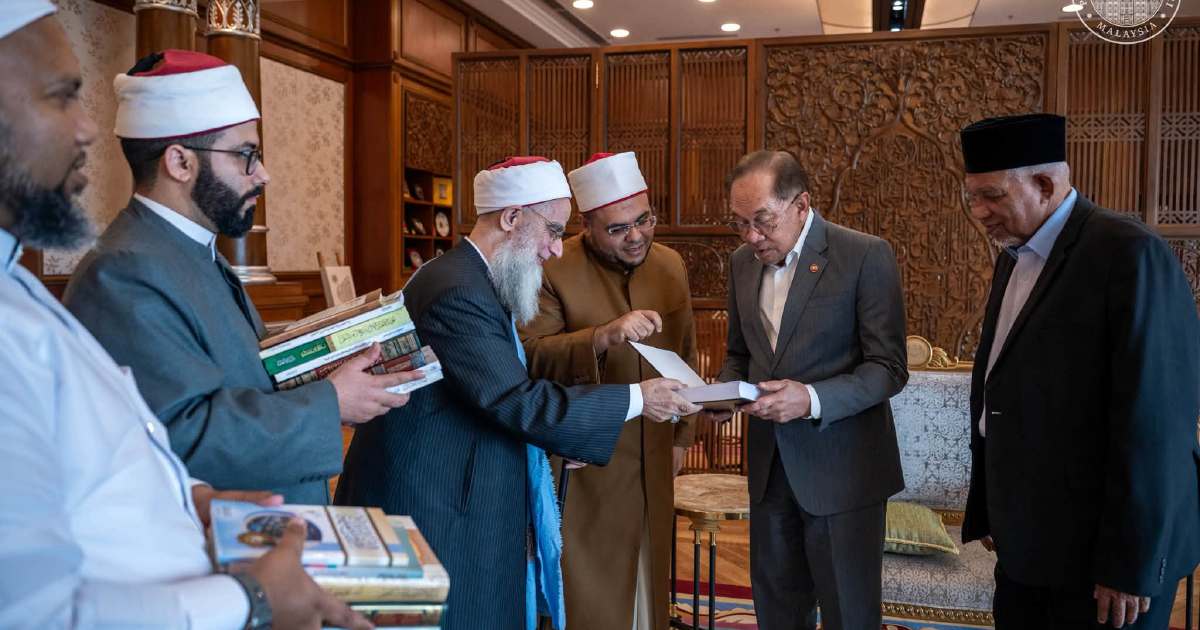
Prime Minister Datuk Seri Anwar Ibrahim received a visit from distinguished Egyptian scholar Sheikh Dr Mustafa An-Nadwi Al-Hasani Mansurah at his official residence in Putrajaya, underscoring Malaysia's commitment to fostering closer ties with prominent Islamic intellectuals from the Arab world.
The reception reflects an ongoing pattern of high-level engagement between Malaysia's political leadership and influential religious scholars across the Muslim-majority regions, particularly from Egypt—a nation that has long served as a cultural and intellectual hub for Islamic thought and tradition. Such diplomatic courtesies between government officials and respected academics signal the government's recognition of the importance of scholarly networks in promoting interfaith understanding and regional cooperation.
Sheikh Dr Mustafa An-Nadwi, whose scholarly credentials span multiple disciplines within Islamic studies, represents the calibre of intellectual figures with whom Malaysia's leadership maintains dialogue. The Egyptian academic tradition has historically wielded considerable influence throughout the Islamic world, including across Southeast Asia, where many Islamic scholars have trained and drawn inspiration. His presence in Malaysia therefore carries significance beyond a simple courtesy call, potentially opening avenues for academic collaboration and knowledge exchange.
Anwar Ibrahim's tenure as Prime Minister has been marked by efforts to position Malaysia as a bridge between different civilizations and faith communities. His engagement with international scholars, particularly those from the Islamic world, demonstrates a deliberate strategy to elevate Malaysia's profile as a nation that values intellectual discourse and cultural diplomacy. Such interactions contribute to broader national initiatives aimed at promoting moderate Islamic thought and countering extremist narratives.
The Putrajaya office serves as a symbolic location for such meetings, representing the seat of executive power and Malaysia's aspirations as a modern, forward-thinking nation. Receiving distinguished foreign visitors there signals the importance placed upon the interaction and reflects the priority assigned to the guest within diplomatic protocol. The choice to host the meeting at this venue rather than at alternative locations underscores the gravitas attached to the engagement.
for Malaysian readers, the significance of such scholarly exchanges extends beyond ceremonial protocol. Egypt's educational institutions, particularly institutions like Al-Azhar University, have long been destination points for Malaysian Islamic scholars seeking advanced religious education. The presence of a renowned Egyptian academic in Putrajaya suggests potential opportunities for strengthening institutional partnerships between Malaysian universities and their Egyptian counterparts, benefiting students and researchers from both nations.
The broader context of Middle Eastern engagement also merits attention. Malaysia has historically maintained strong diplomatic relationships with Arab states and has sought to position itself as a representative of Southeast Asian Muslim interests within international forums. Regular interactions with prominent Islamic scholars from these regions reinforce these connections and demonstrate Malaysia's continued investment in maintaining cultural and intellectual bonds with the broader Islamic world.
Such visits often precede announcements regarding collaborative initiatives, academic programmes, or cultural exchange agreements. The exact nature of discussions between the Prime Minister and Sheikh Dr Mustafa An-Nadwi remains undisclosed, but these high-level meetings typically address areas of mutual interest, including religious education, interfaith dialogue initiatives, and the promotion of Islamic scholarship that emphasizes moderation and contemporary relevance.
The timing of such diplomatic engagement is also noteworthy. As Malaysia navigates complex regional geopolitical dynamics and internal religious discourse, engagement with respected international Islamic figures provides intellectual resources and external validation for the nation's approach to balancing modernity with religious tradition. This positions Malaysia favourably among Muslim-majority nations while also enhancing its standing as a responsible custodian of Islamic values in a pluralistic context.
For Southeast Asian observers, Malaysia's active cultivation of relationships with Arab scholars demonstrates the region's desire to remain connected to broader Islamic intellectual currents rather than developing in isolation. This openness to international scholarly engagement reflects confidence in Malaysia's own educational and cultural institutions, while signalling to international audiences that Malaysia remains an important node within global networks of Islamic thought and practice.
The reception of Sheikh Dr Mustafa An-Nadwi also indicates Malaysia's continued prioritization of soft power diplomacy. Rather than relying solely on economic or military instruments, the nation leverages cultural, religious, and intellectual attractions to advance its interests and influence. Scholars and religious leaders often carry considerable weight within their respective communities, making their impressions of Malaysia valuable for shaping international perceptions and potentially encouraging deeper engagement between institutions.
Looking forward, such interactions may catalyze formal partnerships in research, education, and cultural production. Malaysian universities increasingly seek international collaborations to enhance their global rankings and research output, while Arab institutions benefit from Southeast Asian perspectives on Islamic practice in diverse societies. These exchanges therefore represent investments in long-term institutional relationships that generate benefits extending well beyond the initial diplomatic courtesy.

