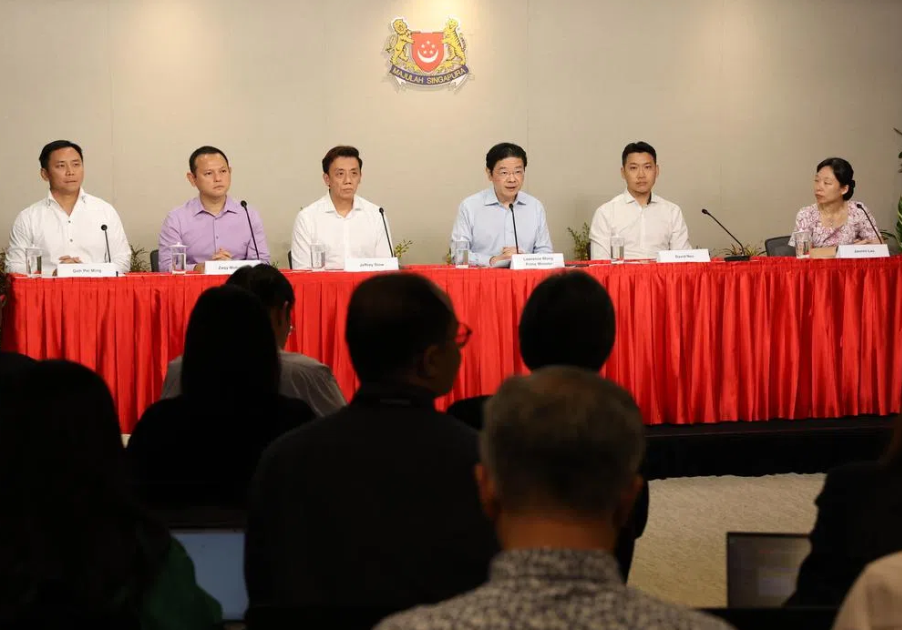
Singapore's leadership landscape is undergoing a significant transformation following Prime Minister Lawrence Wong's Cabinet reshuffle announced on July 22. The restructuring represents a deliberate calibration between maintaining governmental stability through seasoned administrators and accelerating the rise of a younger cohort of politicians deemed ready for expanded responsibilities. This balancing act has become increasingly critical as the city-state navigates multiple challenges that demand both institutional experience and fresh perspectives.
The most prominent promotions centre on two general election newcomers gaining full ministerial status. Jeffrey Siow will advance to minister while continuing as Transport Minister, a portfolio he has stewarded since May 2025 in an acting capacity. David Neo similarly transitions to minister while maintaining his position overseeing Culture, Community and Youth, having served in that role on an interim basis. Both politicians have, according to Wong, demonstrated sufficient competence and earned the backing of cabinet colleagues and civil service leadership during their probationary periods in these roles.
Among other first-term legislators, Jasmin Lau now assumes the acting ministership of the Manpower Ministry, a shift requiring her to navigate labour relations and workforce development during economically sensitive times. Tan See Leng, who relinquishes the Manpower brief, redirects his efforts toward Trade and Industry with specific oversight of energy and industrial sectors—a portfolio demanding technical acumen amid regional economic competition. This reassignment reflects calculated matching of individual capabilities to evolving governmental priorities rather than mere positional shuffling.
Two additional backbench members and former senior civil servants—Foo Cexiang and Shawn Loh—graduate to ministerial-of-state appointments, positions that typically serve as intermediate stages before full ministerial elevation. Their backgrounds in public administration provide continuity and institutional knowledge to the incoming generation. Simultaneously, Sim Ann's appointment as Second Minister for Foreign Affairs and Home Affairs signals deepening responsibility in the foreign policy domain, underscoring Singapore's continued emphasis on sophisticated diplomacy and internal security management.
The reshuffle simultaneously reinforces the government's senior echelon through strategic repositioning of veteran operators. K. Shanmugam transitions to Senior Minister, joining Lee Hsien Loong in that tier—a deliberate architectural choice acknowledging that the two carry the deepest experience within the current Cabinet structure. Ng Chee Meng, the labour movement's chief, returns to the Cabinet as Minister in the Prime Minister's Office after previous service, introducing union-connected perspective into strategic policy discussions. These appointments reflect recognition that generational succession requires experienced mentors guiding emerging leaders through complex decision-making processes.
PM Wong articulated the philosophical underpinning of these changes during his press conference at the National Press Centre, emphasising that Singapore requires both the steady hands of experienced navigators and dynamic energy of newer politicians prepared to tackle future obstacles. He portrayed the reshuffle not as a sharp break from established practice but rather as an incremental progression within a carefully managed transition framework. This narrative positioning domestically signals continuity and reduces anxiety among both political actors and the broader population about fundamental governance instability.
The timing of these changes emerged partly from unforeseen circumstances. Faishal Ibrahim, serving as Acting Minister-in-charge of Muslim Affairs and Senior Minister of State for Home Affairs, resigned on July 20 following what he characterised as a "lapse of judgment" regarding personal interactions. Earlier in June, Koh Poh Koon departed from political office citing family considerations. Such unexpected departures compelled Wong to calibrate the Cabinet sooner than the usual annual review cycle, forcing accelerated promotions to fill vacancies and maintain functional continuity across all ministerial portfolios.
Wong addressed questions about whether Singapore's leadership structure required a second deputy prime minister alongside incumbent Gan Kim Yong, declining to create that position while acknowledging that the arrangement remains perpetually subject to reassessment. Instead, he highlighted the expanded role of coordinating ministers—positions held by Shanmugam for national security and recently assigned to Chan Chun Sing and Ong Ye Kung overseeing other governmental sectors. This architecture distributes senior responsibility across multiple individuals rather than concentrating power in a single deputy position, reflecting contemporary thinking about organisational resilience.
Regarding his own tenure as finance minister since 2021, Wong indicated that locating a suitable successor represents ongoing work rather than an imminent transition. He acknowledged that leadership capacity develops unevenly across individuals, requiring calibrated assessments of readiness before elevation. This measured approach contrasts with more hurried succession models and suggests that the Singapore establishment prioritises demonstrated competence over rigid timeline adherence when positioning politicians for critical economic portfolios.
For Malaysian observers and broader Southeast Asian audiences, Singapore's Cabinet dynamics warrant attention as a case study in professional bureaucratic succession. The city-state's approach emphasises meritocratic progression, technical preparation in acting capacities before formal promotion, and deliberate mentoring structures that attempt to transmit institutional knowledge across generational boundaries. These mechanisms stand in contrast to some regional alternatives where political succession becomes more personalised or faction-driven.
The reshuffle also carries implications for Singapore's positioning within regional economic and security frameworks. With Shanmugam elevated to senior minister status overseeing national security coordination and Sim Ann deepening involvement in foreign affairs, the government signals sustained commitment to sophisticated external engagement. These appointments suggest continuity in the Lion City's diplomatic posture and security relationships, which matter significantly for neighbouring economies dependent on Singapore's role as a regional financial and strategic hub.
Wong stressed that this restructuring exemplifies Singapore's "continuous process" of leadership renewal, avoiding the impression of either stagnation or destabilising upheaval. By characterising the changes as progression rather than rupture, he seeks to maintain investor confidence, political predictability, and institutional legitimacy simultaneously. The appointment of first-term politicians to substantial responsibilities, coupled with retention of veterans in guiding roles, embodies this incrementalist philosophy that has underpinned Singapore's governance model across multiple decades.

