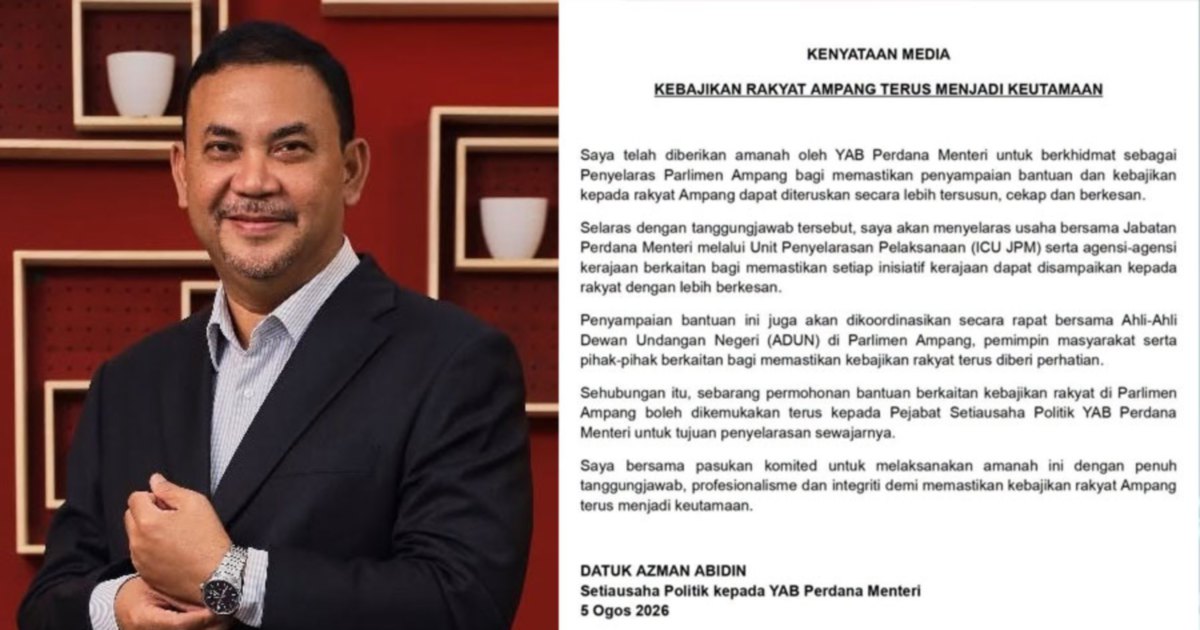
A senior political secretary working within Prime Minister Datuk Seri Anwar Ibrahim's office has taken on the role of parliamentary coordinator for the Ampang constituency, marking a significant administrative shift in the federal territory area. The appointment comes as PKR lawmaker Rodziah Ismail faces a suspension preventing her access to the MyKhas constituency allocation system, a development that raises questions about the structural dynamics within Pakatan Harapan's representation mechanisms and the balance of power within parliamentary oversight functions.
The MyKhas system represents a critical infrastructure for Malaysian lawmakers, enabling them to manage and allocate resources intended to benefit their constituencies. Access suspension from such a system effectively constrains an MP's ability to implement grassroots initiatives and respond to constituent needs, making the loss of such privileges a substantial practical impediment to parliamentary work. For Rodziah Ismail, this suspension marks a notable setback in her capacity to discharge her representative duties, particularly given that Ampang remains an urban constituency with complex socioeconomic demands requiring consistent engagement and resource allocation capabilities.
The appointment of a PM's political secretary to the coordinator position introduces a hierarchical complexity into Ampang's parliamentary structure. Such coordinators typically serve as intermediaries between the constituency secretariat and broader party or government apparatus, managing administrative functions and ensuring alignment between local initiatives and higher-level strategic objectives. The involvement of a figure from the Prime Minister's immediate political orbit suggests heightened central coordination or oversight of the parliamentary function in this particular constituency.
Contextually, this development reflects broader patterns within Malaysian politics where administrative and financial instruments become interwoven with political management strategies. The MyKhas system's controls can effectively modulate an MP's operational independence, creating practical incentives for alignment with prevailing party or government positions. For constituencies with complex political dynamics or where incumbent representatives face organisational pressures, such administrative mechanisms become instrumentally significant.
Anders Ismail's constituency represents an interesting case study within federal territory politics. Ampang encompasses diverse demographic zones ranging from affluent residential areas to informal settlements, presenting varied constituent demands. The MP's ability to respond to these varied needs through coordinated resource allocation remains fundamental to effective representation. Any constraint on such capabilities necessarily reduces the range of interventions available to address local concerns.
Within PKR's internal dynamics, this situation illuminates ongoing tensions regarding party discipline and resource management. The Ampang constituency has represented one of the party's important seats, and developments affecting its parliamentary operations carry implications for party positioning within Selangor's broader political geography. The suspension of Rodziah Ismail's system access suggests underlying dissatisfaction with her operational direction or alignment with party priorities, though official statements have not comprehensively detailed the specific precipitating factors.
The appointment of a PM's aide introduces questions regarding the distinction between party-level decision-making and governmental administrative functions. While parliamentary coordinators perform what appear to be routine administrative roles, their positioning within hierarchies of authority can reflect deeper power distribution patterns. A coordinator operating under direct PM office supervision necessarily operates under different accountability frameworks than those appointed through standard party structures, potentially affecting how local parliamentary work interfaces with broader government machinery.
For Malaysian voters and observers tracking democratic governance dimensions, such appointments warrant scrutiny regarding the exercise of administrative power and its relationship to electoral representation. When access to constituent allocation systems becomes tied to broader political positioning, questions arise about whether resource distribution mechanisms serve purely functional purposes or become intertwined with mechanisms of political control. The transparency of criteria determining system access suspension becomes particularly relevant in assessing governmental administrative practices.
Regionally, this situation connects to broader Southeast Asian patterns where administrative systems intersect with political management. Malaysian electoral politics has long featured sophisticated use of administrative instruments alongside traditional party mechanisms. Understanding these dynamics remains essential for comprehending how governance operates at the intersection of formal democratic structures and practical political management.
The implications for Ampang constituents remain significant. Regardless of the political circumstances precipitating these changes, residents require responsive parliamentary representation capable of efficiently mobilising available resources. The coordination transition and accompanying fund access constraints create operational challenges that ultimately affect service delivery capacity at the constituency level.
Moving forward, the sustainability of this arrangement depends partly on how Ampang's political stakeholders navigate the tensions between centralised oversight and constituency-level operational flexibility. If the coordination structure proves effective in maintaining service delivery while meeting higher-level coordination requirements, it may establish a precedent. Conversely, if constituent satisfaction declines materially, pressure will likely mount for recalibrating the governance arrangement.
The broader implications extend beyond Ampang specifically. This situation contributes to an evolving template for how federal government offices may interface with parliamentary representation mechanisms, potentially influencing patterns across multiple constituencies. Political actors throughout Malaysia will observe how these administrative arrangements function in practice, informing their own strategic calculations regarding governance structure and coordination mechanisms.

