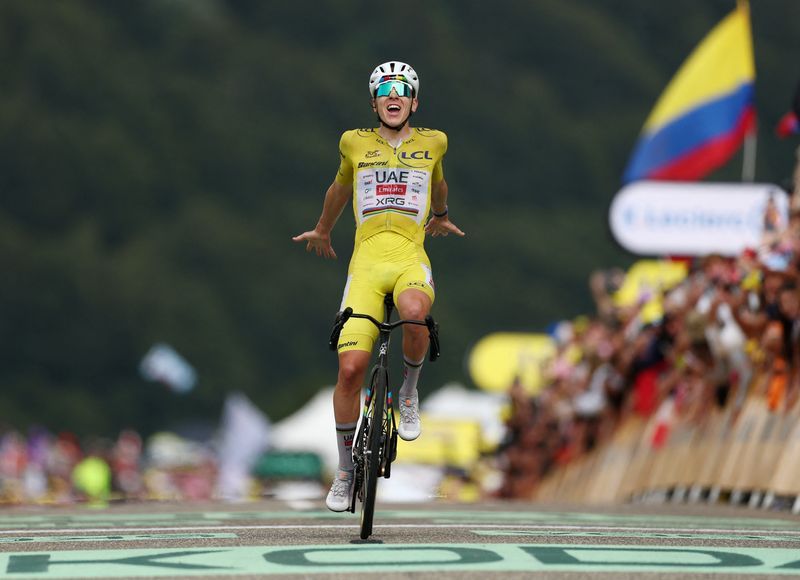
Tadej Pogacar cemented his grip on the 2024 Tour de France on Saturday by capturing another commanding solo victory on stage 14, a demanding 155.3-kilometre mountain test from Mulhouse to Le Markstein Fellering. The four-time champion's clinical performance on the steep gradients of Col du Haag delivered his fourth stage win of the race and stretched his overall advantage to a commanding four minutes and 30 seconds, significantly enhancing his bid for a third consecutive title. The Slovenian's dominance in the mountains came at a moment when the race's hierarchy was being tested by relentless elevation changes and treacherous weather conditions that caught out numerous contenders throughout the day.
Pogacar's superiority became unmistakable during the final climb to Col du Haag, where he timed his attack to perfection as the gradient steepened to 16 percent in the closing two kilometres. His teammates from UAE Team Emirates had worked methodically through the stage to position him ideally, gradually reeling in a breakaway group and setting the table for the decisive moment. When Pogacar made his move with just over two kilometres remaining, he immediately distanced his closest rivals, summiting 30 seconds clear before accelerating through the final five kilometres to the finish line. He crossed the line 38 seconds ahead of his own teammate Isaac del Toro, who managed second place after a strong solo effort of his own.
Del Toro's impressive performance underscored UAE Team Emirates' collective strength in the mountains, with the Spanish rider also capitalizing on the stage's demands to move into fourth place in the general classification. Paul Seixas, bidding to become a favourite among French supporters, completed the podium in third, though he lacked the finishing pace to challenge the stronger climbers ahead of him. Vingegaard, the runner-up in the overall standings, could only manage fourth place on the stage, a result that reflected the growing difficulty he faces in matching Pogacar's consistency and explosive power in the high mountains.
Saturday's route proved exceptionally demanding, featuring three category-one climbs spread across its length and subjecting riders to significant weather variations that complicated pacing and tactics. The morning kilometres included Grand Ballon, where French favourite Valentin Paret-Peintre of Soudal Quick-Step crested first alongside Richard Carapaz, briefly establishing a breakaway that initially held the peloton at bay. However, the Ecuadorian's momentum was disrupted when he and teammate Ben Healy of EF Education–EasyPost took a wrong turn during the ascent to Ballon d'Alsace, forcing them to backtrack and rejoin the leading group. Such navigational errors, though eventually corrected, illustrate the mental and physical concentration required during stages where rain and slippery descents create additional hazards beyond the climbing itself.
The conditions deteriorated significantly during the descent from Col du Page, where heavy rain transformed roads into treacherous surfaces and forced riders to exercise extreme caution. The gap between the breakaway group and the chasing peloton fluctuated wildly depending on descending ability and willingness to take risks on wet roads. Paret-Peintre and Carapaz maintained their advantage through careful riding, but as the stage progressed and Pogacar's teammates increased the pace in the peloton, the breakaway's cushion evaporated. By the time the race reached Ballon d'Alsace, the separation had narrowed to manageable proportions, setting up the dramatic final act on Col du Haag.
Carapaz launched an early attack on the 11.2-kilometre climb to Col du Haag, testing whether a sustained effort from the breakaway could resist the inevitable counter from the general classification contenders. Tobias Johannessen briefly followed his wheel, but both men were ultimately absorbed as Pogacar's teammates maintained a relentless tempo that brought the peloton within striking distance. The decisive moment arrived when gradients exceeded 16 percent, terrain where Pogacar's superior strength and tactical positioning could be exploited. His acceleration, executed with the calculated precision of a rider who has already won multiple Tours, left his competitors unable to respond, and from that point the stage's outcome was effectively decided.
Pogacar's assessment of his performance reflected the controlled confidence of a dominant leader managing a race with significant miles remaining. He noted that his team had targeted this stage from the beginning and that he knew the terrain well, framing his victory as the culmination of deliberate preparation rather than opportunistic brilliance. His familiarity with the Alsatian mountains, which hosted the decisive Col du Haag, gave him a psychological advantage over rivals less knowledgeable about local conditions and the precise demands of specific climbs. This intelligence-gathering and preparation exemplifies the modern Tour de France, where reconnaissance and data analysis complement raw physical capability.
The victory margin of four minutes and 30 seconds represents a substantial lead at this stage of the three-week race, typically indicating that a challenger would need an exceptional performance or Pogacar's collapse to overturn the deficit. For Malaysian cycling enthusiasts and Southeast Asian observers, Pogacar's dominance illustrates how European cycling remains centred on individual superstars and team support systems of remarkable sophistication. The region has produced world-class cyclists like Indonesia's Aru and Malaysia's Azizulhasni Awang, yet the Tour de France remains a European domain where Asian riders rarely compete at the highest levels. Pogacar's clinical efficiency serves as a reminder of the institutional depth required to field competitive Grand Tour teams.
Vingegaard's fourth-place finish, while respectable, suggests that the two-time defending champion faces an uphill battle in the remaining mountain stages. The Dane has demonstrated competitive spirit throughout the race but lacks the explosive power that Pogacar repeatedly demonstrated. Their head-to-head record this season heavily favours Pogacar, and unless Vingegaard can orchestrate a dramatic reversal or capitalize on an unexpected Pogacar weakness, the Slovenian appears destined to secure his third consecutive title. For the broader cycling community, such dominance raises questions about competitive balance and whether the sport's governing bodies should reconsider regulations that permit such substantial disparities in team resources and talent concentration.
Pogacar acknowledged that Sunday's stage 15 from Champagnole to Plateau de Solaison would present fresh challenges, indicating appropriate respect for the remaining mountain stages despite his commanding position. The 27-year-old's maturity in recognizing that no Tour victory is secured until the final kilometres of stage 21 reflects hard-earned wisdom from his previous two victories. His readiness to fight through adversity and his stated commitment to maintaining concentration through the decisive Alpine stages suggest that barring mechanical failure or illness, a third consecutive title appears inevitable. For cycling fans across Southeast Asia and beyond, the race's closing week will primarily involve monitoring whether any challenger can mount a late offensive or whether Pogacar will simply manage his lead through to Paris.
The implications of Pogacar's dominance extend beyond individual prestige to broader cycling culture. His performance style—combining brute force with tactical intelligence—represents a shift towards more confrontational racing, where the strongest rider overwhelms competitors rather than engaging in carefully orchestrated team tactics. This approach, while sometimes criticized as lacking the artistry of previous eras, proves devastatingly effective and has fundamentally altered how teams construct their strategies for supporting a leader. As cycling continues evolving, Pogacar's methods will likely influence how future champions are prepared and how Grand Tours are contested.

