Ewa Lutka-Krawczyk's gravest concern upon receiving her gallbladder cancer diagnosis was not for herself but for Gaja, a shelter dog she had adopted three years earlier and grown profoundly attached to. She pleaded with her physician for reassurance that she would survive long enough to ensure the animal would not be abandoned. The reality proved harsher than she hoped. Recently admitted to the palliative care unit at a Warsaw hospital, the 70-year-old now rests with a drainage tube attached to her abdomen while Gaja remains at home with her husband, the dog refusing food in her owner's absence.
Proposed legislation currently under review in Poland's parliament would grant patients in Lutka-Krawczyk's situation an explicit legal right to receive visits from their companion animals within hospice and palliative care facilities. Although many hospitals already permit such visits informally, no universal legal framework currently protects this practice across the healthcare system. The bill, introduced by a member of Prime Minister Donald Tusk's centrist party, emerged from the advocacy of Dr Tomasz Dzierzanowski, director of the Palliative Medicine Clinic at the Medical University of Warsaw, who has witnessed firsthand the transformative impact of animal companionship on terminal patients.
Dzierzanowski articulates a broader philosophical concern driving the initiative: Polish society, he contends, is grappling with what he characterises as "an epidemic of loneliness," particularly among those nearing the end of life. His clinic operates under the principle that no patient should die without meaningful human presence. Yet he acknowledges a troubling reality in contemporary society. Elderly patients often find themselves isolated because they have outlived their peer networks, while younger terminal patients frequently lack deep friendships that previous generations cultivated more readily, their social connections instead scattered across digital platforms and virtual spaces rather than rooted in tangible bonds.
The catalyst for Dzierzanowski's mission originated with a cancer patient named Waldemar, whose primary anxiety was not his own mortality but the welfare of his two cats. When Dzierzanowski arranged for the animals to be brought to the ward, the emotional reunion proved revelatory. Waldemar wept with joy, the cats responded with visible distress alleviation, and other patients and staff members who witnessed the scene recognised something profound occurring. That moment crystallised Dzierzanowski's conviction that this humanitarian concern required immediate legislative attention and formal protection.
Currently, Dzierzanowski's clinic permits pet visits when circumstances permit, meaning Lutka-Krawczyk can anticipate a reunion with Gaja. The news visibly lifted her spirits. Lawmaker Katarzyna Piekarska, who introduced the legislation now pending before parliament's health committee, emphasises that the reality on the ground often precedes formal legal codification. "Animals are already present in hospitals anyway," she observed, suggesting that regulation would simply acknowledge and standardise existing practice rather than represent a revolutionary departure from current conditions.
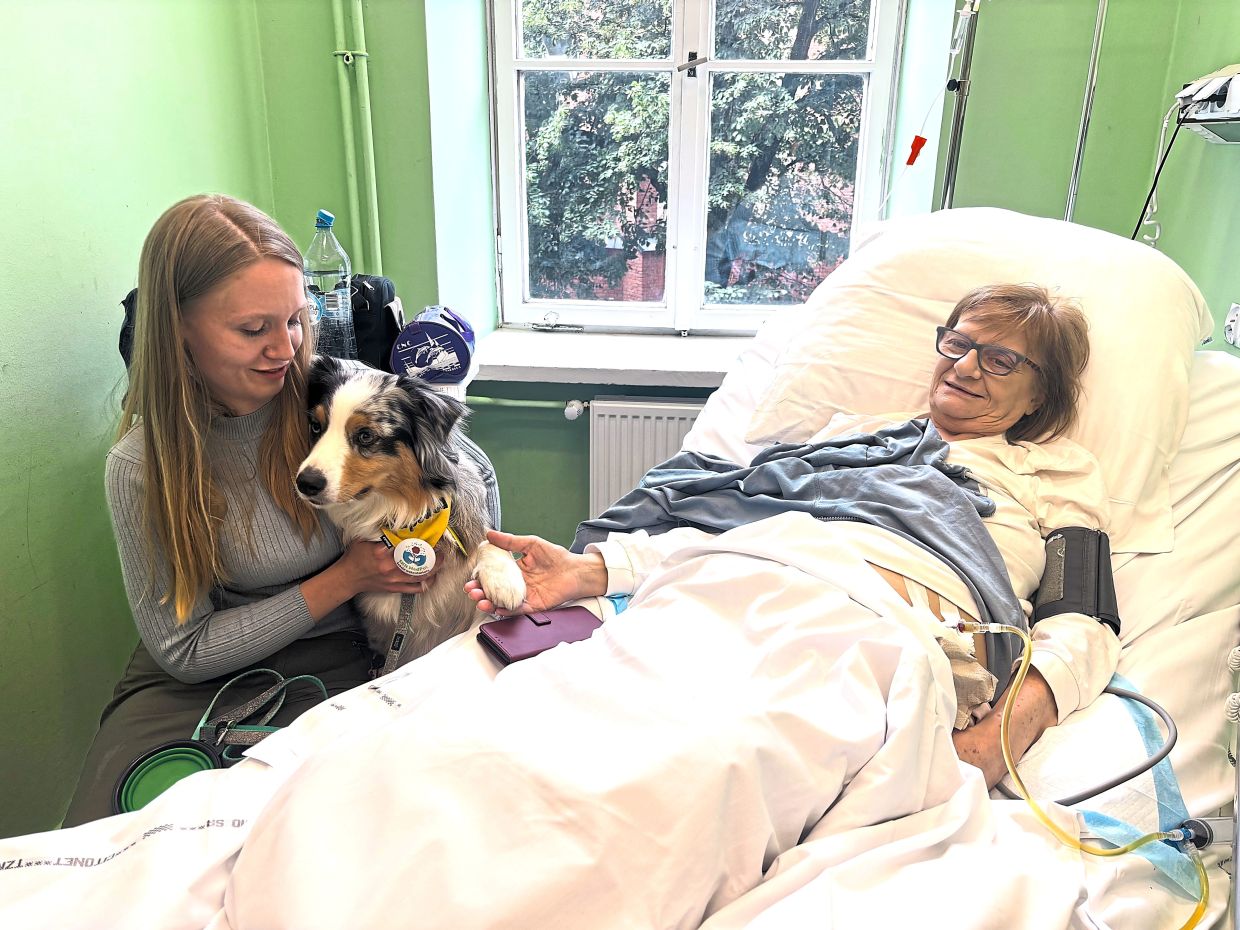
Beyond pets owned by patients, Dzierzanowski's ward also welcomes trained therapy animals. During a recent visit, Kluska, an Australian shepherd, circulated through the facility accompanied by her handler Malgorzata Brzozowska. The dog's presence produced immediate therapeutic effects. Lutka-Krawczyk, propped up in her bed, grasped Kluska's paw and smiled—a moment of levity in her otherwise circumscribed world. Another patient, Wojciech Zelik, a 58-year-old undergoing treatment for a tumour, roused himself to observe the dog's movements with evident interest, requesting that Brzozowska demonstrate Kluska's trained behaviours while he reached over to stroke the animal's fur.
The benefits of these animal interactions extend well beyond the patients themselves. Brzozowska, a medical student who organises the visits, observes that hospital staff members—nurses, kitchen workers, and other personnel engaged in the emotionally demanding work of terminal care—experience measurable stress reduction from brief interactions with the therapy dog. During hallway encounters, multiple staff members paused their duties to crouch down beside Kluska, offering affection and treats. This phenomenon reveals an often-overlooked dimension of hospice work: the cumulative psychological toll on healthcare workers who daily confront mortality and human suffering.
Brzozowska further argues that the therapeutic advantage multiplies when patients encounter their own cherished animals rather than unfamiliar therapy dogs. The presence of a familiar companion produces a tripartite calming effect—reducing anxiety in the patient, soothing the emotional distress of family members present, and notably alleviating stress in the animal itself. She interprets the animals' visible behavioural shifts as evidence of their intuitive comprehension of the situation. "The dog isn't as stressed," she explains. "We interpret this as meaning that he simply knows what's happening, that he knows where the owner, who was always there before, has disappeared to." This interpretation suggests an emotional intelligence in companion animals that transcends mere conditioned response.
The Polish initiative reflects a broader global conversation about humanising end-of-life care and recognising the validity of emotional bonds that extend beyond human relationships. In societies experiencing demographic aging and increasing social fragmentation, the question of how to ensure dignity, comfort, and emotional sustenance for dying individuals takes on heightened urgency. The legislation represents more than a mere procedural adjustment; it constitutes an acknowledgment that terminal patients' emotional and spiritual wellbeing—not merely their physical comfort—warrants institutional support and legal protection.
Dzierzanowski's emphasis on combating loneliness at life's end resonates particularly in contemporary Southeast Asia, where rapid urbanisation and shifting family structures have similarly disrupted traditional support networks. While Malaysia and neighbouring countries have not yet formally addressed pet visitation in palliative care settings, the Polish model offers instructive lessons about the intersection of healthcare policy, human dignity, and the recognition of non-traditional sources of comfort in medical settings. The proposal also signals a philosophical shift in how healthcare systems conceptualise their obligations to terminal patients—moving beyond the purely medical toward a more holistic understanding of what constitutes compassionate end-of-life care.

