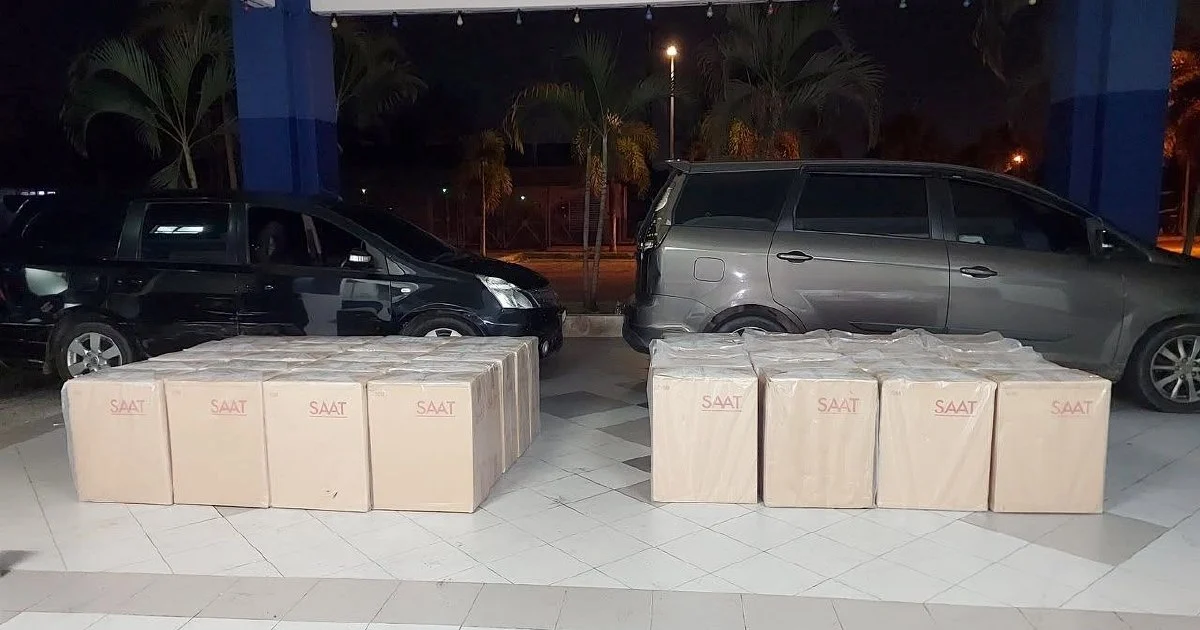
Security forces in Kota Baru made a significant breakthrough in the fight against illicit trade yesterday when they apprehended a 29-year-old suspect following a pursuit operation in Kampung Pulau Panjang. The arrest culminated in the discovery of approximately 400,000 sticks of cigarettes believed to have been smuggled into Malaysia, representing contraband valued at around RM813,000. The operation represents a major disruption to smuggling networks operating in the state and underscores the continuing vigilance of law enforcement agencies across the east coast.
The chase itself developed into a tense pursuit as officers signalled the suspect's vehicle to pull over for routine inspection. Rather than complying, the driver accelerated and attempted to evade authorities through the residential area, prompting enforcement personnel to give pursuit. The decision to flee significantly escalated the seriousness of the situation and ultimately led enforcement teams to the location where the bulk of the contraband was recovered. Local residents reported hearing the commotion as the incident unfolded in their neighbourhood, with police activity continuing late into the evening as officers catalogued and secured the seized items.
Smugglers have increasingly targeted Kelantan and other peninsular states as entry points for contraband cigarettes, particularly those originating from Thailand and Vietnam. These illicit products typically bear counterfeit tax stamps or lack proper Malaysian excise duty documentation, allowing smuggling syndicates to undercut legitimate tobacco retailers by substantial margins. The price differential—often amounting to 40 to 60 percent below legal market rates—makes contraband cigarettes attractive to certain consumer segments and fuels ongoing demand that sustains these criminal networks. Malaysian customs authorities estimate that smuggled cigarettes account for a meaningful share of the total cigarette market, eroding government tax revenue and undermining legitimate retailers.
The recovery of such large quantities in a single operation suggests that yesterday's bust may have disrupted a mid-level distribution point rather than a retail operation. The volume involved indicates the suspect may have been involved in onward distribution to wholesale or street-level retailers rather than personal consumption, elevating the scope and scale of the suspected smuggling enterprise. Authorities are now investigating whether the suspect was connected to larger trafficking organisations and whether additional supply chains remain operational. Such busts frequently become the entry point for broader investigations that can unravel complex supply networks operating across multiple states and involving numerous individuals.
Kelantan has emerged as a persistent flashpoint in Malaysia's ongoing battle against contraband goods, owing to its extensive border with Thailand and relatively porous distribution networks. The state's geography, characterised by numerous smaller towns and rural areas with limited surveillance infrastructure, creates vulnerabilities that smugglers routinely exploit. Previous operations have identified several well-established trafficking corridors through which contraband systematically flows into peninsular markets. The cumulative loss to government revenue from smuggling is substantial when viewed across the entire country, with enforcement agencies treating the issue as a priority that demands continued resource allocation and strategic coordination.
The suspect now faces charges under relevant customs and excise legislation, which carry substantial penalties including imprisonment and fines. Authorities have not disclosed additional details regarding the investigation or whether the individual maintained connections to wider smuggling syndicates. The case will now proceed through the criminal justice system, with prosecutorial authorities building their case based on the circumstances of the arrest and the physical evidence recovered. The manner in which the suspect is charged—whether as a minor operative or as someone with greater knowledge of smuggling operations—may provide clues about the sophistication and scale of the organisation involved.
This seizure arrives amid heightened enforcement activity across multiple enforcement agencies tasked with combating contraband trade. The Royal Malaysian Customs Department, Border Security Agency, and state police forces have coordinated their efforts to dismantle smuggling networks, with operations becoming increasingly sophisticated in their targeting of supply lines. Intelligence sharing between agencies has improved considerably, allowing enforcement personnel to anticipate smuggler movements and interdict supplies at transit points. The effectiveness of these operations depends significantly on sustained investment in surveillance technology, personnel training, and cross-border coordination—areas where Malaysian authorities have made measurable progress over recent years.
The broader implications of smuggling extend beyond revenue loss to include concerns about product safety and consumer protection. Contraband cigarettes frequently originate from unregulated manufacturing facilities that may not comply with basic quality or health standards. Some counterfeit products have been found to contain contaminants or fillers that pose health risks to consumers who believe they are purchasing legitimate branded merchandise. Additionally, proceeds from cigarette smuggling contribute to financing of other illegal activities, creating links between seemingly discrete criminal enterprises. This reality reinforces the importance of sustained anti-smuggling enforcement as a public health and security matter, not merely a tax collection issue.
The arrest and seizure also carry symbolic significance for Malaysia's positioning as a rule-of-law jurisdiction committed to border integrity and financial accountability. Foreign investors and legitimate businesses depend on reliable enforcement against smuggling to maintain fair competitive conditions. When smuggling goes unchecked, it distorts markets, undermines legitimate enterprises, and signals weakness in state capacity. Conversely, high-profile enforcement actions demonstrate commitment to maintaining order and protecting legal commerce, factors that contribute to Malaysia's broader investment climate and international standing. The Kota Baru operation fits within this larger narrative of institutional capacity and commitment to regulatory standards.

