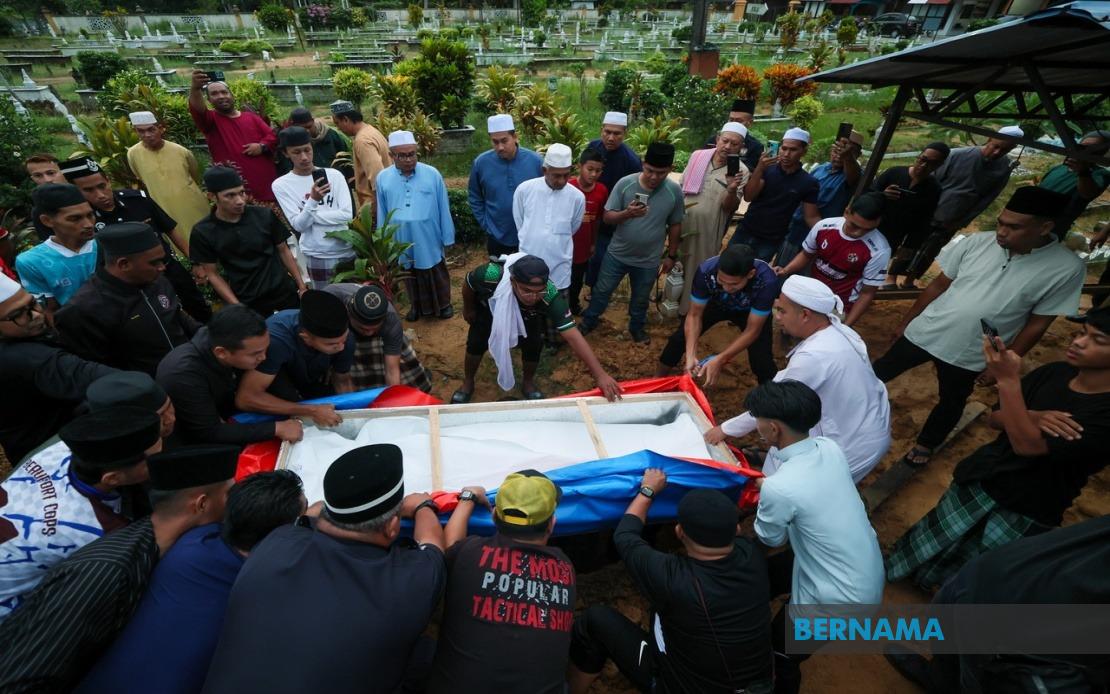
Corporal Mohamad Nur Hafiz Rahim, a 29-year-old police officer who lost his life in an electrocution incident in Beaufort, Sabah, was buried on Thursday morning at Kampung Pangkal Kuang Muslim Cemetery in Ketereh, Kelantan. His funeral prayers were conducted at his family home in Kampung Hutan Pasir before the final rites were observed, marking the end of a heartbreaking chapter for his grieving relatives and colleagues in the Royal Malaysia Police.
The tragedy unfolded on Tuesday evening at 5.50 pm when Mohamad Nur Hafiz and two colleagues stationed at Weston Police Station in Beaufort came into contact with a live electrical source while handling a 29-foot metal pole designed for harvesting coconuts. The pole, positioned outside the police station near Sekolah Kebangsaan Weston, became a fatal conductor of electricity. His two companions—Corporal Chiu Teck Siong, 40, from Sarawak, and Constable Muhammad Raimi Ismarubee, 26, from Terengganu—also perished in the incident, transforming a routine maintenance task into a catastrophe that claimed three uniformed lives.
The officer's eldest sister, Nurlella Rahim, expressed deep gratitude to the police force for their logistical support in transporting her brother's remains from Sabah back to their Kelantan home. She told assembled journalists at the cemetery that the remains arrived at 4.45 am, after a coordinated effort involving multiple departments to facilitate the repatriation. The gesture, though small in the face of overwhelming grief, underscored the institutional support that helps families navigate such tragedies during their darkest moments.
Nurlella painted a portrait of a close-knit family bound by technology and affection despite geographical separation. The five siblings maintained daily contact through video calls and social media platforms, a modern testament to how families navigate distance in contemporary Malaysia. Though Nurlella resided in Ipoh, Perak, and her brother served in distant Sabah, they bridged the gap through regular virtual interactions, commenting on each other's photographs and gathering for group video calls whenever schedules permitted.
The final interaction between Mohamad Nur Hafiz and their mother occurred on Thursday afternoon, just hours before his fatal shift. During that video call, his mother observed that her son appeared fatigued and withdrawn, yet he managed to offer reassurance through a smile. He informed her he needed to return to his duties, promising to continue their conversation later. Even in those brief moments between responsibilities, he made time for his family—a pattern that defined his character and commitment to maintaining bonds across the miles.
Nurlella's last personal contact with her brother took place on Sunday, when she saw him via video call enjoying a beach outing with his wife, Fatimah Shahira, and their child. Those innocent family moments—a father introducing his young child to the seaside, a husband sharing simple pleasures with his spouse—would become the final memories his family would cherish. The normalcy of that Sunday video call stands in stark contrast to the tragedy that would strike just days later.
The incident immediately captured national attention and prompted Prime Minister Datuk Seri Anwar Ibrahim to order a comprehensive investigation into the circumstances surrounding the deaths. Through a Facebook statement, Anwar emphasized the importance of conducting the inquiry with thoroughness and transparency, signalling that accountability and preventative measures would be prioritized. His intervention reflected the gravity of losing three serving police officers in a single, preventable accident, raising urgent questions about workplace safety protocols within law enforcement facilities across the country.
The Prime Minister's directive touched upon a critical concern for similar operations nationwide: determining the root cause of the electrocution and identifying systemic improvements to prevent recurrence. Questions about electrical hazard awareness, proper handling procedures for metal poles near power sources, and safety compliance at police stations would inevitably form the core of investigative scrutiny. The tragedy exposed potential vulnerabilities in routine operational practices that officers across Malaysia's police force might encounter in their daily work.
For the police fraternity, the loss of three officers—representing different ranks, backgrounds, and service records—resonated as a sobering reminder of occupational hazards that extend far beyond the traditional perceptions of policing danger. While firearms and confrontations dominate public discourse about officer safety, everyday accidents involving electrical hazards claim lives with equal finality. The incident underscores the necessity of comprehensive workplace safety audits across police stations and outposts throughout the nation.
The repatriation of Mohamad Nur Hafiz's remains to his native Kelantan reflected the interconnected nature of Malaysia's police force, where officers serve across state boundaries and return home draped in the respect their sacrifice commands. His burial in Ketereh would provide some solace to his immediate family, though no funeral rites could restore the presence of a son, brother, husband, and father whose life was extinguished in a moment of electrical misfortune at a workplace that should have been safe.
As investigations proceed and preliminary findings emerge, Malaysian authorities face mounting pressure to implement enhanced electrical safety measures at police facilities nationwide. The tragedy serves as a stark cautionary tale: even institutions tasked with protecting public safety must themselves establish robust protocols to protect their own personnel from hazards that proper oversight and training might prevent. For Mohamad Nur Hafiz's family, grieving in Kelantan, answers and systemic change represent the only meaningful legacy they can hope will emerge from this irreversible loss.

