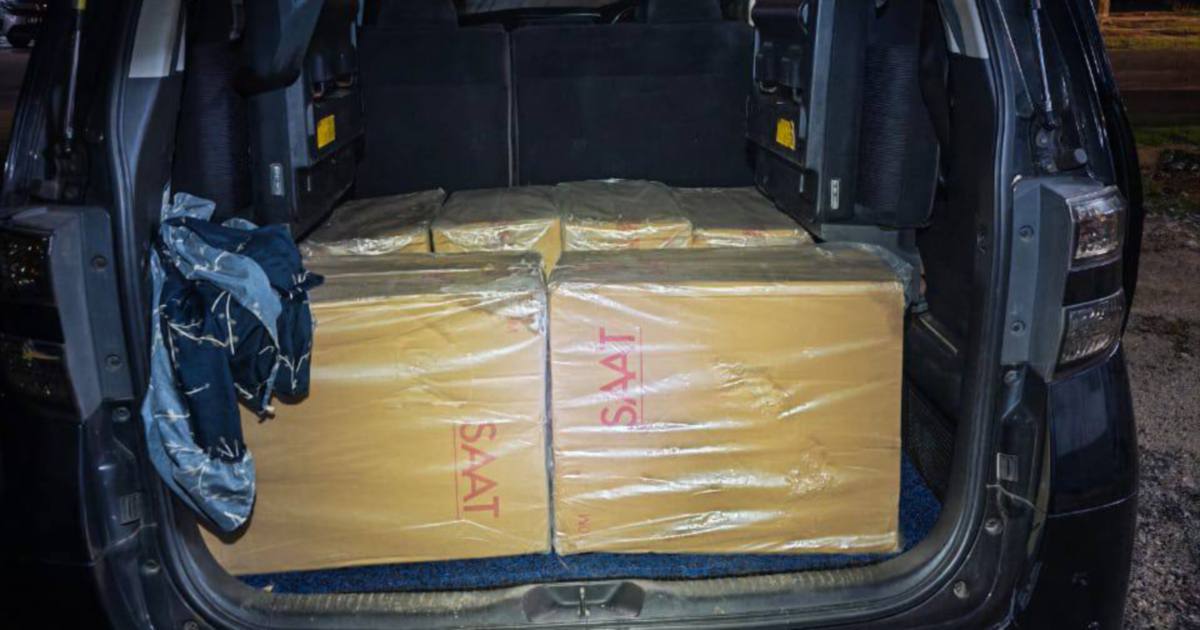
Enforcement authorities in Kota Baru have dealt a significant blow to the illicit cigarette trade following an early morning operation that netted a substantial haul of untaxed tobacco products. The General Operations Force intercepted a Toyota Vellfire at the shoulder of Pasir Tumboh Bridge and seized 60,000 cigarettes suspected of avoiding duty payments, with an estimated market value of RM112,200. The vehicle's 37-year-old driver was arrested at the scene, marking another successful interdiction in the ongoing battle against smuggled and duty-unpaid tobacco products flowing through the northern corridor.
The seizure represents a meaningful interruption of the illicit cigarette supply chain in Kelantan, a state that has long been identified as a critical transit point for smuggled goods destined for distribution across Malaysia. The location of the interception—the Pasir Tumboh Bridge—is particularly strategic, as it sits along major transport routes connecting the border regions with central Malaysian markets. Early morning timing of the operation suggests coordinated intelligence work, indicating that enforcement agencies may have had advance information about the suspected shipment or identified patterns consistent with smuggling operations.
Duty-unpaid cigarettes represent a significant revenue leakage for the Malaysian government, which imposes substantial excise taxes on tobacco products as part of both fiscal and public health policy. The confiscation of 60,000 units suggests an operation targeting commercial-scale distribution rather than small-scale personal importation, implying organised involvement in the contraband network. At the stated market value of RM112,200, this single seizure demonstrates the financial stakes involved in the illegal tobacco trade and the economic incentives driving organised smuggling operations.
The arrest of the 37-year-old driver marks the human element of what is typically a sophisticated logistical operation. Drivers in smuggling networks often occupy junior positions within larger organisational structures, frequently carrying out transportation duties with limited knowledge of upstream sourcing or downstream distribution arrangements. However, the vehicle itself—a Toyota Vellfire—deserves scrutiny, as such vehicles are commonly utilised in smuggling because they provide substantial cargo capacity while maintaining a civilian appearance that may evade initial suspicion at routine checkpoints.
This operation reflects broader enforcement efforts targeting the illicit cigarette market, which has grown substantially in recent years due to price differentials between Malaysia and neighbouring countries. Significantly higher taxation on tobacco products in Malaysia has created profitable arbitrage opportunities for smugglers, who procure cigarettes across the border at considerably lower cost and distribute them domestically at prices below legitimate commercial channels. This undercuts legitimate retailers and deprives the government of substantial tax revenue while simultaneously undermining public health initiatives designed to reduce smoking prevalence through price mechanisms.
The General Operations Force has been instrumental in pursuing tobacco smuggling cases, working alongside customs authorities and state police units to intercept shipments at various points along major transport corridors. Such operations require intelligence gathering, coordination between agencies, and deployment at strategic locations where contraband is likely to transit. The early morning timing of this Kota Baru interception aligns with operational patterns observed in similar enforcement activities, when traffic volumes are lower and vehicles attempting to move illicit goods may be less likely to encounter civilian obstacles.
For Malaysian readers, the implications extend beyond simple law enforcement statistics. Every uncollected cigarette tax represents foregone revenue that could fund public services, healthcare, or education initiatives. Additionally, the proliferation of untaxed cigarettes in the market undermines government health policy objectives, as cheaper illicit products encourage consumption among price-sensitive demographic groups, including younger consumers. The environmental and social costs of increased smoking prevalence ultimately impose significant burdens on the healthcare system.
The seizure also highlights vulnerabilities in transport networks, even as enforcement capacity improves. Smugglers continuously adapt their methods, routes, and logistics to circumvent detection, employing techniques ranging from camouflage within legitimate cargo to utilisation of less-monitored roads and times. The persistence of substantial illicit cigarette flows despite repeated enforcement operations suggests that the problem requires multifaceted responses encompassing not merely interception and arrest, but also investigation of upstream trafficking networks, financial tracking of proceeds, and international cooperation with source countries.
For Kelantan and the broader northern region, this operation underscores the ongoing challenge of controlling goods movement across state borders and international frontiers. The proximity to Thailand and the intricate local geography create persistent opportunities for smugglers, requiring sustained vigilance and resourceful deployment by enforcement agencies. Future success in addressing the illicit tobacco trade will likely depend on enhanced intelligence capabilities, technological advancement in detection, and continued inter-agency coordination that extends beyond immediate seizures to dismantle the organisational structures enabling such operations at scale.

