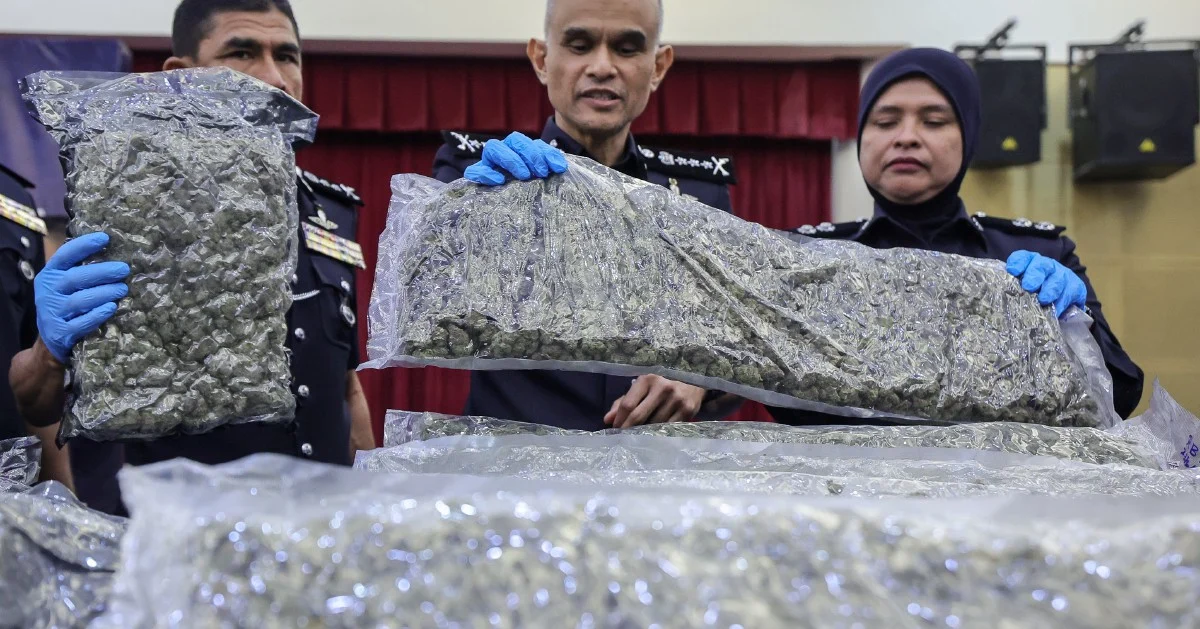
Police operations at Malaysia's primary international aviation hub have yielded a significant breakthrough in combating organised drug smuggling, with the seizure of 650 kilograms of cannabis buds at Kuala Lumpur International Airport marking one of the country's substantial recent narcotics intercepts. The haul, accumulated over recent months beginning in January, underscores the persistent challenge of trafficking networks attempting to exploit airport infrastructure to move high-value contraband through Southeast Asia's busiest aviation gateway. The 38 individuals taken into custody span both Malaysian nationals and foreign operatives, suggesting the involvement of transnational criminal syndicates with coordinated distribution logistics across borders.
The operation conducted by Shah Alam police authorities reflects intensified screening protocols and intelligence-gathering capabilities at KLIA, where custom officials and drug enforcement units maintain continuous vigilance over passenger baggage and cargo movements. Cannabis remains classified as a controlled substance under Malaysia's Dangerous Drugs Act 1952, with possession and trafficking offences carrying severe penalties including extended imprisonment and substantial fines. The concentration of seizures at a single transport node indicates that organised networks view airport channels as relatively accessible distribution points, particularly through checked luggage, concealed compartments in legitimate cargo, or insider collaboration among ground personnel.
The international dimension of this investigation carries significance beyond domestic law enforcement success. The involvement of foreign nationals demonstrates how Southeast Asian nations serve as transit hubs within broader regional and global drug trafficking corridors. Neighbouring countries including Thailand, Indonesia, and the Philippines face comparable challenges, and coordinated cross-border intelligence-sharing mechanisms have become increasingly essential for disrupting supply chains. Malaysia's strategic position—offering direct connectivity to Chinese markets, Indian subcontinent distribution networks, and Australian sources—makes the nation an inevitable waypoint for criminal organisations moving narcotics across Asian trading routes.
The scale of the 650-kilogram seizure merits contextualisation within recent Malaysian drug enforcement trends. While cannabis trafficking historically received less enforcement priority than heroin, methamphetamine, or fentanyl derivatives in Malaysia, the exponential growth of international cannabis cultivation and increasingly sophisticated smuggling techniques have prompted expanded police focus. The shift reflects global trends whereby cannabis markets have become increasingly commodified and professionalised, particularly as legalisation movements in Western jurisdictions create perception gaps regarding substance harmfulness and availability.
Law enforcement agencies have adapted detection methodologies accordingly, implementing advanced screening technologies and canine unit deployments specifically trained for cannabis odour identification. The sustained nature of this operation—spanning months rather than isolated seizures—indicates systematic investigation into trafficking infrastructure, with authorities likely pursuing upstream supplier networks and downstream distribution networks simultaneously. Such comprehensive approaches prove significantly more disruptive than singular interdiction events, as they target organisational vulnerabilities and financial flows underlying criminal enterprises.
The arrest of 38 individuals across a single investigation suggests either extensive operational scope or significant organisational reach requiring numerous personnel for logistics coordination, packaging, warehousing, and distribution functions. Traffickers increasingly employ compartmentalised cell structures wherein operatives lack comprehensive knowledge of entire networks, complicating prosecution and potentially limiting intelligence extraction during interrogation phases. However, the concentration of arrests within one timeframe likely reflects coordinated simultaneous apprehensions following intelligence consolidation, a tactic designed to prevent warning networks and preserve evidence while suspects remain dispersed.
Malaysia's narcotics enforcement authorities continue acknowledging cannabis as an emerging priority despite traditional focus on synthetic drugs and heroin. The Royal Malaysian Police's Narcotics Crime Investigation Division, working alongside the Malaysian Anti-Corruption Commission and airport security personnel, maintains systematic intelligence-gathering regarding trafficking methodologies and known smuggler networks. The KLIA seizure demonstrates practical application of enhanced scanning technologies and increased personnel deployment at the airport's cargo and passenger terminals.
The economic implications of the 650-kilogram seizure extend beyond mere drug quantity metrics. Street-level cannabis valuations in Malaysia typically range from RM80 to RM150 per gram depending on quality and locality, suggesting this haul represents potential black-market value approaching RM50 to RM100 million if successfully distributed. Such figures underline the substantial criminal profit margins driving continued trafficking attempts despite interdiction risks, and explain why seizures alone prove insufficient without simultaneous financial investigation targeting money laundering and asset recovery.
Regional cooperation frameworks including ASEAN drug enforcement protocols and bilateral intelligence-sharing agreements between Malaysian and neighbouring authorities enhance the probability of identifying trafficking network nodes beyond Malaysia's jurisdiction. International criminal networks demonstrate remarkable adaptability, continuously modifying routes, concealment methods, and personnel arrangements following enforcement operations. The KLIA seizure and subsequent arrests will likely prompt tactical adjustments whereby smugglers explore alternative routes, transportation methods, or distribution hubs—a perpetual pattern within drug enforcement dynamics requiring sustained intelligence investment and cross-border coordination.
Authorities acknowledge that airport interdiction represents merely one layer within comprehensive drug control strategies requiring parallel investment in demand reduction, rehabilitation services, and community-level prevention initiatives. However, denying trafficking networks reliable transit capacity through major transport hubs remains operationally essential, particularly regarding cannabis where supply elasticity remains relatively high compared to pharmaceutical substances. The successful KLIA operation demonstrates Malaysian law enforcement's sustained commitment to disrupting transnational trafficking networks and protecting the nation from becoming a permanent fixture within international drug trafficking infrastructure.