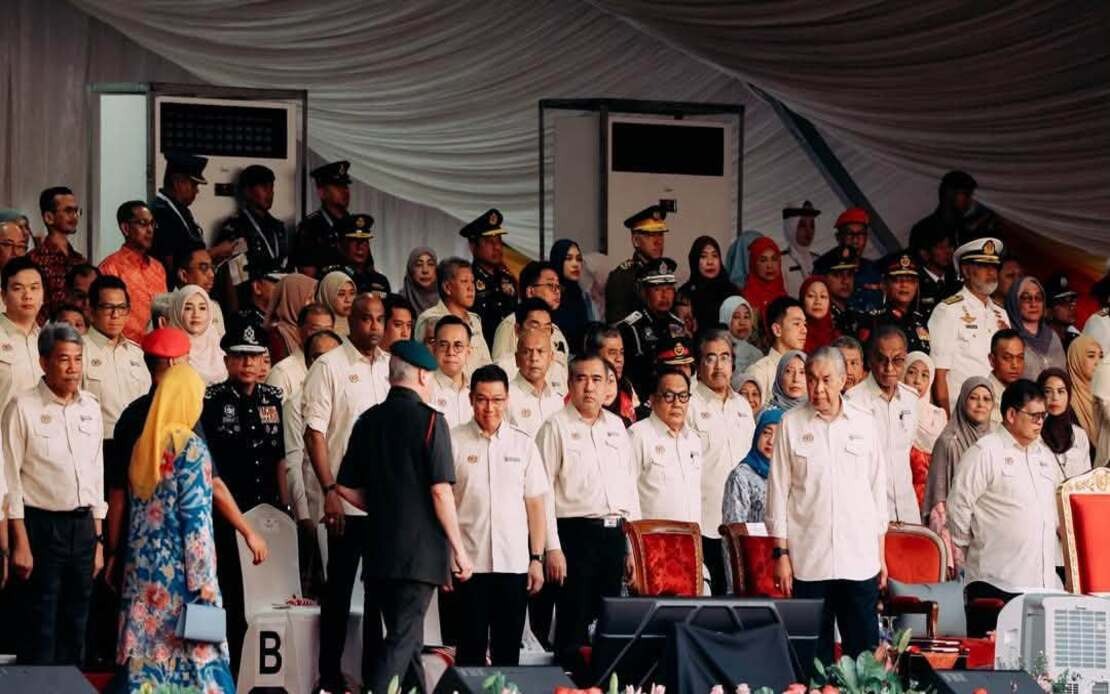
Datuk Armizan Mohd Ali, Malaysia's Domestic Trade and Cost of Living Minister, has underscored the necessity of political maturity as a cornerstone for maintaining the stability of the Unity Government, highlighting how the country's transformed political landscape demands conscious acceptance and leadership discipline. Speaking on National Day, Armizan pointed to the broader implications of the post-GE15 era, where Malaysia has shifted away from single-party dominance toward a multi-coalition framework that requires sustained commitment from political stakeholders at all levels.
The minister's remarks carry particular weight given the contrast between the current government's trajectory and Malaysia's recent turbulent political history. The period spanning 2018 to 2022 witnessed three changes of prime minister and three complete Cabinet restructurings within a single parliamentary term—an instability that Armizan characterised as fundamentally incompatible with building sustainable national prosperity. This cautionary reference underscores why the current administration views consensus-building and coalition cohesion not as mere procedural matters but as prerequisites for effective governance and economic development.
Armizan's conception of political maturity extends beyond rhetoric about unity. He described it as a sophisticated balance between exercising legitimate political rights—including party activism and competitive positioning—and acknowledging shared responsibility for national development and public welfare. This framing suggests that within Malaysia's current power-sharing arrangement, leaders must reconcile their institutional interests with the broader imperative of steering the country toward prosperity, a balancing act that has proven elusive in recent Malaysian politics.
Particularly revealing is Armizan's observation about the disconnect between lower-level party activism and Cabinet dynamics. He noted that whilst party representatives have engaged in heated public exchanges over recent months, senior Cabinet members have maintained cordial, constructive relationships during official meetings. This apparent separation between partisan competition and governmental collaboration demonstrates a deliberate compartmentalisation strategy that appears to be working, at least at the leadership tier. The sustainability of this approach, however, remains contingent upon continuous reinforcement from the top political echelon.
The minister's emphasis on accepting Malaysia's new political landscape reflects a recognition that the country must move beyond the zero-sum competition that characterised earlier periods. The shift from hegemonic single-party governance to coalition-based administration represents a structural transformation with profound implications for how political actors conceptualise power, legitimacy, and governance. For Malaysian policymakers and observers, this transition raises fundamental questions about institutional adaptation, whether existing political structures can accommodate genuine power-sharing, and what mechanisms best prevent coalitions from fragmenting under pressure.
Armizan's framing of National Day celebrations as an occasion to reinforce unity and collective commitment speaks to the government's broader strategy of anchoring the Unity Government within nationalist narratives. By connecting political maturity to patriotic duty and shared stewardship of the nation, the minister attempts to elevate coalition maintenance beyond partisan calculation and ground it in civic responsibility. This rhetorical approach reflects how contemporary Malaysian governance increasingly relies on appeals to national interest and constitutional patriotism rather than ideological differentiation.
The challenge facing the coalition government, as Armizan's statement implicitly acknowledges, involves sustaining this delicate equilibrium across multiple levels of political organisation. Party activists and grassroots supporters operate under different incentive structures than Cabinet ministers; they derive motivation from competitive struggle rather than shared governance. Maintaining party morale whilst demanding loyalty to coalition discipline creates inherent tensions that require sophisticated political management and, crucially, tangible governance successes that benefit diverse constituencies represented within the coalition.
Armizan's invocation of balanced political rights and nation-building responsibilities also addresses concerns about whether Malaysia's democratic system has developed sufficient institutional maturity to manage power-sharing arrangements effectively. Democratic systems require mechanisms through which competing interests negotiate outcomes without threatening governmental stability or fundamental institutional integrity. The success of the Unity Government depends partly on whether Malaysian political institutions, judicial structures, and established conventions can accommodate genuine pluralism and contested governance without reverting to patterns of winner-takes-all competition.
Looking forward, the sustainability of the coalition rests on several factors that extend beyond ministerial exhortations about political maturity. Economic performance, equitable distribution of coalition benefits, and the management of intra-coalition disagreements on substantive policy matters will ultimately determine whether the Unity Government survives beyond the next electoral cycle. Armizan's statement provides insight into how the government frames these challenges internally—as questions of political culture and leadership responsibility rather than purely institutional design or political calculation.
For Southeast Asian observers, Malaysia's experiment with coalition governance after years of single-party dominance offers instructive lessons about the preconditions for stable democratic power-sharing. The region features several countries grappling with similar transitions toward more pluralistic political arrangements; examining how Malaysia manages these tensions provides valuable perspective on whether multiparty democracies can function effectively in developing Asian contexts where institutional capacity and democratic norms remain contested terrain.

