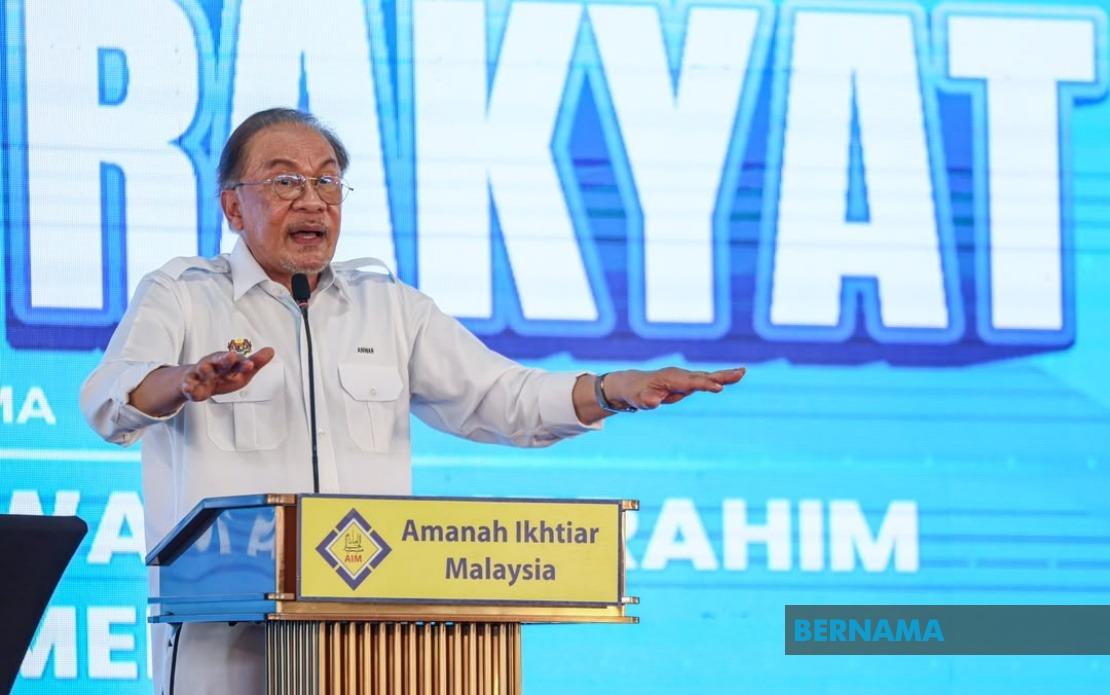
Prime Minister Datuk Seri Anwar Ibrahim has accused certain political parties of banding together to destabilise his administration precisely because the government refuses to tolerate corruption or the misuse of public office. Speaking at a Pakatan Harapan gathering in Batu Pahat ahead of Johor's state election, Anwar, who also heads PH as party chairman, contended that rivals recognise his government's strict approach to punishing those who siphon public resources or exploit positions for personal enrichment. The convergence of opposition forces, he suggested, reflects not policy disagreement but rather fear of accountability.
Anwar's remarks underscore a central theme in his political messaging: that integrity in governance forms the cornerstone of the MADANI administration. He characterised the government's intolerant approach toward financial impropriety and abuse of power as a line that will not be crossed, irrespective of political cost. This framing positions anti-corruption not as one policy among many but as a defining principle that separates his vision from that of predecessors and rivals alike. For voters in Johor, the implicit message is that supporting PH means endorsing a government willing to challenge entrenched interests and vested power structures.
To illustrate his personal commitment to these principles, Anwar referenced his own conduct during his many visits to Johor as Prime Minister. He stated categorically that he has never acquired land, secured lucrative projects, or obtained shareholdings in the state, despite decades of prominence and numerous opportunities to do so. This personal testimony was framed as a standard that elected representatives nationwide should emulate. By positioning himself as an exemplar of the restraint and ethical conduct he demands from others, Anwar sought to lend credibility to his administration's broader anti-corruption agenda. The message implicitly asks voters to evaluate whether rival political figures would pass the same test of personal integrity.
A significant portion of Anwar's remarks focused on what he characterised as a governance gap in Johor despite the state's considerable wealth and the federal government's substantial investment in its development. While billions of ringgit have flowed into major infrastructure projects, Anwar contended that the state government has fallen short in addressing fundamental needs affecting ordinary citizens. Housing affordability remains out of reach for many; roads, places of worship, and social assistance programmes require attention. This critique reflects a distinction Anwar seeks to draw between his federal administration's commitment to inclusive development and what he suggests is the state government's failure to translate resources into tangible improvements in living standards for the majority. The argument carries implications for how Johor voters might evaluate the prospect of a PH-governed state aligned with the federal administration.
Anwar's appeal for Johor to align its state government with the federal administration merits particular attention given the strategic context. A state government aligned with the federal government can theoretically streamline policy implementation, coordinate resource allocation, and avoid institutional friction that might slow development initiatives and welfare programmes. By framing alignment as a practical governance necessity rather than purely a partisan consideration, Anwar positioned support for PH candidates as a vote for administrative efficiency and coordinated service delivery. This argument potentially resonates with voters prioritising concrete improvements in public services over narrow factional politics.
The Prime Minister also devoted considerable attention to defending PH's coalition with the Democratic Action Party, a sensitive issue given DAP's multiracial character and the concerns some voters harbour about its influence on Malay and Islamic interests. Anwar pointed to his three-and-a-half years as Prime Minister, asserting that DAP ministers in the Cabinet have never opposed programmes designed to benefit Malays or Islam. This factual claim, presented as verifiable through the government's record, attempts to neutralise a long-standing criticism and provide reassurance to Malay-Muslim voters concerned about DAP's presence in the coalition. By grounding his defence in concrete government history rather than abstract principle, Anwar sought to transform potential anxiety into confidence.
The gathering in Senggarang itself became part of Anwar's narrative. He described the turnout as extraordinary, noting that supporters had endured intense heat to attend the event. Such observations about popular enthusiasm serve multiple functions: they provide anecdotal evidence of grassroots support, they appeal to voters' sense of being part of a larger movement, and they implicitly contrast PH's mobilisation capacity with that of rivals. For a government facing political pressure and operating amid significant governance challenges, demonstrated popular support offers psychological and tactical reinforcement. The heat endured by attendees became a metaphor for the commitment Anwar associates with his political base.
The Johor state election itself constitutes a significant test for both the federal government and PH's coalition partners. With 172 candidates competing for 56 state seats, the election will provide the first clear indication of whether Anwar's anti-corruption messaging and broader policy platform resonate with voters in a major state. Polling scheduled for July 11, with early voting on July 7, occurred in what proved to be a tightly contested campaign. The outcome would carry consequences not only for Johor's governance but also for the trajectory of federal politics and Anwar's capacity to consolidate his leadership within PH and the broader political landscape.
Anwar's willingness to attribute opposition moves to fear of his anti-corruption stance rather than to substantive policy disagreements or political differences reflects a particular rhetorical strategy. It positions his government as engaged in a righteous struggle against entrenched corruption and self-interest, framing opposition not as legitimate political competition but as resistance to necessary reform. This framing demands careful scrutiny, as it risks oversimplifying complex political dynamics and attributing singular motivation to diverse political actors. Nevertheless, it represents a calculated effort to elevate the moral stakes of electoral competition and to cast support for PH as support for broader institutional integrity.
The broader context of anti-corruption efforts in Malaysian politics deserves consideration. Multiple administrations have launched anti-corruption initiatives with varying degrees of consistency and effectiveness. Anwar's emphasis on personal example and institutional firmness positions him as offering something distinct, though observers might reasonably question whether rhetorical commitment translates into sustained institutional change. The test of any anti-corruption agenda ultimately lies in sustained enforcement, institutional independence, and willingness to pursue cases regardless of political affiliation or proximity to power. Anwar's framing of his administration as uniquely committed to these principles will be evaluated against implementation outcomes across subsequent years.
The Prime Minister's comments in Batu Pahat reflect a government engaged in active political consolidation ahead of crucial state elections. By linking opposition to his anti-corruption stance, Anwar seeks to transform electoral competition into a referendum on governance integrity. Whether this messaging proves persuasive to Johor voters will depend on their assessment of both his administration's record and rivals' alternatives. The election thus becomes not merely a contest for state seats but a moment reflecting broader questions about the direction of Malaysian politics and whether voters prioritise the anti-corruption agenda as central to their political choices.

