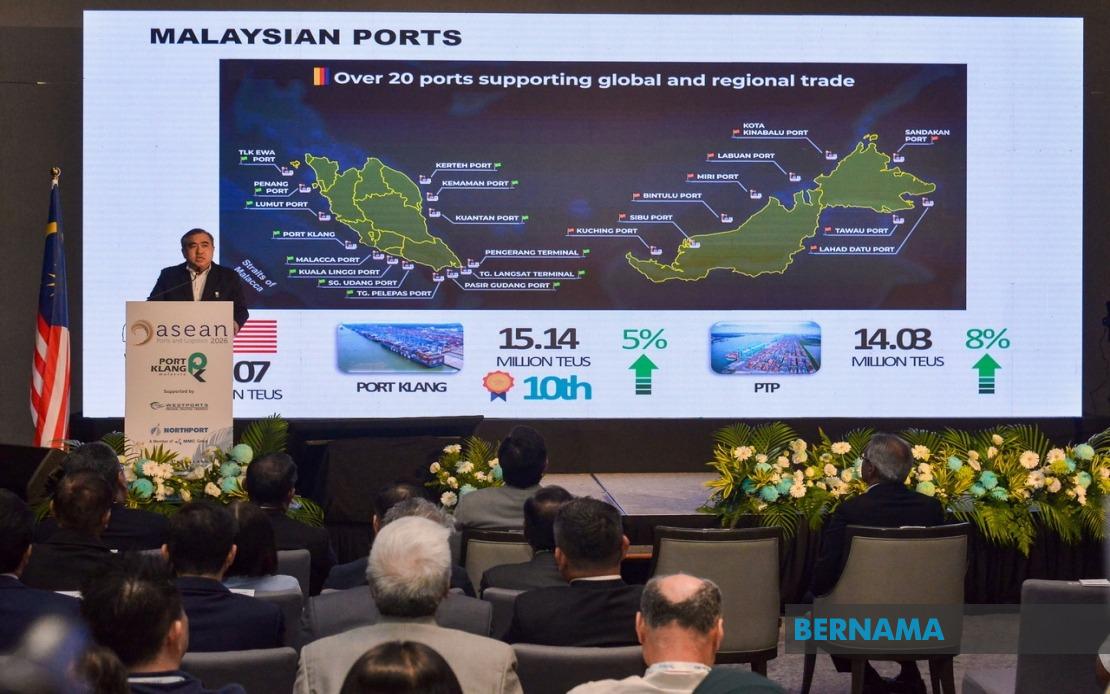
Transport Minister Anthony Loke has laid out an ambitious vision for Malaysia's maritime future, unveiling plans for Port Klang's Third Terminal on Carey Island as the linchpin in a strategy to position the country as a dominant shipping and logistics centre across Southeast Asia. Speaking at the ASEAN Ports and Logistics Conference and Exhibition in Kuala Lumpur on July 8, Loke framed the mega development as essential to maintaining Malaysia's competitive edge over the next two to three decades, with construction anticipated to unfold over nearly two decades in carefully sequenced phases.
The scale of the challenge facing Malaysia's port infrastructure becomes apparent when comparing current capacity with regional rivals. Port Klang presently handles around 20 million twenty-foot equivalent units annually, a substantial figure that pales beside Singapore's Tuas Port, which boasts a capacity three times larger at 60 million TEUs yearly. This disparity underscores why Malaysian policymakers view the Carey Island expansion not as a luxury but as a strategic necessity if the country wishes to retain its relevance in an increasingly competitive regional maritime landscape dominated by Singapore's efficiency and scale.
The Third Terminal project represents far more than simply adding berths and storage facilities. According to Loke, the overarching goal is to fundamentally transform Port Klang into a mega port capable of processing extraordinarily large volumes of container traffic, thereby anchoring Malaysia's position within global supply chains that increasingly route cargo through Southeast Asian gateways. The minister emphasised that this infrastructure planning constitutes a critical foundation for ensuring the nation's long-term economic viability, particularly as trade routes and transshipment patterns continue to evolve.
Progress on the project has already advanced to a crucial stage. The feasibility study, initiated in 2018, has been completed, and Malaysia's Cabinet has granted preliminary approval for the development to proceed under a public-private partnership model. This PPP structure suggests the government recognises the scale of capital investment required and the wisdom of leveraging private sector expertise and financing to accelerate delivery. However, significant hurdles remain before shovels hit the ground, with Loke acknowledging that land acquisition and coordination issues with the Selangor state government require resolution before the project formally commences.
The geopolitical environment, far from dampening Malaysia's port ambitions, has paradoxically created new opportunities. Loke highlighted how recent tensions in West Asia have redirected shipping patterns, with vessels increasingly rerouting through Southeast Asian ports perceived as safer alternatives to traditional passages. Both Port Klang and the Port of Tanjung Pelepas have capitalised on this shift, recording positive cargo growth in the first quarter of this year as transshipment activities migrated away from conflict-affected regions. This dynamic suggests Malaysia can leverage its stable political environment and strategic location to capture a larger share of global maritime traffic.
The Strait of Melaka, that vital international waterway through which a substantial portion of global trade passes, features prominently in Loke's maritime vision. He called upon all ASEAN member states to collaborate in upholding principles of neutrality and security within the strait, emphasising that maintaining free passage along this critical trade route benefits the entire region. Malaysia's advocacy for ASEAN unity on maritime security reflects recognition that regional prosperity depends on keeping shipping lanes open and accessible to all nations.
For Malaysian policymakers, the Third Terminal on Carey Island represents the physical manifestation of a broader economic strategy. Rather than competing with Singapore on its own terms across every metric, Malaysia can differentiate itself through capacity, efficiency, and reliability while offering competitive advantages that attract cargo operators seeking alternatives or additional capacity. The long construction timeline, stretching across two decades, aligns with strategic thinking that acknowledges sustainable port operations require careful phasing, environmental management, and integration with existing infrastructure and operations.
The implications for Malaysia's regional standing are substantial. A significantly expanded Port Klang would enhance the country's attractiveness as a distribution and transshipment hub, potentially drawing investment in associated logistics facilities, manufacturing clusters, and service industries. This multiplier effect could generate employment across the entire supply chain, from port operations to customs brokerage and inland transport. Singapore's dominance of regional shipping has historically constrained Malaysian ambitions, but a credible third-terminal expansion could rebalance competitive dynamics.
However, project realisation depends on navigating complex land and administrative arrangements with Selangor state authorities. The minister's acknowledgement that these issues require resolution before commencement signals that despite cabinet approval, significant groundwork remains. Given Malaysia's track record with major infrastructure projects, maintaining momentum and avoiding delays will prove critical to maintaining investor confidence and ensuring the terminal becomes operational within realistic timeframes.
Looking ahead, the Port Klang expansion must be viewed within a broader Southeast Asian context where multiple countries are simultaneously upgrading port infrastructure. Thailand, Vietnam, and Indonesia are all investing heavily in maritime facilities, intensifying competition for regional shipping business. Malaysia's advantage lies in its established operations, strategic location, and government commitment, provided the Third Terminal executes efficiently and achieves the scale and efficiency targets outlined by Loke.

